Omar K B, Barnard T G
Faculty of Health Sciences, Water and Health Research Centre, University of Johannesburg, Doornfontein, PO Box 17011, Johannesburg, 2028, South Africa,
World J Microbiol Biotechnol. 2014 Oct;30(10):2663-71. doi: 10.1007/s11274-014-1690-4. Epub 2014 Jun 27.
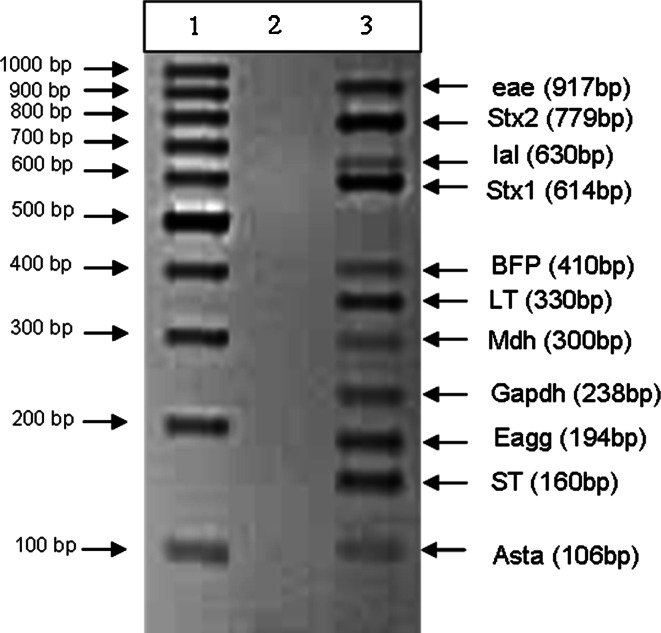
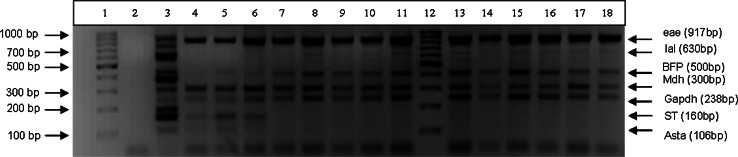
Escherichia coli (E. coli) consists of commensal (ComEC) and diarrhoeagenic (DEC) groups. ComEC are detected using traditional culture methods. Conformational steps are performed after culturing if it is required to test for the presence of DEC, increasing cost and time in obtaining the results. The aim of this study was to develop a single-step multiplex polymerase chain reaction (m-PCR) that can simultaneously amplify genes associated with DEC and ComEC, with the inclusion of controls to monitor inhibition. A total of 701 samples, taken from clinical and environmental water sources in South Africa, were analysed with the optimised m-PCR which targeted the eaeA, stx1, stx2, lt, st, ial, eagg, astA and bfp virulence genes. The mdh and gapdh genes were included as an internal and external control, respectively. The presence of the external control gapdh gene in all samples excluded any possible PCR inhibition. The internal control mdh gene was detected in 100 % of the environmental and 85 % of the clinical isolates, confirming the classification of isolates as E. coli PCR positive samples. All DEC types were detected in varying degrees from the mdh positive environmental and clinical isolates. Important gene code combinations were detected for clinical isolates of 0.4 % lt and eagg. However, 2.3 % of eaeA and ial, and 8.7 % of eaeA and eagg were reported for environmental water samples. The E. coli astA toxin was detected as positive at 35 and 17 % in environmental isolates and clinical isolates, respectively. Interestingly, 25 % of the E. coli astA toxin detected in environmental isolates and 17 % in clinical isolates did not contain any of the other virulence genes tested. In conclusion, the optimised single-step 11-gene m-PCR reactions could be successfully used for the identification of pathogenic and non-pathogenic E. coli types. The m-PCR was also successful in showing monitoring for PCR inhibition to ensure correct reporting of the results.
大肠杆菌(E. coli)分为共生型(ComEC)和致泻型(DEC)两类。共生型大肠杆菌通过传统培养方法检测。若要检测致泻型大肠杆菌的存在,培养后还需进行构象步骤,这增加了获得结果的成本和时间。本研究的目的是开发一种单步多重聚合酶链反应(m-PCR),它能够同时扩增与致泻型大肠杆菌和共生型大肠杆菌相关的基因,并包含用于监测抑制作用的对照。从南非的临床和环境水源采集了总共701份样本,使用优化后的m-PCR进行分析,该m-PCR靶向eaeA、stx1、stx2、lt、st、ial、eagg、astA和bfp毒力基因。mdh和gapdh基因分别作为内部对照和外部对照。所有样本中外部对照gapdh基因的存在排除了任何可能的PCR抑制。在100%的环境分离株和85%的临床分离株中检测到内部对照mdh基因,证实这些分离株被分类为大肠杆菌PCR阳性样本。在mdh阳性的环境和临床分离株中不同程度地检测到了所有致泻型大肠杆菌类型。在0.4%的临床分离株中检测到了重要的基因编码组合lt和eagg。然而,环境水样中报告了2.3%的eaeA和ial,以及8.7%的eaeA和eagg。大肠杆菌astA毒素在环境分离株和临床分离株中的检测阳性率分别为35%和17%。有趣的是,在环境分离株中检测到的25%的大肠杆菌astA毒素和临床分离株中检测到的17%的大肠杆菌astA毒素不包含任何其他检测的毒力基因。总之,优化后的单步11基因m-PCR反应可成功用于鉴定致病性和非致病性大肠杆菌类型。m-PCR在显示监测PCR抑制以确保结果正确报告方面也取得了成功。