Chandler Clare I R, Meta Judith, Ponzo Célia, Nasuwa Fortunata, Kessy John, Mbakilwa Hilda, Haaland Ane, Reyburn Hugh
Department of Global Health and Development, London School of Hygiene & Tropical Medicine, 15-17 Tavistock Place, London WC1H 9SH, UK.
Implement Sci. 2014 Jun 26;9:83. doi: 10.1186/1748-5908-9-83.
Parasitological confirmation is now recommended for all cases of suspected malaria. The roll-out of rapid diagnostic tests (RDTs) is hoped to enable this goal in low resource settings through point of care testing. However, simply making RDTs available has not led to high uptake of the tests or adherence to results by clinicians, with malaria continuing to be overdiagnosed in many settings. We undertook to design an evidence-based intervention package that would be sufficient to support the introduction of RDTs at dispensaries in Tanzania, to be evaluated through the Targeting Artemisinin Combination Therapy (TACT) cluster randomised controlled trial.
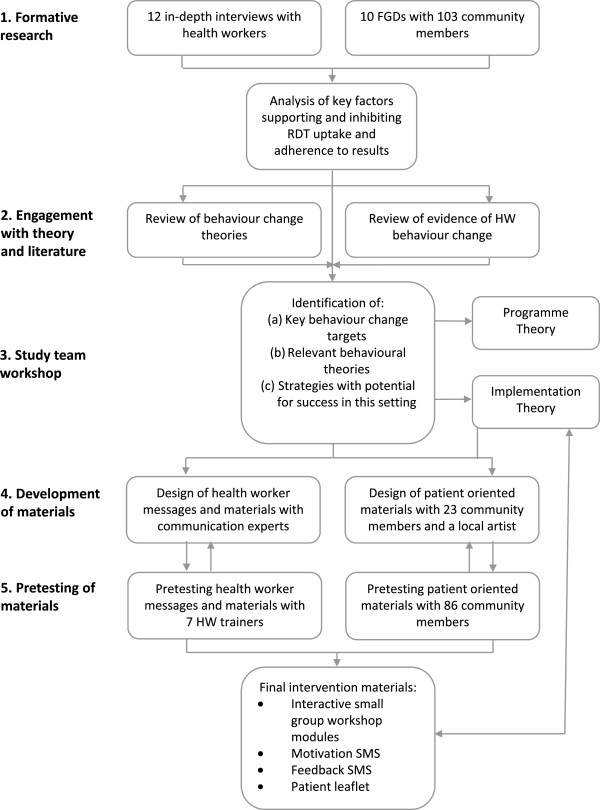
We describe five steps in our intervention design: formative research, review of existing evidence and theory, a workshop to define the intervention approach and content and results of formative research, engagement with behaviour change theory and literature, detailed design of intervention materials and piloting and pretesting of intervention materials. This involved fieldwork with a total of 19 health workers and 212 community members in northeast Tanzania.
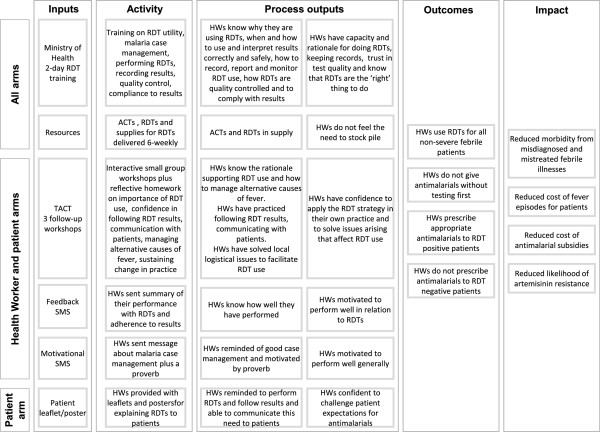
The formative research suggested that RDTs were a potential source of conflict in the health worker-patient interaction, but that health workers used various techniques to resolve this, including provision of antimalarial drugs for RDT-negative patients. Our reviews showed that evidence was mixed regarding the effectiveness of different methods and theories to support change in prescribing practice. Our design process is presented, drawing from this collective evidence. We describe the final TACT intervention package (including interactive small group workshops, feedback text messages, motivational text messages and patient information leaflets and posters) in terms of its programme theory and implementation theory.
Our study suggests that evidence-based design of complex interventions is possible. The use of formative research to understand malaria overdiagnosis in context was central to the design of the intervention as well as empirical research to test materials and methods prior to implementation. The TACT interventions may be appropriate for other settings where clinicians face similar challenges with malaria diagnostics.
NCT01292707.
目前建议对所有疑似疟疾病例进行寄生虫学确诊。快速诊断检测(RDT)的推广有望通过即时检测在资源匮乏地区实现这一目标。然而,仅仅提供RDT并未导致临床医生对检测的高接受度或对检测结果的遵循,在许多地区疟疾仍被过度诊断。我们致力于设计一个基于证据的干预方案,该方案足以支持在坦桑尼亚的诊所引入RDT,并通过靶向青蒿素联合疗法(TACT)整群随机对照试验进行评估。
我们描述了干预设计中的五个步骤:形成性研究、现有证据和理论的回顾、一个确定干预方法和内容以及形成性研究结果的研讨会、与行为改变理论和文献的结合、干预材料的详细设计以及干预材料的试点和预测试。这涉及在坦桑尼亚东北部与总共19名卫生工作者和212名社区成员进行实地调查。
形成性研究表明,RDT在卫生工作者与患者的互动中是冲突的一个潜在来源,但卫生工作者使用各种技巧来解决这一问题,包括为RDT检测结果为阴性的患者提供抗疟药物。我们的回顾表明,关于支持处方实践改变的不同方法和理论的有效性,证据不一。我们根据这些综合证据展示了设计过程。我们从项目理论和实施理论方面描述了最终的TACT干预方案(包括互动式小组研讨会、反馈短信、激励短信以及患者信息传单和海报)。
我们的研究表明,复杂干预的基于证据的设计是可行的。利用形成性研究来了解实际情况下的疟疾过度诊断对于干预设计以及在实施前对材料和方法进行实证研究以测试它们至关重要。TACT干预可能适用于临床医生在疟疾诊断上面临类似挑战的其他地区。
NCT01292707。