Perreault Leigh, Temprosa Marinella, Mather Kieren J, Horton Ed, Kitabchi Abbas, Larkin Mary, Montez Maria G, Thayer Debra, Orchard Trevor J, Hamman Richard F, Goldberg Ronald B
Anschutz Medical Campus, University of Colorado, Aurora, CO
The Biostatistics Center, George Washington University, Rockville, MD.
Diabetes Care. 2014 Sep;37(9):2622-31. doi: 10.2337/dc14-0656. Epub 2014 Jun 26.
Restoration of normal glucose regulation (NGR) in people with prediabetes significantly decreases the risk of future diabetes. We sought to examine whether regression to NGR is also associated with a long-term decrease in cardiovascular disease (CVD) risk.
The Framingham (2008) score (as an estimate of the global 10-year CVD risk) and individual CVD risk factors were calculated annually for the Diabetes Prevention Program Outcomes Study years 1-10 among those patients who returned to NGR at least once during the Diabetes Prevention Program (DPP) compared with those who remained with prediabetes or those in whom diabetes developed during DPP (N = 2,775).
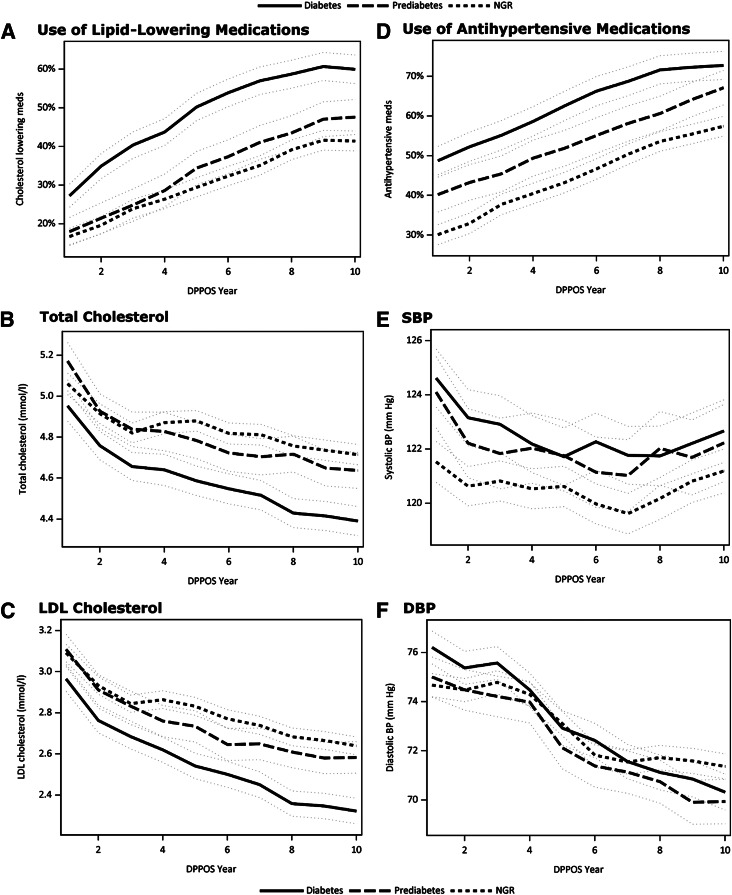
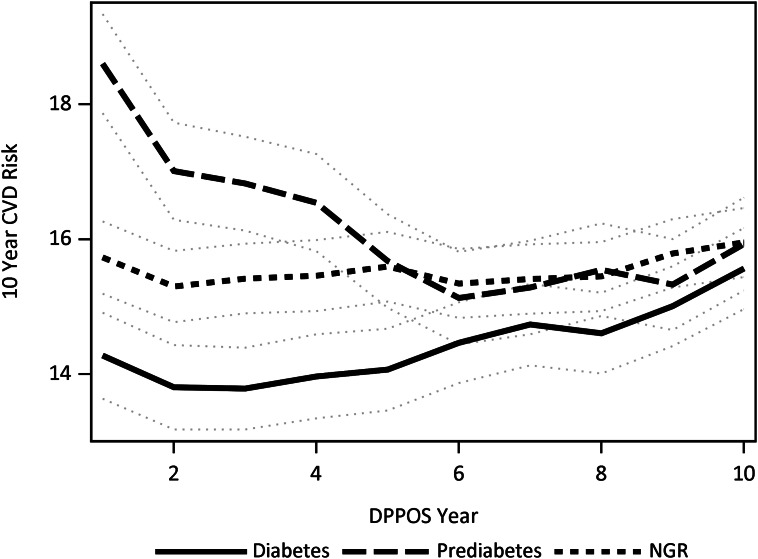
The Framingham scores by glycemic exposure did not differ among the treatment groups; therefore, pooled estimates were stratified by glycemic status and were adjusted for differences in risk factors at DPP baseline and in the treatment arm. During 10 years of follow-up, the mean Framingham 10-year CVD risk scores were highest in the prediabetes group (16.2%), intermediate in the NGR group (15.5%), and 14.4% in people with diabetes (all pairwise comparisons P < 0.05), but scores decreased over time for those people with prediabetes (18.6% in year 1 vs. 15.9% in year 10, P < 0.01). The lower score in the diabetes group versus other groups, a declining score in the prediabetes group, and favorable changes in each individual risk factor in all groups were explained, in part, by higher or increasing medication use for lipids and blood pressure.
Prediabetes represents a high-risk state for CVD. Restoration of NGR and/or medical treatment of CVD risk factors can significantly reduce the estimated CVD risk in people with prediabetes.
恢复糖尿病前期患者的正常血糖调节(NGR)可显著降低未来患糖尿病的风险。我们试图研究回归NGR是否也与心血管疾病(CVD)风险的长期降低有关。
在糖尿病预防计划结果研究的第1 - 10年,每年计算弗雷明汉(2008)评分(作为全球10年CVD风险的估计值)以及个体CVD风险因素,将那些在糖尿病预防计划(DPP)期间至少有一次恢复到NGR的患者与那些仍处于糖尿病前期或在DPP期间发展为糖尿病的患者进行比较(N = 2775)。
各治疗组中按血糖暴露情况得出的弗雷明汉评分无差异;因此,合并估计值按血糖状态分层,并针对DPP基线时的风险因素差异以及治疗组进行了调整。在10年的随访期间,糖尿病前期组的平均弗雷明汉10年CVD风险评分最高(16.2%),NGR组居中(15.5%),糖尿病患者为14.4%(所有两两比较P < 0.05),但糖尿病前期患者的评分随时间下降(第1年为18.6%,第10年为15.9%,P < 0.01)。糖尿病组与其他组相比评分较低、糖尿病前期组评分下降以及所有组中各个体风险因素的有利变化,部分原因是脂质和血压用药增加或用药量增加。
糖尿病前期是CVD的高危状态。恢复NGR和/或对CVD风险因素进行药物治疗可显著降低糖尿病前期患者的估计CVD风险。