Bastolla Ugo
Centro de Biologia Molecular Severo Ochoa, CSIC-UAM, Madrid E-28049, Spain.
Biomolecules. 2014 Mar 7;4(1):291-314. doi: 10.3390/biom4010291.
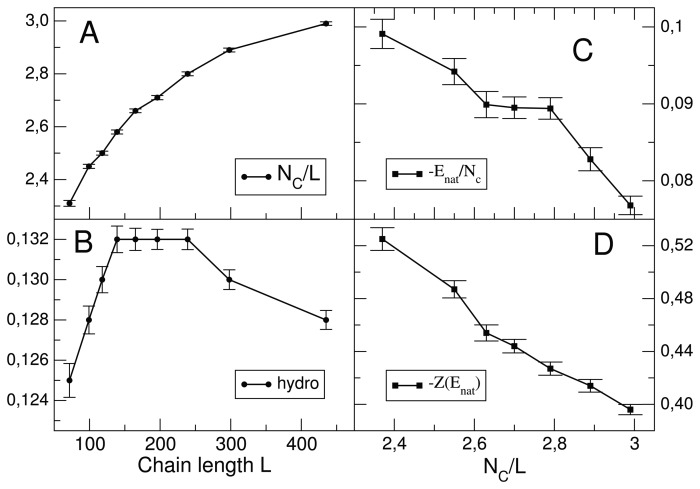
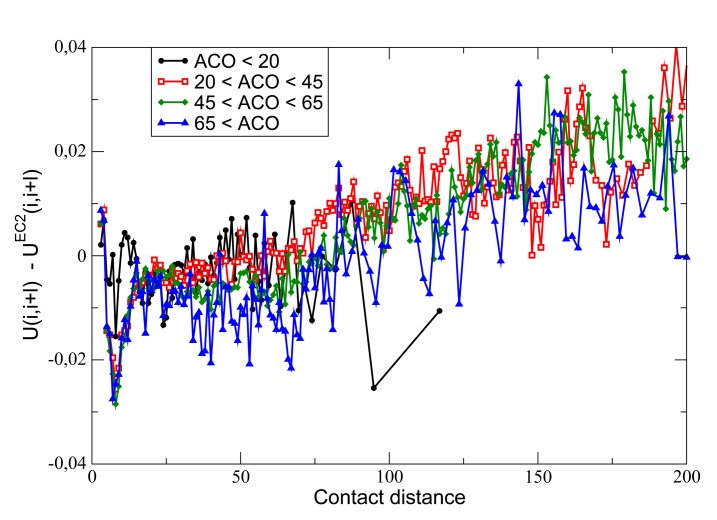
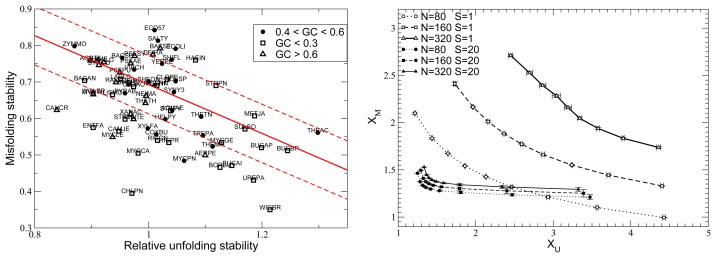
The properties of biomolecules depend both on physics and on the evolutionary process that formed them. These two points of view produce a powerful synergism. Physics sets the stage and the constraints that molecular evolution has to obey, and evolutionary theory helps in rationalizing the physical properties of biomolecules, including protein folding thermodynamics. To complete the parallelism, protein thermodynamics is founded on the statistical mechanics in the space of protein structures, and molecular evolution can be viewed as statistical mechanics in the space of protein sequences. In this review, we will integrate both points of view, applying them to detecting selection on the stability of the folded state of proteins. We will start discussing positive design, which strengthens the stability of the folded against the unfolded state of proteins. Positive design justifies why statistical potentials for protein folding can be obtained from the frequencies of structural motifs. Stability against unfolding is easier to achieve for longer proteins. On the contrary, negative design, which consists in destabilizing frequently formed misfolded conformations, is more difficult to achieve for longer proteins. The folding rate can be enhanced by strengthening short-range native interactions, but this requirement contrasts with negative design, and evolution has to trade-off between them. Finally, selection can accelerate functional movements by favoring low frequency normal modes of the dynamics of the native state that strongly correlate with the functional conformation change.
生物分子的特性既取决于物理学,也取决于形成它们的进化过程。这两种观点产生了强大的协同作用。物理学设定了分子进化必须遵循的舞台和限制条件,而进化理论有助于解释生物分子的物理特性,包括蛋白质折叠热力学。为了完善这种平行关系,蛋白质热力学建立在蛋白质结构空间中的统计力学基础上,而分子进化可以看作是蛋白质序列空间中的统计力学。在这篇综述中,我们将整合这两种观点,将它们应用于检测对蛋白质折叠状态稳定性的选择。我们将首先讨论正向设计,它增强了蛋白质折叠态相对于未折叠态的稳定性。正向设计解释了为什么蛋白质折叠的统计势可以从结构基序的频率中获得。对于较长的蛋白质,防止展开的稳定性更容易实现。相反,负向设计在于破坏频繁形成的错误折叠构象的稳定性,对于较长的蛋白质来说更难实现。通过加强短程天然相互作用可以提高折叠速率,但这一要求与负向设计相矛盾,进化必须在它们之间进行权衡。最后,选择可以通过支持与功能构象变化高度相关的天然态动力学的低频正常模式来加速功能运动。