Ueno Takayoshi, Endo Kazuhira, Hori Kiyomi, Ozaki Noriyuki, Tsuji Akira, Kondo Satoru, Wakisaka Naohiro, Murono Shigeyuki, Kataoka Kazunori, Kato Yasuki, Yoshizaki Tomokazu
Division of Otolaryngology-Head and Neck Surgery, Graduate School of Medical Science, Kanazawa University, Kanazawa, Japan.
Department of Functional Anatomy, Graduate School of Medical Science, Kanazawa University, Kanazawa, Japan.
Int J Nanomedicine. 2014 Jun 19;9:3005-12. doi: 10.2147/IJN.S60564. eCollection 2014.
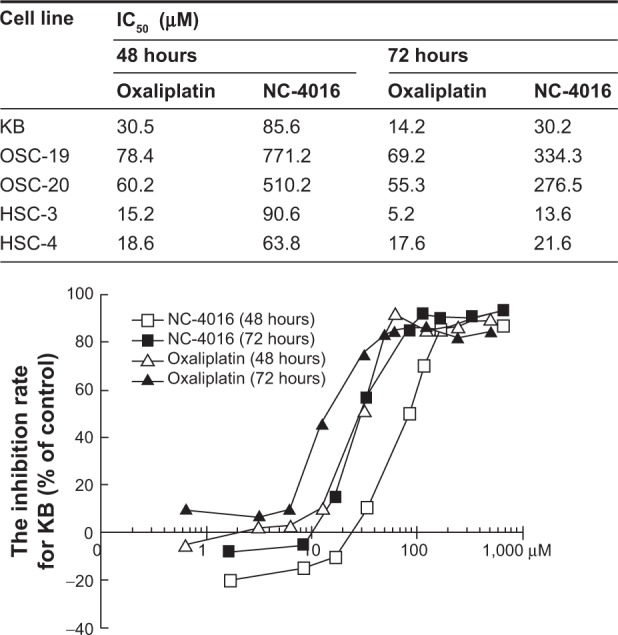
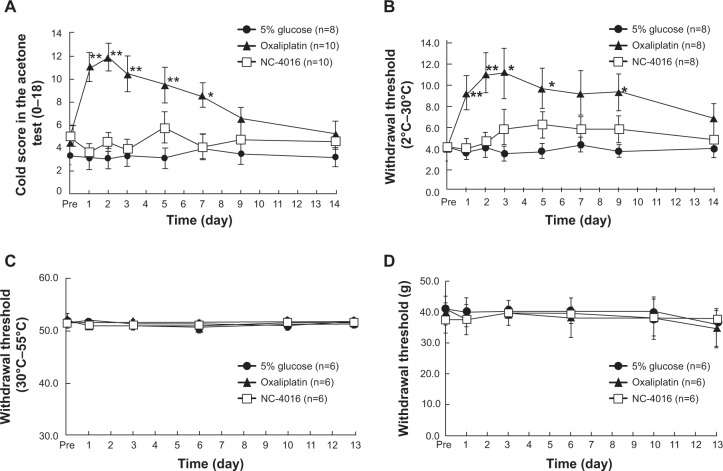
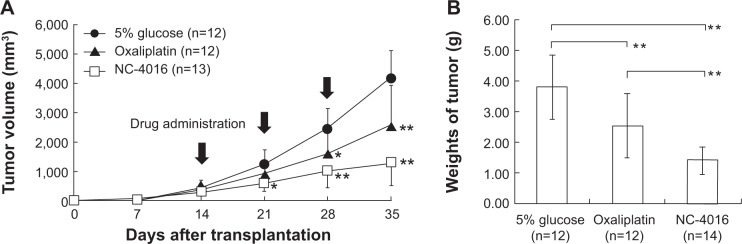
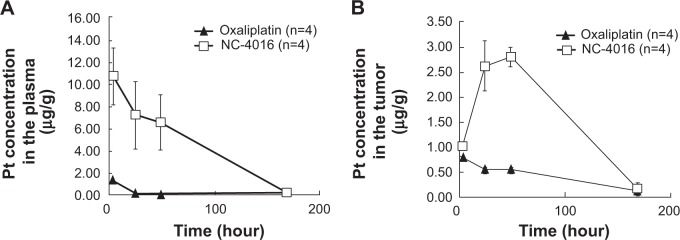
Oxaliplatin, a third-generation platinum compound incorporating oxalate and 1,2-diaminocyclohexane platinum, has been widely used in chemotherapy regimens for the treatment of metastatic colorectal cancer. Because of its wide spectrum of antitumor activity, oxaliplatin has been applied for the treatment of other carcinomas. However, the antitumor activity of single-agent oxaliplatin is insufficient. To increase its antitumor effects, polymeric micellar nanoparticles incorporating 1,2-diaminocyclohexane platinum (NC-4016) have been developed. The present study was designed to evaluate the efficacy of NC-4016 and its association with peripheral neuropathy, which is a primary dose-limiting factor in oxaliplatin therapy. The in vitro antitumor activity of NC-4016 was investigated using human carcinoma cell lines. To investigate the antitumor effects of NC-4016 in vivo, nude mice bearing the human carcinoma cell line KB were administered NC-4016 or oxaliplatin. The in vitro growth-inhibiting effect of NC-4016 was significantly weaker than that of oxaliplatin. However, the antitumor efficacy of NC-4016 was superior to that of oxaliplatin in vivo. Moreover, we compared the severity of peripheral neuropathy induced by oxaliplatin and NC-4016 in a rat model. Oxaliplatin, NC-4016, or 5% glucose (control) were administered by a single tail vein injection. In the oxaliplatin-treated rats, neither mechanical nor heat allodynia was observed during the experimental period, whereas cold hyperalgesia/allodynia was observed from day 1 to 7. Conversely, cold hyperalgesia/allodynia was not observed in the NC-4016-treated rats. The present study demonstrated that the antitumor efficacy of NC-4016 was superior to that of oxaliplatin in a mouse model of human carcinoma cell line KB. In addition, NC-4016-treated rats did not develop acute cold hypersensitivity, which is frequently experienced by patients after oxaliplatin administration.
奥沙利铂是一种第三代铂化合物,包含草酸酯和1,2 - 二氨基环己烷铂,已广泛用于转移性结直肠癌的化疗方案。由于其广泛的抗肿瘤活性,奥沙利铂已被应用于其他癌症的治疗。然而,单药奥沙利铂的抗肿瘤活性不足。为了增强其抗肿瘤效果,已开发出包含1,2 - 二氨基环己烷铂的聚合物胶束纳米颗粒(NC - 4016)。本研究旨在评估NC - 4016的疗效及其与周围神经病变的关联,周围神经病变是奥沙利铂治疗的主要剂量限制因素。使用人癌细胞系研究了NC - 4016的体外抗肿瘤活性。为了研究NC - 4016在体内的抗肿瘤作用,给携带人癌细胞系KB的裸鼠施用NC - 4016或奥沙利铂。NC - 4016的体外生长抑制作用明显弱于奥沙利铂。然而,NC - 4016在体内的抗肿瘤疗效优于奥沙利铂。此外,我们在大鼠模型中比较了奥沙利铂和NC - 4016诱导的周围神经病变的严重程度。通过单次尾静脉注射给予奥沙利铂、NC - 4016或5%葡萄糖(对照)。在奥沙利铂治疗的大鼠中,实验期间未观察到机械性或热性痛觉过敏,而从第1天到第7天观察到冷超敏反应/痛觉过敏。相反,在NC - 4016治疗的大鼠中未观察到冷超敏反应/痛觉过敏。本研究表明,在人癌细胞系KB的小鼠模型中,NC - 4016的抗肿瘤疗效优于奥沙利铂。此外,接受NC - 4016治疗的大鼠未出现急性冷超敏反应,而奥沙利铂给药后的患者经常会出现这种反应。