Nisar Yasir Bin, Dibley Michael J
Sydney School of Public Health, The University of Sydney, Room 128C, Edward Ford Building, Sydney NSW 2006, Australia.
BMC Public Health. 2014 Jun 28;14:663. doi: 10.1186/1471-2458-14-663.
Globally 7.6 million children died in 2010 before reaching their fifth birthday and 40% of these deaths occur in the neonatal period. Pakistan has the third highest rate of neonatal mortality globally. To implement evidence-based interventions for the reduction of neonatal mortality, it is important to investigate factors associated with neonatal mortality. The aim of the current study was to identify determinants of neonatal mortality in Pakistan.
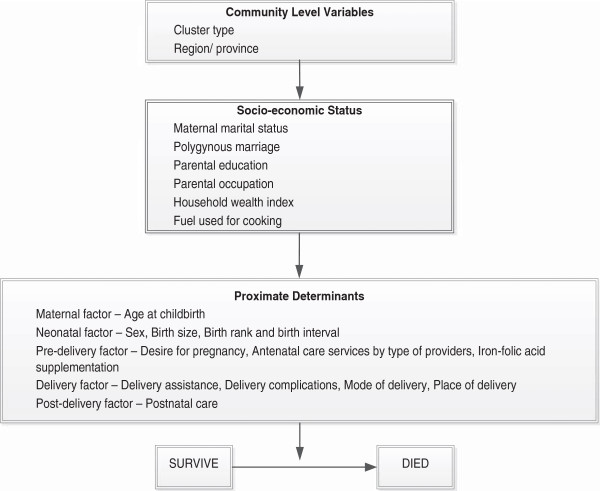
Data was derived from the Pakistan Demographic and Health Survey 2006-07. All singleton live births between 2002 and 2006 were selected for the current analyses. Data was analysed by using STATA 13 and adjusted for the cluster sampling design. Multivariate Cox proportional hazard models were performed using step-wise backward elimination procedures to identify the determinants of neonatal mortality.
A total of 5,702 singleton live births in the last five years preceding the survey were selected. Multivariate analyses showed that living in Punjab province (Adj HR = 2.10, p = 0.015), belonging to the poorest household wealth index quintile (Adj HR = 1.95, p = 0.035), male infants (Adj HR = 1.57, p = 0.014), first rank baby (Adj HR = 1.59, p = 0.049), smaller than average birth size (Adj HR = 1.61, p = 0.023) and mothers with delivery complications (Adj HR = 1.93, p = 0.001) had significantly higher hazards of neonatal death in Pakistan.
To reduce neonatal mortality, there is a need to implement interventions focusing on antenatal care, effective referral system and retraining of healthcare providers to manage delivery complications and smaller than average birth size babies in resource poor communities of Pakistan.
2010年全球有760万儿童在五岁前死亡,其中40%的死亡发生在新生儿期。巴基斯坦的新生儿死亡率在全球排名第三。为实施基于证据的干预措施以降低新生儿死亡率,调查与新生儿死亡率相关的因素很重要。本研究的目的是确定巴基斯坦新生儿死亡率的决定因素。
数据来自2006 - 2007年巴基斯坦人口与健康调查。本次分析选取了2002年至2006年间所有单胎活产儿。使用STATA 13进行数据分析,并针对整群抽样设计进行了调整。采用逐步向后排除程序进行多变量Cox比例风险模型分析,以确定新生儿死亡率的决定因素。
在调查前的过去五年中,共选取了5702名单胎活产儿。多变量分析显示,居住在旁遮普省(调整后风险比=2.10,p = 0.015)、属于最贫困家庭财富指数五分位数(调整后风险比=1.95,p = 0.035)、男婴(调整后风险比=1.57,p = 0.014)、头胎婴儿(调整后风险比=1.59,p = 0.049)、出生体重小于平均水平(调整后风险比=1.61,p = 0.023)以及有分娩并发症的母亲(调整后风险比=1.93,p = 0.001)在巴基斯坦的新生儿死亡风险显著更高。
为降低新生儿死亡率,有必要在巴基斯坦资源匮乏的社区实施重点关注产前护理、有效转诊系统以及对医护人员进行再培训以处理分娩并发症和出生体重小于平均水平婴儿的干预措施。