Waelchli R, Aylett S E, Robinson K, Chong W K, Martinez A E, Kinsler V A
Department of Paediatric Dermatology, Great Ormond Street Hospital for Children, London, WC1N 3JH, U.K.
Br J Dermatol. 2014 Oct;171(4):861-7. doi: 10.1111/bjd.13203. Epub 2014 Oct 1.
Facial port-wine stains (PWSs) are usually isolated findings; however, when associated with cerebral and ocular vascular malformations they form part of the classical triad of Sturge-Weber syndrome (SWS).
To evaluate the associations between the phenotype of facial PWS and the diagnosis of SWS in a cohort with a high rate of SWS.
Records were reviewed of all 192 children with a facial PWS seen in 2011-13. Adverse outcome measures were clinical (seizures, abnormal neurodevelopment, glaucoma) and radiological [abnormal magnetic resonance imaging (MRI)], modelled by multivariate logistic regression.
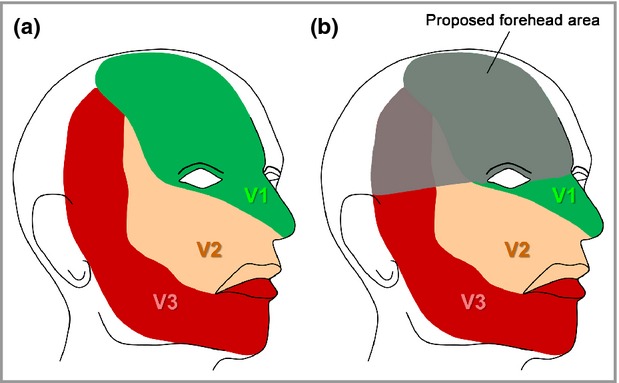
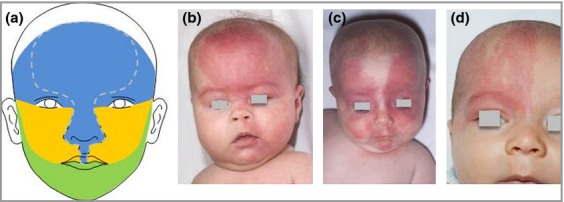
The best predictor of adverse outcomes was a PWS involving any part of the forehead, delineated at its inferior border by a line joining the outer canthus of the eye to the top of the ear, and including the upper eyelid. This involves all three divisions of the trigeminal nerve, but corresponds well to the embryonic vascular development of the face. Bilateral distribution was not an independently significant phenotypic feature. Abnormal MRI was a better predictor of all clinical adverse outcome measures than PWS distribution; however, for practical reasons guidelines based on clinical phenotype are proposed.
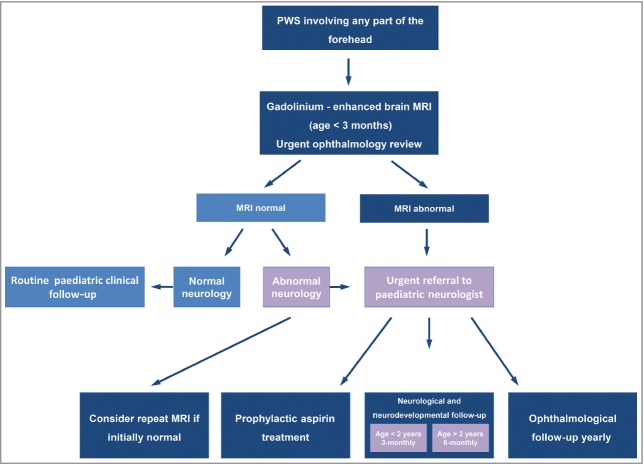
Facial PWS distribution appears to follow the embryonic vasculature of the face, rather than the trigeminal nerve. We propose that children with a PWS on any part of the 'forehead' should have an urgent ophthalmology review and a brain MRI. A prospective study has been established to test the validity of these guidelines.
面部葡萄酒色斑(PWS)通常为孤立性表现;然而,当与脑和眼部血管畸形相关时,它们构成了斯特奇-韦伯综合征(SWS)经典三联征的一部分。
在一个SWS发病率较高的队列中,评估面部PWS的表型与SWS诊断之间的关联。
回顾了2011年至2013年期间就诊的所有192例面部PWS患儿的记录。不良结局指标包括临床指标(癫痫、神经发育异常、青光眼)和放射学指标[磁共振成像(MRI)异常],通过多变量逻辑回归进行建模。
不良结局的最佳预测指标是累及前额任何部位的PWS,其下缘由一条连接眼外眦与耳尖的线划定,并包括上眼睑。这涉及三叉神经的所有三个分支,但与面部的胚胎血管发育情况非常吻合。双侧分布并非独立的显著表型特征。MRI异常比PWS分布更能预测所有临床不良结局指标;然而,出于实际原因,提出了基于临床表型的指导原则。
面部PWS的分布似乎遵循面部的胚胎血管系统,而非三叉神经。我们建议,“前额”任何部位有PWS的儿童应接受紧急眼科检查和脑部MRI检查。已开展一项前瞻性研究以检验这些指导原则的有效性。