Health Services and Outcomes Research, National Healthcare Group, Singapore ; Joint first authors.
Global eHealth Unit, Department of Primary Care and Public Health, School of Public Health, Imperial College London, London, UK ; Joint first authors.
J Glob Health. 2014 Jun;4(1):010406. doi: 10.7189/jogh.04.010406.
Health systems worldwide are facing shortages in health professional workforce. Several studies have demonstrated the direct correlation between the availability of health workers, coverage of health services, and population health outcomes. To address this shortage, online eLearning is increasingly being adopted in health professionals' education. To inform policy-making, in online eLearning, we need to determine its effectiveness.
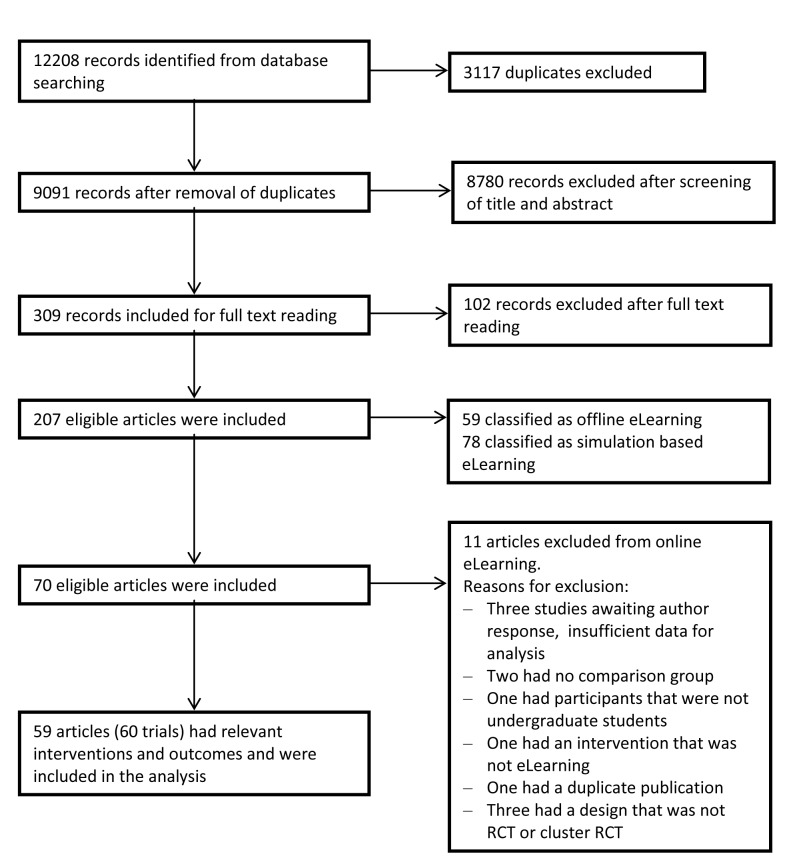
We performed a systematic review of the effectiveness of online eLearning through a comprehensive search of the major databases for randomised controlled trials that compared online eLearning to traditional learning or alternative learning methods. The search period was from January 2000 to August 2013. We included articles which primarily focused on students' knowledge, skills, satisfaction and attitudes toward eLearning and cost-effectiveness and adverse effects as secondary outcomes. Two reviewers independently extracted data from the included studies. Due to significant heterogeneity among the included studies, we presented our results as a narrative synthesis.
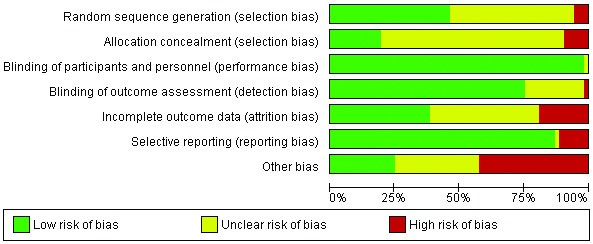
Fifty-nine studies, including 6750 students enrolled in medicine, dentistry, nursing, physical therapy and pharmacy studies, met the inclusion criteria. Twelve of the 50 studies testing knowledge gains found significantly higher gains in the online eLearning intervention groups compared to traditional learning, whereas 27 did not detect significant differences or found mixed results. Eleven studies did not test for differences. Six studies detected significantly higher skill gains in the online eLearning intervention groups, whilst 3 other studies testing skill gains did not detect differences between groups and 1 study showed mixed results. Twelve studies tested students' attitudes, of which 8 studies showed no differences in attitudes or preferences for online eLearning. Students' satisfaction was measured in 29 studies, 4 studies showed higher satisfaction for online eLearning and 20 studies showed no difference in satisfaction between online eLearning and traditional learning. Risk of bias was high for several of the included studies.
The current evidence base suggests that online eLearning is equivalent, possibly superior to traditional learning. These findings present a potential incentive for policy makers to cautiously encourage its adoption, while respecting the heterogeneity among the studies.
全球卫生系统面临卫生专业人员短缺的问题。多项研究表明,卫生工作者的可获得性、卫生服务的覆盖范围与人群健康结果之间存在直接关联。为了应对这一短缺,在线电子学习在卫生专业人员教育中得到了越来越多的应用。为了为决策提供信息,在在线电子学习中,我们需要确定其效果。
我们通过对主要数据库进行全面搜索,以确定随机对照试验的效果,这些试验将在线电子学习与传统学习或替代学习方法进行了比较。搜索期为 2000 年 1 月至 2013 年 8 月。我们纳入的文章主要关注学生对电子学习的知识、技能、满意度和态度以及成本效益和不良影响作为次要结果。两位评审员独立从纳入的研究中提取数据。由于纳入的研究之间存在显著的异质性,我们以叙述性综合的形式呈现了我们的结果。
共有 59 项研究,包括 6750 名医学生、牙科学学生、护理学生、理疗学生和药学学生符合纳入标准。在 12 项测试知识增益的研究中,在线电子学习干预组的知识增益显著高于传统学习组,而 27 项研究未发现显著差异或结果混杂。11 项研究未测试差异。6 项研究检测到在线电子学习干预组的技能增益显著提高,而另外 3 项研究检测技能增益未发现组间差异,1 项研究结果混杂。12 项研究测试了学生的态度,其中 8 项研究表明对在线电子学习的态度或偏好没有差异。在 29 项研究中测量了学生的满意度,4 项研究表明对在线电子学习的满意度更高,而 20 项研究表明在线电子学习与传统学习之间的满意度没有差异。纳入的多项研究存在较高的偏倚风险。
目前的证据基础表明,在线电子学习与传统学习相当,可能更优。这些发现为决策者谨慎鼓励其采用提供了一个潜在的激励,同时尊重研究之间的异质性。