Naing Cho, Whittaker Maxine A, Aung Htar Htar, Chellappan Dinesh Kumar, Riegelman Amy
Division of Tropical Health and Medicine James Cook University Townsville Australia.
Department of Human Biology, School of Medicine International Medical University Kuala Lumpur Malaysia.
Campbell Syst Rev. 2023 Jul 7;19(3):e1339. doi: 10.1002/cl2.1339. eCollection 2023 Sep.
The 'flipped classroom' approach is an innovative approach in educational delivery systems. In a typical flipped class model, work that is typically done as homework in the didactic model is interactively undertaken in the class with the guidance of the teacher, whereas listening to a lecture or watching course-related videos is undertaken at home. The essence of a flipped classroom is that the activities carried out during traditional class time and self-study time are reversed or 'flipped'.
The primary objectives of this review were to assess the effectiveness of the flipped classroom intervention for undergraduate health professional students on their academic performance, and their course satisfaction.
We identified relevant studies by searching MEDLINE (Ovid), APA PsycINFO, Education Resources Information Center (ERIC) as well as several more electronic databases, registries, search engines, websites, and online directories. The last search update was performed in April 2022.
Included studies had to meet the following criteria: : Undergraduate health professional students, regardless of the type of healthcare streams (e.g., medicine, pharmacy), duration of the learning activity, or the country of study. : We included any educational intervention that included the flipped classroom as a teaching and learning tool in undergraduate programs, regardless of the type of healthcare streams (e.g., medicine, pharmacy). We also included studies that aimed to improve student learning and/or student satisfaction if they included the flipped classroom for undergraduate students. We excluded studies on standard lectures and subsequent tutorial formats. We also excluded studies on flipped classroom methods, which did not belong to the health professional education(HPE) sector (e.g., engineering, economics). : The included studies used primary outcomes such as academic performance as judged by final examination grades/scores or other formal assessment methods at the immediate post-test, as well as student satisfaction with the method of learning. : We included randomised controlled trials (RCTs), quasi-experimental studies (QES), and two-group comparison designs. Although we had planned to include cluster-level RCTs, natural experiments, and regression discontinuity designs, these were not available. We did not include qualitative research.
Two members of the review team independently screened the search results to assess articles for their eligibility for inclusion. The screening involved an initial screening of the title and abstracts, and subsequently, the full text of selected articles. Discrepancies between the two investigators were settled through discussion or consultation with a third author. Two members of the review team then extracted the descriptions and data from the included studies.
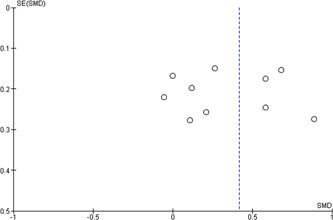
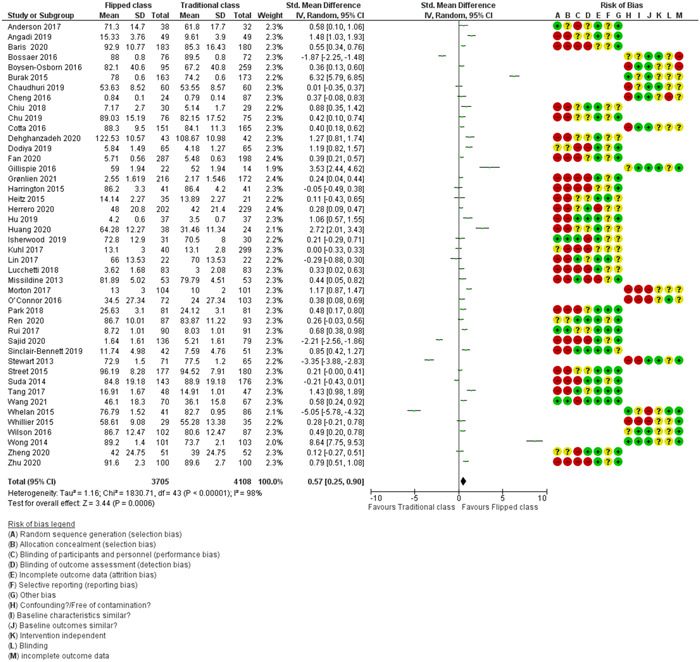
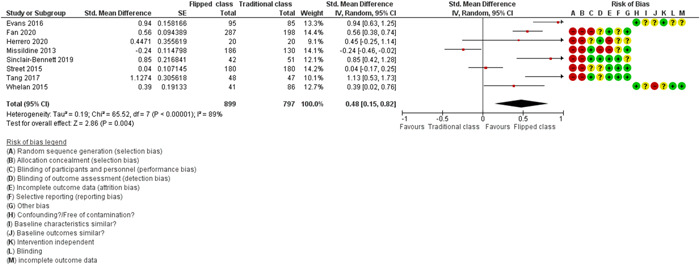
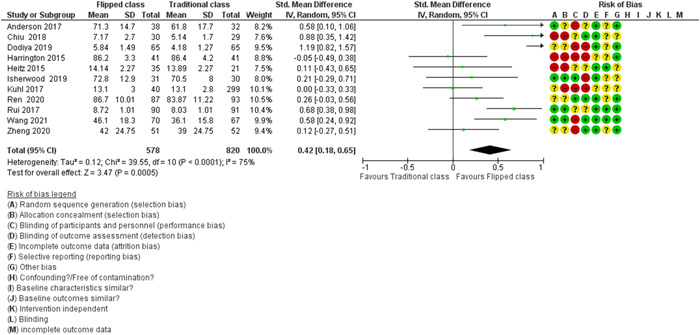
We found 5873 potentially relevant records, of which we screened 118 of them in full text, and included 45 studies (11 RCTs, 19 QES, and 15 two-group observational studies) that met the inclusion criteria. Some studies assessed more than one outcome. We included 44 studies on academic performance and eight studies on students' satisfaction outcomes in the meta-analysis. The main reasons for excluding studies were that they had not implemented a flipped class approach or the participants were not undergraduate students in health professional education. A total of 8426 undergraduate students were included in 45 studies that were identified for this analysis. The majority of the studies were conducted by students from medical schools (53.3%, 24/45), nursing schools (17.8%, 8/45), pharmacy schools (15.6%, 7/45). medical, nursing, and dentistry schools (2.2%, 1/45), and other health professional education programs (11.1%, 5/45). Among these 45 studies identified, 16 (35.6%) were conducted in the United States, six studies in China, four studies in Taiwan, three in India, two studies each in Australia and Canada, followed by nine single studies from Brazil, German, Iran, Norway, South Korea, Spain, the United Kingdom, Saudi Arabia, and Turkey. Based on overall average effect sizes, there was better academic performance in the flipped class method of learning compared to traditional class learning (standardised mean difference [SMD] = 0.57, 95% confidence interval [CI] = 0.25 to 0.90, : 1.16; : 98%; < 0.00001, 44 studies, = 7813). In a sensitivity analysis that excluded eleven studies with imputed data from the original analysis of 44 studies, academic performance in the flipped class method of learning was better than traditional class learning (SMD = 0.54, 95% CI = 0.24 to 0.85, : 0.76; : 97%; < 0.00001, 33 studies, = 5924); all being low certainty of evidence. Overall, student satisfaction with flipped class learning was positive compared to traditional class learning (SMD = 0.48, 95% CI = 0.15 to 0.82, : 0.19, :89%, < 0.00001, 8 studies = 1696); all being low certainty of evidence.
AUTHORS' CONCLUSIONS: In this review, we aimed to find evidence of the flipped classroom intervention's effectiveness for undergraduate health professional students. We found only a few RCTs, and the risk of bias in the included non-randomised studies was high. Overall, implementing flipped classes may improve academic performance, and may support student satisfaction in undergraduate health professional programs. However, the certainty of evidence was low for both academic performance and students' satisfaction with the flipped method of learning compared to the traditional class learning. Future well-designed sufficiently powered RCTs with low risk of bias that report according to the CONSORT guidelines are needed.
“翻转课堂”教学法是教育传递系统中的一种创新方法。在典型的翻转课堂模式中,传统讲授模式下通常作为家庭作业完成的任务在课堂上由教师引导进行互动,而听课或观看课程相关视频则在家中完成。翻转课堂的本质是传统课堂时间和自学时间所开展的活动被颠倒或“翻转”。
本综述的主要目的是评估翻转课堂教学法对本科健康专业学生学业成绩和课程满意度的效果。
我们通过检索MEDLINE(Ovid)、美国心理学会心理学文摘数据库、教育资源信息中心(ERIC)以及其他几个电子数据库、注册库、搜索引擎、网站和在线目录来确定相关研究。最后一次检索更新于2022年4月进行。
纳入的研究必须符合以下标准:本科健康专业学生,无论医疗保健专业方向类型(如医学、药学)、学习活动时长或学习所在国家/地区。我们纳入任何将翻转课堂作为本科课程教学工具的教育干预措施,无论医疗保健专业方向类型(如医学、药学)。我们还纳入了旨在提高学生学习效果和/或学生满意度的研究,如果这些研究将翻转课堂应用于本科生。我们排除了关于标准讲座及后续辅导形式的研究。我们还排除了不属于健康专业教育(HPE)领域(如工程、经济学)的翻转课堂方法的研究。纳入的研究使用主要结局指标,如在即时后测时通过期末考试成绩/分数或其他正式评估方法判断的学业成绩,以及学生对学习方法的满意度。我们纳入随机对照试验(RCT)、准实验研究(QES)和两组比较设计。尽管我们原计划纳入整群水平的RCT、自然实验和回归间断设计,但未找到此类研究。我们未纳入定性研究。
综述团队的两名成员独立筛选检索结果,以评估文章是否符合纳入资格。筛选包括对标题和摘要进行初步筛选,随后对选定文章的全文进行筛选。两位研究者之间的差异通过讨论或与第三位作者协商解决。然后,综述团队的两名成员从纳入的研究中提取描述和数据。
我们找到5873条潜在相关记录,其中对118条进行了全文筛选,纳入了45项符合纳入标准的研究(11项RCT、19项QES和15项两组观察性研究)。一些研究评估了多个结局。我们在荟萃分析中纳入了44项关于学业成绩的研究和8项关于学生满意度结局的研究。排除研究的主要原因是它们未实施翻转课堂教学法或参与者不是健康专业教育的本科生。共有8426名本科生被纳入本次分析确定的45项研究中。大多数研究由医学院学生(53.3%,24/45)、护理学院学生(17.8%,8/45)、药学院学生(15.6%,7/45)、医学、护理和牙科学院学生(2.2%,1/45)以及其他健康专业教育项目学生(11.1%,5/45)开展。在确定的这45项研究中,16项(35.6%)在美国进行,6项在中国进行,4项在台湾进行,3项在印度进行,2项在澳大利亚和加拿大各进行1项,其余9项分别来自巴西、德国、伊朗、挪威、韩国、西班牙、英国、沙特阿拉伯和土耳其。基于总体平均效应量,与传统课堂学习相比,翻转课堂学习方法的学业成绩更好(标准化均数差[SMD]=0.57,95%置信区间[CI]=0.25至0.90,I²=1.16;P=98%;P<0.00001,44项研究,n=7813)。在一项敏感性分析中,从最初44项研究的分析中排除11项有估算数据的研究后,翻转课堂学习方法的学业成绩仍优于传统课堂学习(SMD=0.54,95%CI=0.24至0.85,I²=0.76;P=97%;P<0.00001,33项研究,n=5924);所有证据确定性均为低。总体而言,与传统课堂学习相比,学生对翻转课堂学习的满意度为正向(SMD=0.48,95%CI=0.15至0.82,I²=0.19,P=89%,P<0.00001,8项研究,n=1696);所有证据确定性均为低。
在本综述中,我们旨在寻找翻转课堂教学法对本科健康专业学生有效性的证据。我们仅找到少数RCT,且纳入的非随机研究存在高偏倚风险。总体而言,实施翻转课堂可能提高学业成绩,并可能提升本科健康专业项目中学生的满意度。然而,与传统课堂学习相比,翻转学习方法在学业成绩和学生满意度方面的证据确定性均为低。未来需要设计良好、样本量充足、偏倚风险低且按照CONSORT指南报告结果的RCT。