Lee Sang Kun
Department of Neurology, Seoul National University College of Medicine, Seoul, Korea.
J Epilepsy Res. 2014 Jun 30;4(1):1-6. doi: 10.14581/jer.14001. eCollection 2014 Jun.
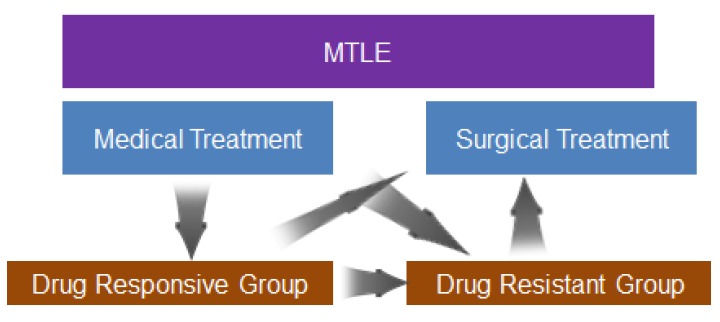
Despite many epilepsy patients respond to antiepileptic drugs (AED) successfully, more than 30% of patients continue to have seizures on multiple AEDs. The refractory epilepsy increases the risk of cognitive deterioration, psychosocial dysfunction, and sudden unexpected death of epilepsy patients (SUDEP). It is important to identify refractory epilepsy early and make the goal of epilepsy treatment as the prevention of decline in social, vocational, and cognitive performances and minimizing the risk of accident or SUDEP. The syndrome of medial temporal lobe epilepsy with hippocampal sclerosis (MTLE with HS) is often resistant to AEDs, and surgically remediable. Initially well-controlled seizures often become intractable to AEDs. There are progressive behavioral changes including increasing memory deficit. Surgical outcome is also worse with longer duration of epilepsy or increasing age at surgery, which suggests that MTLE is a progressive disorder. Some emphasized the ultimate intractability of MTLE in which intractability of MTLE could be evident only after some years following initial diagnosis. However, when patients considered to have intractable epilepsy were followed up for a long period of time, many of them experienced seizure-free state. Some studies clearly demonstrated the wax and wane courses of treatment response in epilepsy. Late remission could be achieved up to in a half of patients. Thus intractable state is not a static condition but a fluctuating one and initial refractoriness does not necessarily mean the final intractability. Even though the chance of seizure remission with AEDs is not high for MTLE, some of them do well respond to drugs. It is even possible to withdraw AEDs for a few patients. Though epilepsy surgery is very effective method to treat MTLE, considering the fluctuation courses of intractability and the possibility of delayed remission, at least two adequate AEDs could be applied to the patients before surgery. However, medical intractability becomes evident by definition, it is not reasonable to delay epilepsy surgery.
尽管许多癫痫患者对抗癫痫药物(AED)反应良好,但仍有超过30%的患者在使用多种AED时仍会发作。难治性癫痫增加了癫痫患者认知功能恶化、心理社会功能障碍和癫痫猝死(SUDEP)的风险。早期识别难治性癫痫并将癫痫治疗目标设定为预防社会、职业和认知能力下降,以及将事故或SUDEP风险降至最低非常重要。内侧颞叶癫痫伴海马硬化(MTLE伴HS)综合征通常对AED耐药,但可通过手术治疗。最初控制良好的癫痫发作常常会变得对AED难以控制。还会出现渐进性的行为改变,包括记忆力减退加剧。癫痫发作持续时间越长或手术时年龄越大,手术效果也越差,这表明MTLE是一种进行性疾病。一些人强调MTLE的最终难治性,即MTLE的难治性可能仅在初始诊断后的若干年后才会显现。然而,对被认为患有难治性癫痫的患者进行长期随访时,许多患者经历了无癫痫发作状态。一些研究清楚地证明了癫痫治疗反应的波动过程。高达一半的患者可实现晚期缓解。因此,难治状态不是一种静态状况,而是一种波动状态,初始难治并不一定意味着最终难治。尽管MTLE使用AED缓解癫痫发作的机会不高,但其中一些患者对药物反应良好。甚至有少数患者可以停用AED。虽然癫痫手术是治疗MTLE的非常有效的方法,但考虑到难治性的波动过程和延迟缓解的可能性,术前至少应给患者应用两种合适的AED。然而,根据定义,药物难治性已很明显,延迟癫痫手术是不合理的。