Maeda Shoji, Sun Dawei, Singhal Ankita, Foggetta Marcello, Schmid Georg, Standfuss Joerg, Hennig Michael, Dawson Roger J P, Veprintsev Dmitry B, Schertler Gebhard F X
Laboratory of Biomolecular Research, Paul Scherrer Institut, Villigen, Switzerland and Department of Biology, ETH Zurich, Zurich, Switzerland.
pRED Pharma Research and Early Development, Small Molecule Research, Discovery Technologies, F. Hoffmann-La Roche Ltd, Basel, Switzerland.
PLoS One. 2014 Jun 30;9(6):e98714. doi: 10.1371/journal.pone.0098714. eCollection 2014.
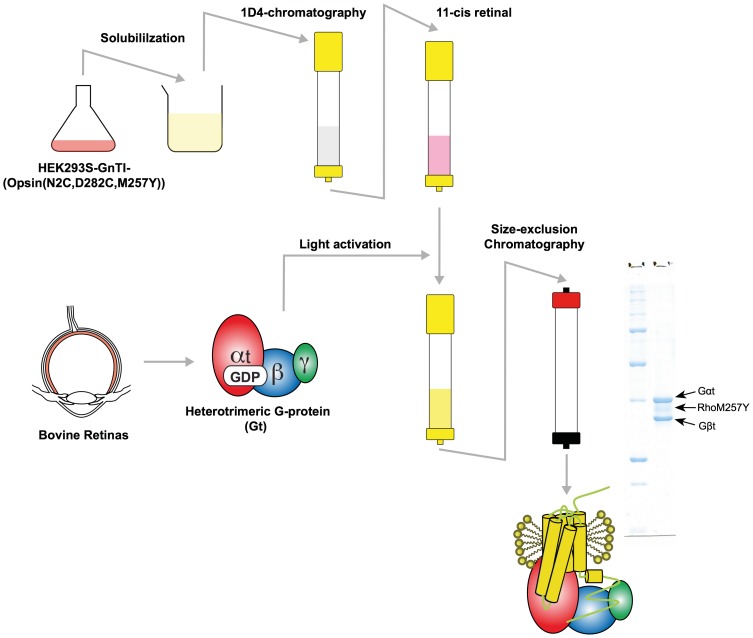
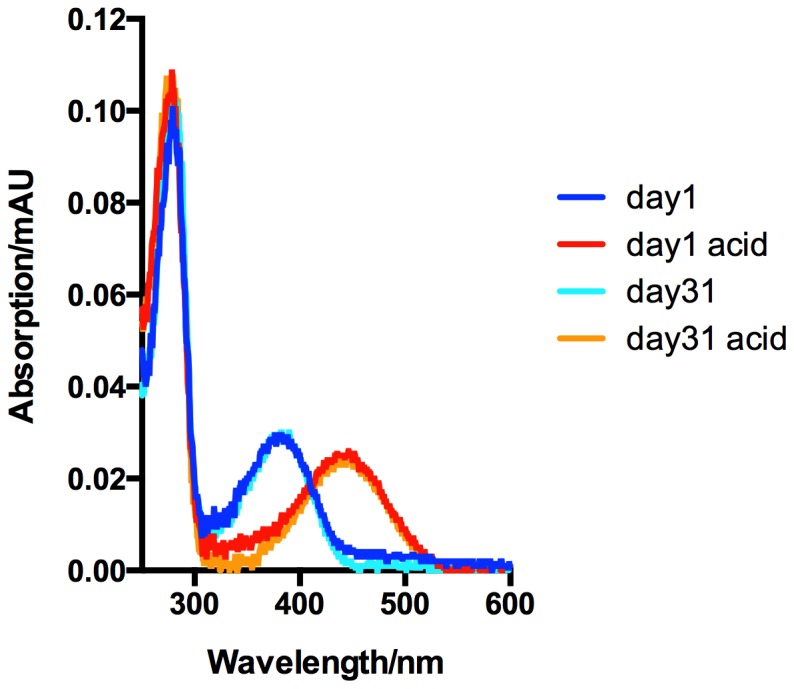
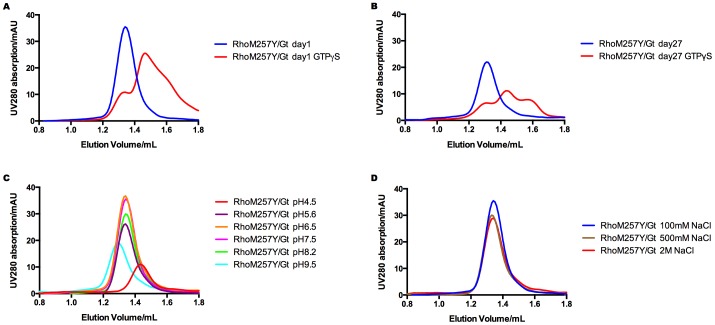
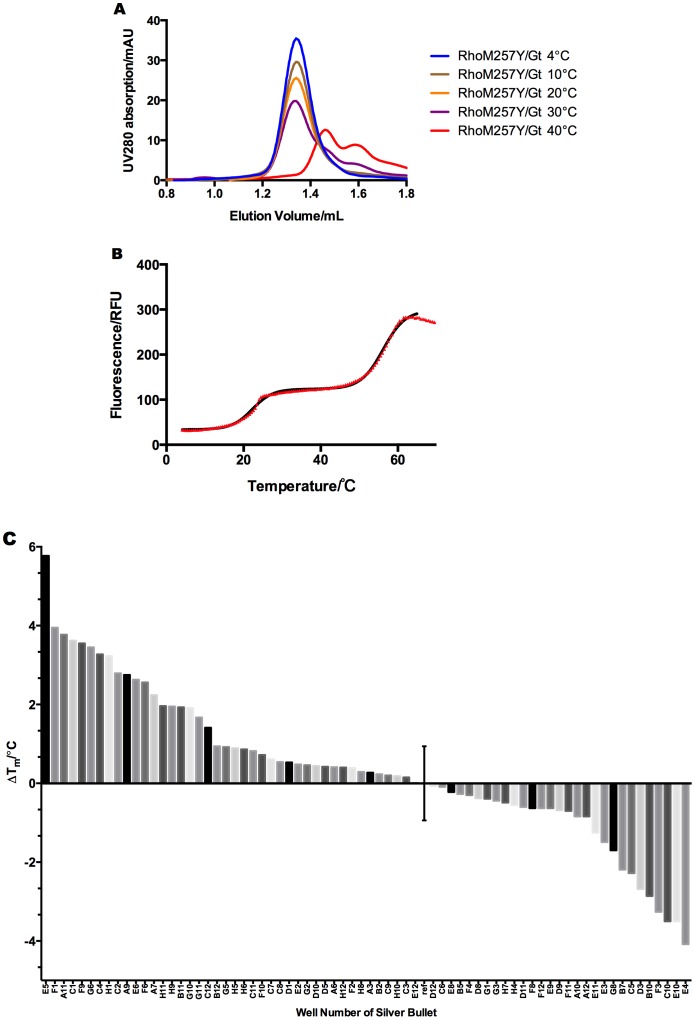
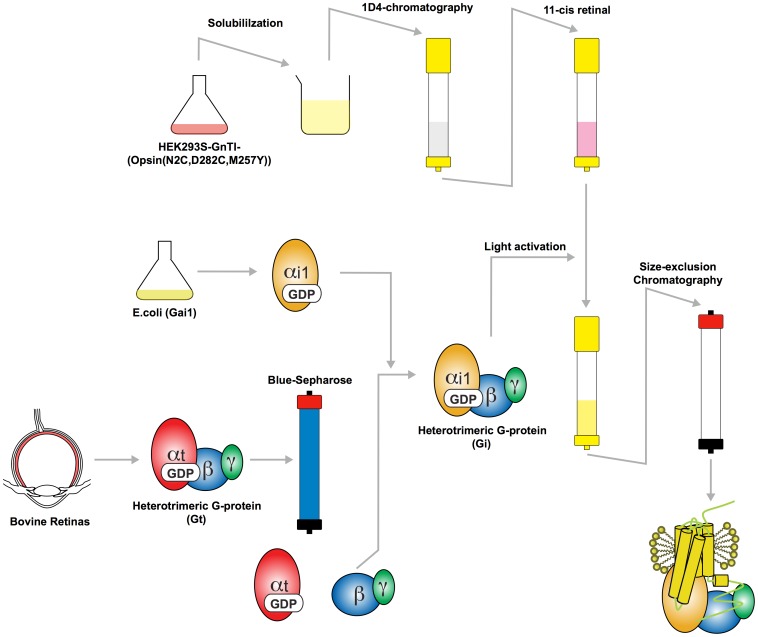
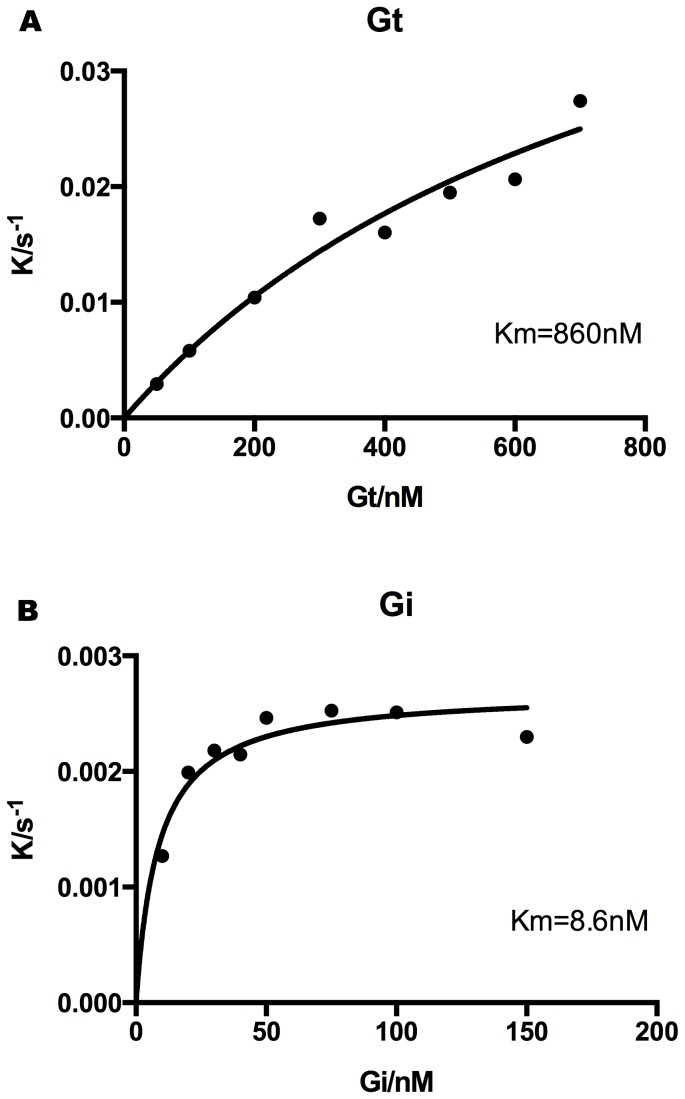
The activation of the G-protein transducin (Gt) by rhodopsin (Rho) has been intensively studied for several decades. It is the best understood example of GPCR activation mechanism and serves as a template for other GPCRs. The structure of the Rho/G protein complex, which is transiently formed during the signaling reaction, is of particular interest. It can help understanding the molecular details of how retinal isomerization leads to the G protein activation, as well as shed some light on how GPCR recognizes its cognate G protein. The native Rho/Gt complex isolated from bovine retina suffers from low stability and loss of the retinal ligand. Recently, we reported that constitutively active mutant of rhodopsin E113Q forms a Rho/Gt complex that is stable in detergent solution. Here, we introduce methods for a large scale preparation of the complex formed by the thermo-stabilized and constitutively active rhodopsin mutant N2C/M257Y/D282C(RhoM257Y) and the native Gt purified from bovine retinas. We demonstrate that the light-activated rhodopsin in this complex contains a covalently bound unprotonated retinal and therefore corresponds to the active metarhodopin II state; that the isolated complex is active and dissociates upon addition of GTPγS; and that the stoichiometry corresponds to a 1∶1 molar ratio of rhodopsin to the heterotrimeric G-protein. And finally, we show that the rhodopsin also forms stable complex with Gi. This complex has significantly higher thermostability than RhoM257Y/Gt complex and is resistant to a variety of detergents. Overall, our data suggest that the RhoM257Y/Gi complex is an ideal target for future structural and mechanistic studies of signaling in the visual system.
视紫红质(Rho)对G蛋白转导素(Gt)的激活作用已被深入研究了数十年。这是G蛋白偶联受体(GPCR)激活机制中最被熟知的例子,并为其他GPCR提供了模板。在信号反应过程中短暂形成的Rho/G蛋白复合物的结构尤其令人感兴趣。它有助于理解视网膜异构化如何导致G蛋白激活的分子细节,也能为GPCR如何识别其同源G蛋白提供一些线索。从牛视网膜中分离出的天然Rho/Gt复合物稳定性较差,且会失去视网膜配体。最近,我们报道视紫红质E113Q的组成型活性突变体形成了一种在去污剂溶液中稳定的Rho/Gt复合物。在此,我们介绍了大规模制备由热稳定且具有组成型活性的视紫红质突变体N2C/M257Y/D282C(RhoM257Y)与从牛视网膜中纯化的天然Gt形成的复合物的方法。我们证明该复合物中光激活的视紫红质含有共价结合的未质子化视网膜,因此对应于活性视紫红质II状态;分离出的复合物具有活性,加入GTPγS后会解离;化学计量比对应视紫红质与异源三聚体G蛋白的1∶1摩尔比。最后,我们表明视紫红质也能与Gi形成稳定复合物。该复合物的热稳定性明显高于RhoM257Y/Gt复合物,并且对多种去污剂具有抗性。总体而言,我们的数据表明RhoM257Y/Gi复合物是未来视觉系统信号传导结构和机制研究的理想靶点。