Van Dyck D, Cerin E, De Bourdeaudhuij I, Hinckson E, Reis R S, Davey R, Sarmiento O L, Mitas J, Troelsen J, MacFarlane D, Salvo D, Aguinaga-Ontoso I, Owen N, Cain K L, Sallis J F
1] Research Foundation Flanders, Brussels, Belgium [2] Department of Movement and Sport Sciences, Faculty of Medicine and Health Sciences, Ghent University, Ghent, Belgium.
Centre for Physical Activity and Nutrition Research, School of Exercise and Nutrition Sciences, Deakin University, Burwood, Victoria, Australia.
Int J Obes (Lond). 2015 Feb;39(2):199-207. doi: 10.1038/ijo.2014.115. Epub 2014 Jul 2.
Physical activity (PA) has been consistently implicated in the etiology of obesity, whereas recent evidence on the importance of sedentary time remains inconsistent. Understanding of dose-response associations of PA and sedentary time with overweight and obesity in adults can be improved with large-scale studies using objective measures of PA and sedentary time. The purpose of this study was to examine the strength, direction and shape of dose-response associations of accelerometer-based PA and sedentary time with body mass index (BMI) and weight status in 10 countries, and the moderating effects of study site and gender.
Data from the International Physical activity and the Environment Network (IPEN) Adult study were used. IPEN Adult is an observational multi-country cross-sectional study, and 12 sites in 10 countries are included. Participants wore an accelerometer for seven consecutive days, completed a socio-demographic questionnaire and reported height and weight. In total, 5712 adults (18-65 years) were included in the analyses. Generalized additive mixed models, conducted in R, were used to estimate the strength and shape of the associations.
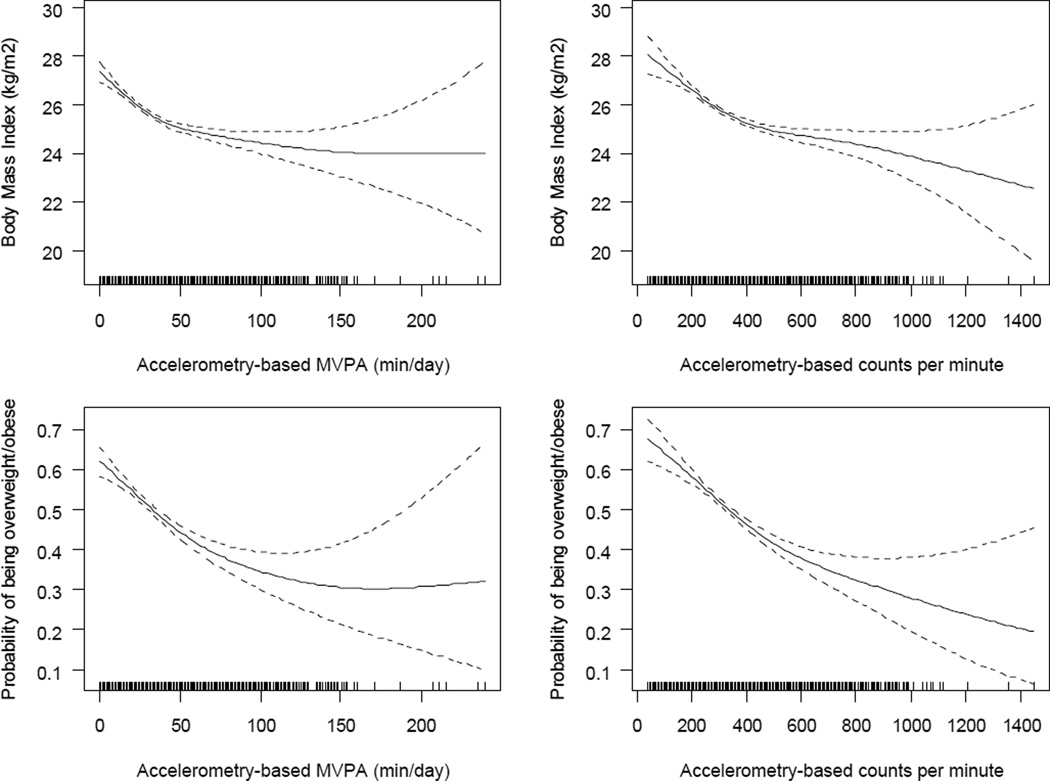
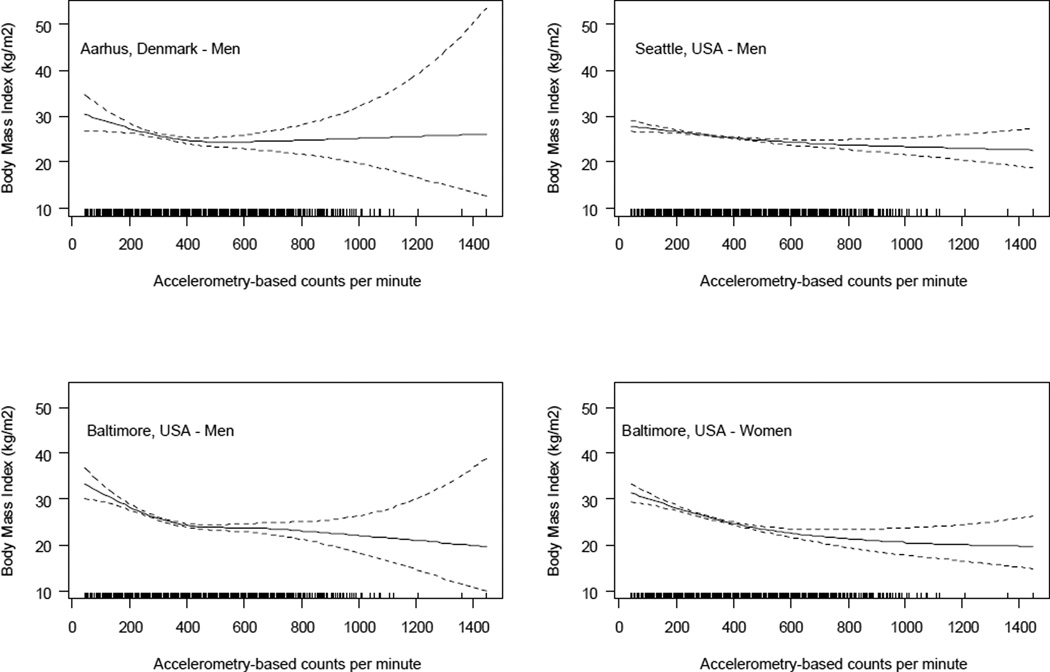
A curvilinear relationship of accelerometer-based moderate-to-vigorous PA and total counts per minute with BMI and the probability of being overweight/obese was identified. The associations were negative, but weakened at higher levels of moderate-to-vigorous PA (>50 min per day) and higher counts per minute. No associations between sedentary time and weight outcomes were found. Complex site- and gender-specific findings were revealed for BMI, but not for weight status.
On the basis of these results, the current Institute of Medicine recommendation of 60 min per day of moderate-to-vigorous PA to prevent weight gain in normal-weight adults was supported. No relationship between sedentary time and the weight outcomes was present, calling for further examination. If moderator findings are confirmed, the relationship between PA and BMI may be country- and gender-dependent, which could have important implications for country-specific health guidelines.
身体活动(PA)一直被认为与肥胖的病因有关,而近期关于久坐时间重要性的证据仍不一致。通过使用PA和久坐时间的客观测量方法进行大规模研究,可以更好地理解PA和久坐时间与成年人超重和肥胖之间的剂量反应关联。本研究的目的是检验基于加速度计的PA和久坐时间与10个国家的体重指数(BMI)和体重状况之间剂量反应关联的强度、方向和形状,以及研究地点和性别的调节作用。
使用国际身体活动与环境网络(IPEN)成人研究的数据。IPEN成人研究是一项多国家观察性横断面研究,包括10个国家的12个地点。参与者连续七天佩戴加速度计,完成社会人口统计学问卷,并报告身高和体重。分析共纳入5712名成年人(18 - 65岁)。在R中进行的广义相加混合模型用于估计关联的强度和形状。
确定了基于加速度计的中等至剧烈PA和每分钟总计数与BMI以及超重/肥胖概率之间的曲线关系。这些关联是负相关的,但在中等至剧烈PA水平较高(>每天50分钟)和每分钟计数较高时减弱。未发现久坐时间与体重结果之间的关联。对于BMI发现了复杂的地点和性别特异性结果,但对于体重状况未发现。
基于这些结果,支持了医学研究所目前关于正常体重成年人每天进行60分钟中等至剧烈PA以预防体重增加的建议。久坐时间与体重结果之间不存在关联,需要进一步研究。如果调节因素的结果得到证实,PA与BMI之间的关系可能因国家和性别而异,这可能对特定国家的健康指南具有重要意义。