Al-Turkistani Hatim K
Department of Pediatrics, College of Medicine, University of Dammam, King Fahd Hospital of the University, Al-Khobar, Kingdom of Saudi Arabia.
J Family Community Med. 2014 May;21(2):125-9. doi: 10.4103/2230-8229.134772.
The history of resuscitation going back thousands of years has been reported in literature throughout history. This concept has undergone several decisive revolutionary changes particularly in pediatrics. Although the cardio-pulmonary resuscitation (CPR) is relatively new in pediatrics, progress has been remarkable in the last a few decades. As it becomes more popular, especially under the influence of globalizing media, CPR also becomes a life requirement that is not restricted to health professionals.
This was a cross-sectional community-based survey of 753 individuals of both sexes, visiting the first Pediatric Health Awareness Week held at Dammam University Hospital in April 2013. Data were collected by a personal face-to-face interview during which a short history was taken and a check list of sociodemographic data and questions related to infants' CPR was completed. Statistical analysis was performed by using SPSS.
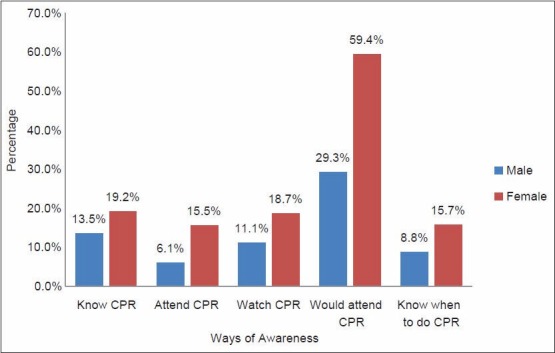
The study was carried out on 753 subjects (602 Saudis, 151 non-Saudis, 483 females, and 270 males). The mean age of participants was 33.3 ± 10.9 years. The postsecondary school level of education was 37.5% among females versus 21.9% among males. Of the participants, 80.8% of the females and 86.5% of males were totally unaware of CPR. The mean number of children among participants was 3.5 ± 2.5 children. There were 150 participants (19.9%) with disabled children; 32% of them (6.4% of all participants) were completely unaware of CPR despite having disabled children. Overall, 15.5% of all female participants had attended some CPR course (s) compared with 6.1% of the males; 18.7% of the females had watched CPR program (s)/video (s) on TV or online compared to 11.1% of the males, and 59.4% of the females were willing and eager to participate in any CPR course compared with 29.3% of the males. The reasons for not wanting to attend CPR courses were as follows: 48.6% indicated that it was because of the unavailability of such courses, 41.4% said because of time constraints, and 10% gave financial reasons. Finally, the study showed that 365 females (84.3%) and 247 males (91.2%) did not know when to perform mouth-to-mouth resuscitation and/or chest compression, and would do it for the wrong reasons.
Public awareness and knowledge on CPR was inadequate even among the younger population, and among parents with disabled children. The general public were willing to improve their knowledge and skills of CPR. We recommend that CPR courses/campaigns should be provided to the public and be included in high school curricula.
文献记载复苏的历史可追溯到数千年前。这一概念经历了几次决定性的革命性变革,尤其是在儿科领域。尽管心肺复苏术(CPR)在儿科领域相对较新,但在过去几十年里取得了显著进展。随着其越来越普及,特别是在全球化媒体的影响下,CPR也成为一项不仅限于卫生专业人员的生活必备技能。
这是一项基于社区的横断面调查,对753名男女进行了调查,他们参加了2013年4月在达曼大学医院举行的首届儿科健康意识周活动。通过个人面对面访谈收集数据,在此过程中获取简短病史,并完成一份社会人口统计学数据清单以及与婴儿CPR相关的问题。使用SPSS进行统计分析。
该研究对753名受试者进行(602名沙特人、151名非沙特人、483名女性和270名男性)。参与者的平均年龄为33.3±10.9岁。女性中受过高等教育的比例为37.5%,而男性为21.9%。在参与者中,80.8%的女性和86.5%的男性对CPR完全不了解。参与者中孩子的平均数量为3.5±2.5个。有150名参与者(19.9%)有残疾儿童;其中32%(占所有参与者的6.4%)尽管有残疾儿童,但对CPR完全不了解。总体而言,所有女性参与者中有15.5%参加过一些CPR课程,而男性为6.1%;18.7%的女性在电视或网上观看过CPR节目/视频,而男性为11.1%,59.4%的女性愿意并渴望参加任何CPR课程,而男性为29.3%。不想参加CPR课程的原因如下:48.6%表示是因为没有此类课程,41.4%说是因为时间限制,10%给出了经济原因。最后,研究表明365名女性(84.3%)和247名男性(91.2%)不知道何时进行口对口复苏和/或胸外按压,并且会出于错误原因进行操作。
即使在年轻人群体以及有残疾儿童的父母中,公众对CPR的认识和知识也不足。公众愿意提高他们的CPR知识和技能。我们建议向公众提供CPR课程/活动,并将其纳入高中课程。