Department of Biomedical Engineering, New Jersey Institute of Technology Newark, NJ, USA.
Front Integr Neurosci. 2014 Jun 17;8:50. doi: 10.3389/fnint.2014.00050. eCollection 2014.
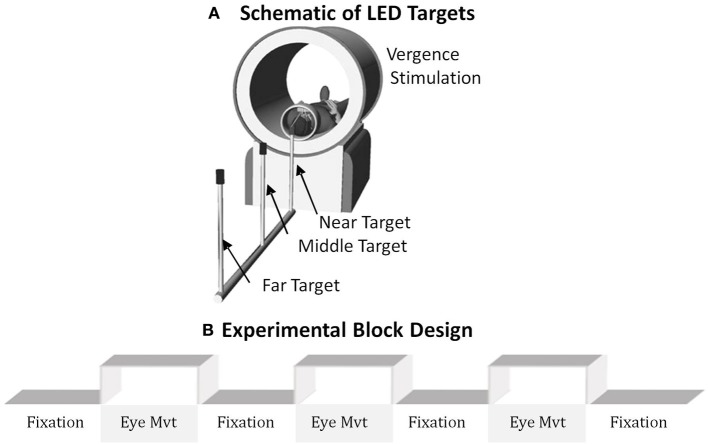
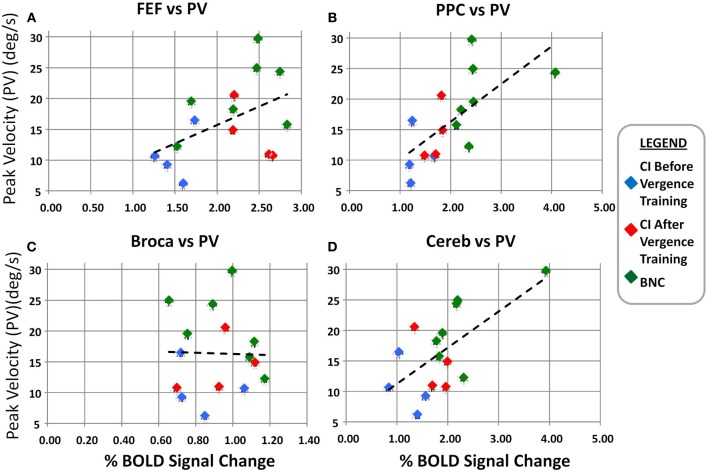
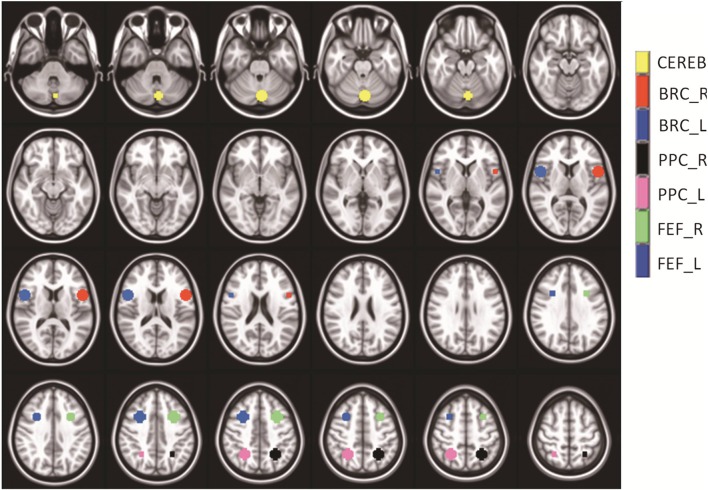
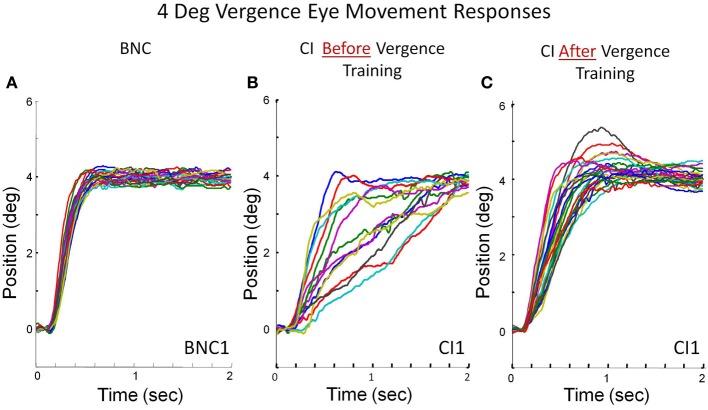
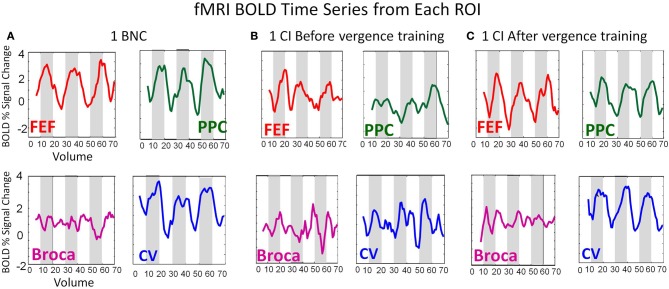
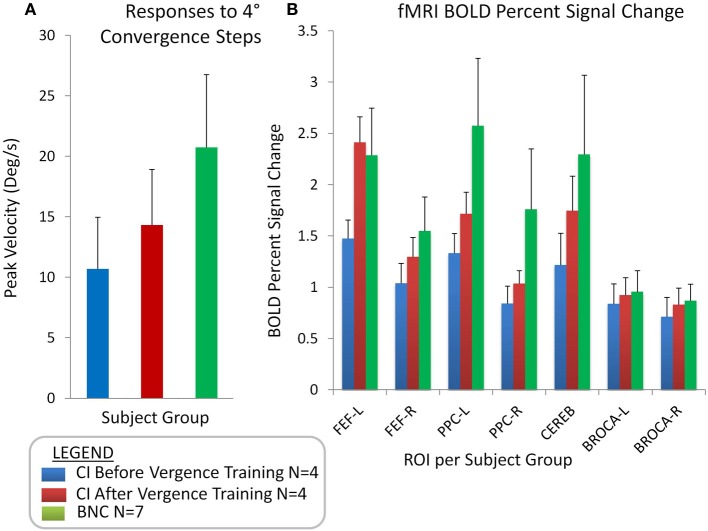
Convergence insufficiency (CI) is a prevalent binocular vision disorder with symptoms that include double/blurred vision, eyestrain, and headaches when engaged in reading or other near work. Randomized clinical trials support that Office-Based Vergence and Accommodative Therapy with home reinforcement leads to a sustained reduction in patient symptoms. However, the underlying neurophysiological basis for treatment is unknown. Functional activity and vergence eye movements were quantified from seven binocularly normal controls (BNC) and four CI patients before and after 18 h of vergence training. An fMRI conventional block design of sustained fixation vs. vergence eye movements stimulated activity in the frontal eye fields (FEF), the posterior parietal cortex (PPC), and the cerebellar vermis (CV). Comparing the CI patients' baseline measurements to the post-vergence training data sets with a paired t-test revealed the following: (1) the percent change in the BOLD signal in the FEF, PPC, and CV significantly increased (p < 0.02), (2) the peak velocity from 4° symmetrical convergence step responses increased (p < 0.01) and (3) patient symptoms assessed using the CI Symptom Survey (CISS) improved (p < 0.05). CI patient measurements after vergence training were more similar to levels observed within BNC. A regression analysis revealed the peak velocity from BNC and CI subjects before and after vergence training was significantly correlated to the percent BOLD signal change within the FEF, PPC, and CV (r = 0.6; p < 0.05). Results have clinical implications for understanding the behavioral and neurophysiological changes after vergence training in patients with CI, which may lead to the sustained reduction in visual symptoms.
集合不足(CI)是一种常见的双眼视觉障碍,其症状包括阅读或其他近距工作时出现的复视、眼疲劳和头痛。随机临床试验支持基于办公室的聚散和调节治疗,加上家庭强化,可以持续减少患者的症状。然而,治疗的潜在神经生理基础尚不清楚。从 7 名正常双眼(BNC)对照者和 4 名 CI 患者中定量测量了功能活动和聚散眼动,这些患者在进行 18 小时的聚散训练之前和之后进行了测量。使用 fMRI 常规的持续注视与聚散眼动刺激的块设计,刺激了额眼区(FEF)、顶后皮质(PPC)和小脑蚓部(CV)的活动。通过配对 t 检验将 CI 患者的基线测量值与聚散训练后的数据集进行比较,结果显示:(1)FEF、PPC 和 CV 中的 BOLD 信号的百分比变化显著增加(p < 0.02);(2)4°对称聚散阶跃反应的峰值速度增加(p < 0.01);(3)使用 CI 症状调查(CISS)评估的患者症状改善(p < 0.05)。CI 患者在聚散训练后的测量值与 BNC 观察到的水平更相似。回归分析显示,BNC 和 CI 患者在聚散训练前后的峰值速度与 FEF、PPC 和 CV 中的 BOLD 信号变化百分比显著相关(r = 0.6;p < 0.05)。结果对理解 CI 患者聚散训练后的行为和神经生理变化具有临床意义,这可能导致视觉症状的持续减轻。