Pelikan Zdenek
Allergy Research Foundation, Breda, The Netherlands.
Allergy Rhinol (Providence). 2014 Jul;5(2):96-109. doi: 10.2500/ar.2014.5.0087. Epub 2014 Jul 1.
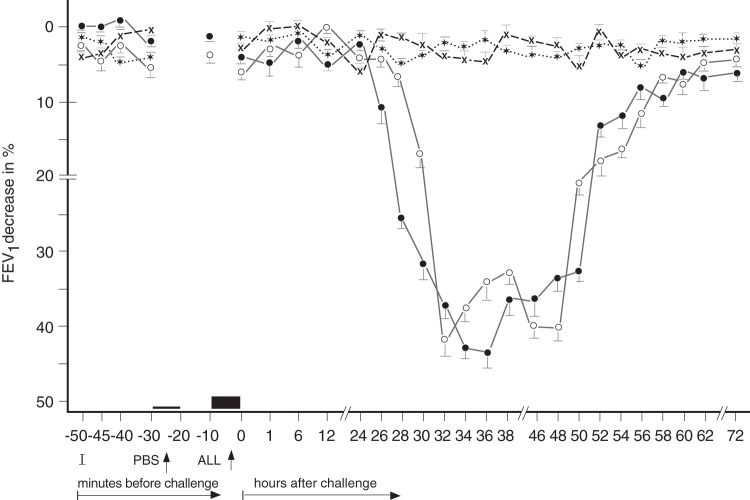
Patients with bronchial asthma develop various types of asthmatic response to bronchial challenge with allergen, such as immediate/early asthmatic response (IAR), late asthmatic response (LAR) or delayed asthmatic response (DYAR), because of different immunologic mechanisms. The DYAR, occurring between 24 and 56 hours after the bronchial allergen challenge (p < 0.01), differs from IAR and LAR in clinical as well as immunologic features. This study investigates the expression of CD molecules (markers) on the surface of particular cell populations in the peripheral blood and their changes during the DYAR. In 17 patients developing the DYAR (p < 0.01), the bronchial challenge with allergen was repeated 2-6 weeks later. The repeated DYAR (p < 0.001) was combined with recording of CD molecule expression on various types of blood cells by means of flow cytometry up to 72 hours after the challenge. The results were expressed in percent of the mean relative fluorescence intensity. The DYAR was accompanied by (a) increased expression of CD11b, CD11b/18, CD16,CD32, CD35, CD62E, CD62L, CD64, and CD66b on neutrophils; CD203C on basophils; CD25 and CD62L on eosinophils; CD14, CD16, CD64, and CD86 on monocytes; CD3, CD4, CD8, CD11a, CD18, and CD69 on lymphocytes; CD16, CD56, CD57, and CD94 on natural killer (NK) cells; and CD31, CD41, CD61, CD62P, and CD63 on thrombocytes and (b) decreased expression of CD18 and CD62L on eosinophils, CD15 on neutrophils, and CD40 on lymphocytes. These results suggest involvement of cell-mediated hypersensitivity mechanism, on participation of Th1- lymphocytes, neutrophils, monocytes, NK cells, and thrombocytes in the DYAR.
由于免疫机制不同,支气管哮喘患者对过敏原支气管激发试验会产生多种类型的哮喘反应,如速发/早发哮喘反应(IAR)、迟发哮喘反应(LAR)或延迟哮喘反应(DYAR)。DYAR发生在支气管过敏原激发试验后24至56小时之间(p<0.01),在临床和免疫特征上与IAR和LAR不同。本研究调查外周血中特定细胞群体表面CD分子(标志物)的表达及其在DYAR期间的变化。在17例发生DYAR的患者中(p<0.01),2至6周后重复进行过敏原支气管激发试验。重复的DYAR(p<0.001)与通过流式细胞术记录激发试验后72小时内各类血细胞上CD分子的表达情况相结合。结果以平均相对荧光强度的百分比表示。DYAR伴有:(a)中性粒细胞上CD11b、CD11b/18、CD16、CD32、CD35、CD62E、CD62L、CD64和CD66b;嗜碱性粒细胞上CD203C;嗜酸性粒细胞上CD25和CD62L;单核细胞上CD14、CD16、CD64和CD86;淋巴细胞上CD3、CD4、CD8、CD11a、CD18和CD69;自然杀伤(NK)细胞上CD16、CD56、CD57和CD94;血小板上CD31、CD41、CD61、CD62P和CD63的表达增加;以及(b)嗜酸性粒细胞上CD18和CD62L、中性粒细胞上CD15以及淋巴细胞上CD40的表达降低。这些结果表明细胞介导的超敏反应机制参与其中,Th1淋巴细胞、中性粒细胞、单核细胞、NK细胞和血小板参与了DYAR。