Shih Ming-Che, Chou Ming-Lun, Yue Jin-Jun, Hsu Cheng-Tran, Chang Wan-Jung, Ko Swee-Suak, Liao De-Chih, Huang Yao-Ting, Chen Jeremy J W, Yuan Jin-Ling, Gu Xiao-Ping, Lin Choun-Sea
Agricultural Biotechnology Research Center, Academia Sinica, Taipei, Taiwan.
BMC Plant Biol. 2014 Jul 2;14:179. doi: 10.1186/1471-2229-14-179.
The bamboo Bambusa edulis has a long juvenile phase in situ, but can be induced to flower during in vitro tissue culture, providing a readily available source of material for studies on reproductive biology and flowering. In this report, in vitro-derived reproductive and vegetative materials of B. edulis were harvested and used to generate transcriptome databases by use of two sequencing platforms: Illumina and 454. Combination of the two datasets resulted in high transcriptome quality and increased length of the sequence reads. In plants, many MADS genes control flower development, and the ABCDE model has been developed to explain how the genes function together to create the different whorls within a flower.
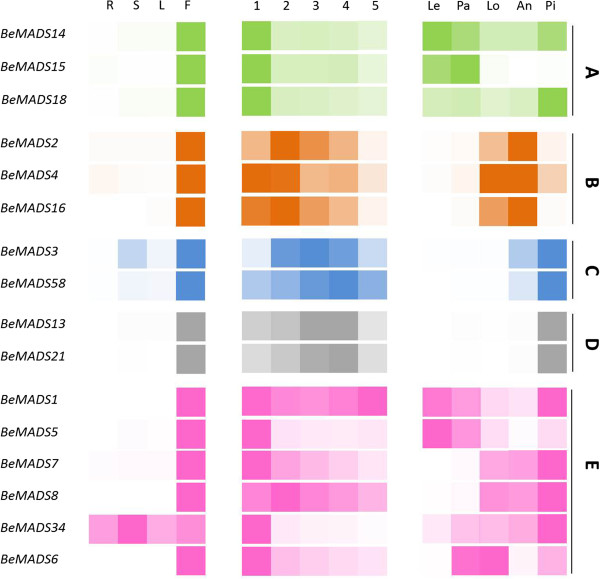
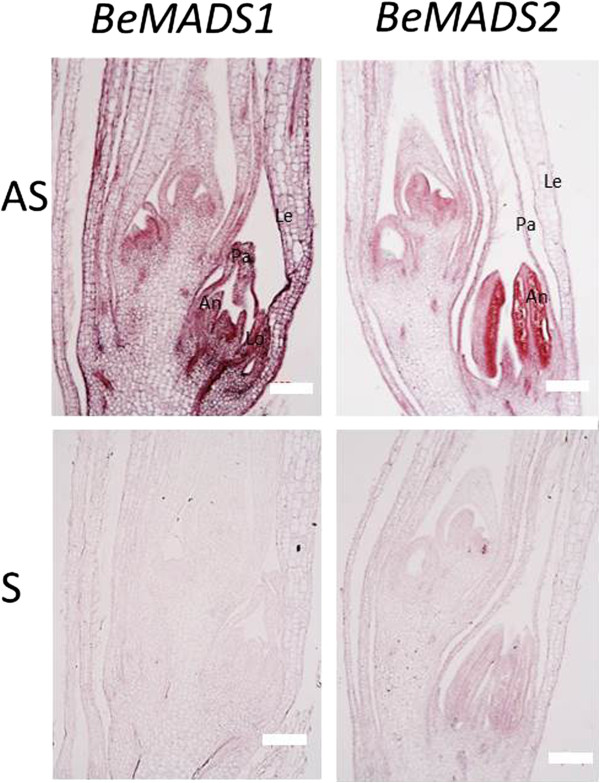
As a case study, published floral development-related OsMADS proteins from rice were used to search the B. edulis transcriptome datasets, identifying 16 B. edulis MADS (BeMADS). The BeMADS gene expression levels were determined qRT-PCR and in situ hybridization. Most BeMADS genes were highly expressed in flowers, with the exception of BeMADS34. The expression patterns of these genes were most similar to the rice homologs, except BeMADS18 and BeMADS34, and were highly similar to the floral development ABCDE model in rice. Transient expression of MADS-GFP proteins showed that only BeMADS1 entered leaf nucleus. BeMADS18, BeMADS4, and BeMADS1 were located in the lemma nucleus. When co-transformed with BeMADS1, BeMADS15, 16, 13, 21, 6, and 7 translocated to nucleus in lemmas, indicating that BeMADS1 is a key factor for subcellular localization of other BeMADS.
Our study provides abundant B. edulis transcriptome data and offers comprehensive sequence resources. The results, molecular materials and overall strategy reported here can be used for future gene identification and for further reproductive studies in the economically important crop of bamboo.
毛竹在自然生长状态下有很长的幼年期,但在离体组织培养过程中可被诱导开花,这为生殖生物学和开花研究提供了易于获取的材料来源。在本报告中,采集了毛竹离体培养获得的生殖和营养材料,并利用Illumina和454两种测序平台生成转录组数据库。将这两个数据集相结合,提高了转录组质量并增加了序列读取长度。在植物中,许多MADS基因控制花的发育,并且已经建立了ABCDE模型来解释这些基因如何共同作用以形成花内的不同轮。
作为案例研究,利用已发表的水稻中与花发育相关的OsMADS蛋白搜索毛竹转录组数据集,鉴定出16个毛竹MADS(BeMADS)基因。通过qRT-PCR和原位杂交确定了BeMADS基因的表达水平。除BeMADS34外,大多数BeMADS基因在花中高表达。这些基因的表达模式与水稻同源基因最相似,除了BeMADS18和BeMADS34,并且与水稻中的花发育ABCDE模型高度相似。MADS-GFP蛋白的瞬时表达表明只有BeMADS1进入叶细胞核。BeMADS18、BeMADS4和BeMADS1位于外稃细胞核中。当与BeMADS1共转化时,BeMADS15、16、13、21、6和7在外稃中转位到细胞核,表明BeMADS1是其他BeMADS亚细胞定位的关键因素。
我们的研究提供了丰富的毛竹转录组数据并提供了全面的序列资源。本文报道的结果、分子材料和总体策略可用于未来的基因鉴定以及对经济上重要的竹类作物进行进一步的生殖研究。