Pandurangan Ashok Kumar, Kumar Suresh Ananda Sadagopan, Dharmalingam Prakash, Ganapasam Sudhandiran
Department of Biochemistry, University of Madras, Guindy Campus, Chennai, India.
Pharmacogn Mag. 2014 Apr;10(Suppl 2):S306-10. doi: 10.4103/0973-1296.133285.
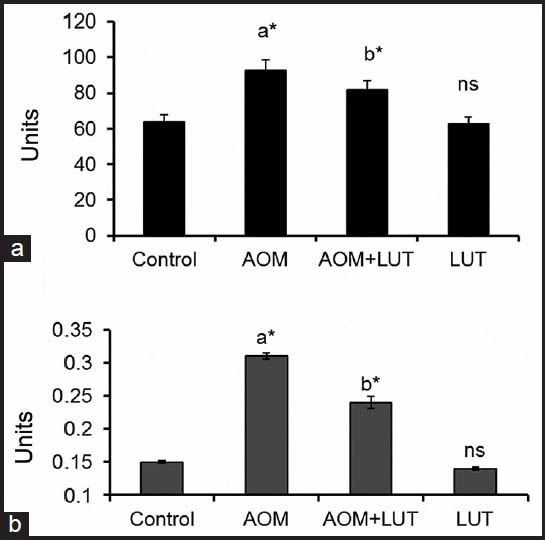
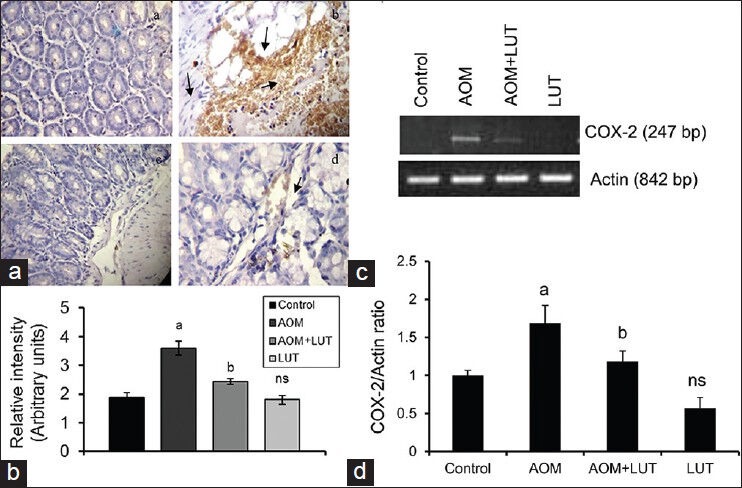
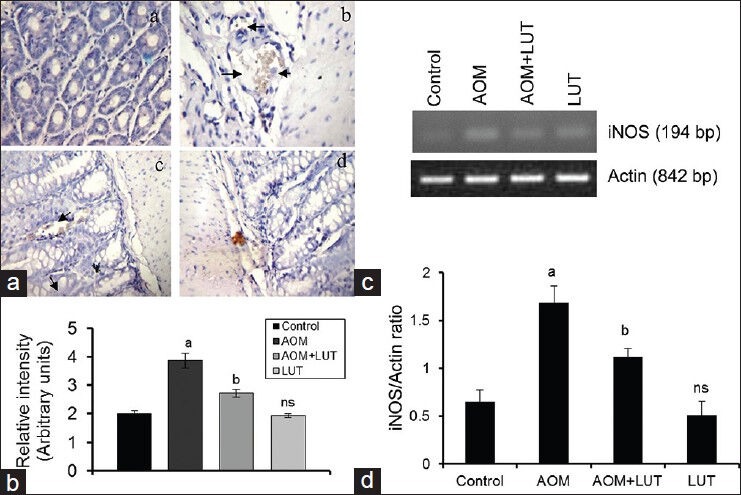
Colon cancer (CRC) is a serious health problem through worldwide. Development of novel drug without side effect for this cancer was crucial. Luteolin (LUT), a bioflavonoid has many beneficial effects such as antioxidant, anti-inflammatory, anti-proliferative properties. Azoxymethane (AOM), a derivative of 1, 2-Dimethyl hydrazine (DMH) was used for the induction of CRC in Balb/C mice. CRC was induced by intraperitoneal injection of AOM to mice at the dose of 15 mg/body kg weight for 3 weeks. Mouse was treated with LUT at the dose of 1.2 mg/body kg weight orally until end of the experiment. The expression of inducible nitric oxide synthase (iNOS) and cyclooxygense (COX)-2 were analyzed by RT-PCR and immunohistochemistry. The expressions of iNOS and COX-2 were increased in the case of AOM induction. Administration of LUT effectively reduced the expressions of iNOS and COX-2. The present study revealed that, LUT suppresses both iNOS and COX-2 expressions and act as an anti-inflammatory role against CRC.
结肠癌(CRC)是一个全球性的严重健康问题。开发针对这种癌症且无副作用的新型药物至关重要。木犀草素(LUT)是一种生物类黄酮,具有许多有益作用,如抗氧化、抗炎、抗增殖特性。偶氮甲烷(AOM)是1,2 - 二甲基肼(DMH)的衍生物,用于诱导Balb/C小鼠患CRC。通过以15毫克/体重千克的剂量对小鼠腹腔注射AOM,持续3周来诱导CRC。小鼠以1.2毫克/体重千克的剂量口服LUT,直至实验结束。通过逆转录聚合酶链反应(RT-PCR)和免疫组织化学分析诱导型一氧化氮合酶(iNOS)和环氧化酶(COX)-2的表达。在AOM诱导的情况下,iNOS和COX-2的表达增加。给予LUT有效降低了iNOS和COX-2的表达。本研究表明,LUT抑制iNOS和COX-2的表达,并对CRC起到抗炎作用。