Patil Susheel P, Brown Todd T, Jacobson Lisa P, Margolick Joseph B, Laffan Alison, Johnson-Hill Lisette, Godfrey Rebecca, Johnson Jacquett, Reynolds Sandra, Schwartz Alan R, Smith Philip L
Division of Pulmonary and Critical Care Medicine, Johns Hopkins School of Medicine, Baltimore, Maryland, United States of America.
Division of Endocrinology and Metabolism, Johns Hopkins School of Medicine, Baltimore, Maryland, United States of America.
PLoS One. 2014 Jul 3;9(7):e99258. doi: 10.1371/journal.pone.0099258. eCollection 2014.
We investigated the association of HIV infection and highly active antiretroviral therapy (HAART) with sleep disordered breathing (SDB), fatigue, and sleepiness.
HIV-uninfected men (HIV-; n = 60), HIV-infected men using HAART (HIV+/HAART+; n = 58), and HIV-infected men not using HAART (HIV+/HAART-; n = 41) recruited from two sites of the Multicenter AIDS cohort study (MACS) underwent a nocturnal sleep study, anthropometric assessment, and questionnaires for fatigue and the Epworth Sleepiness Scale. The prevalence of SDB in HIV- men was compared to that in men matched from the Sleep Heart Health Study (SHHS).
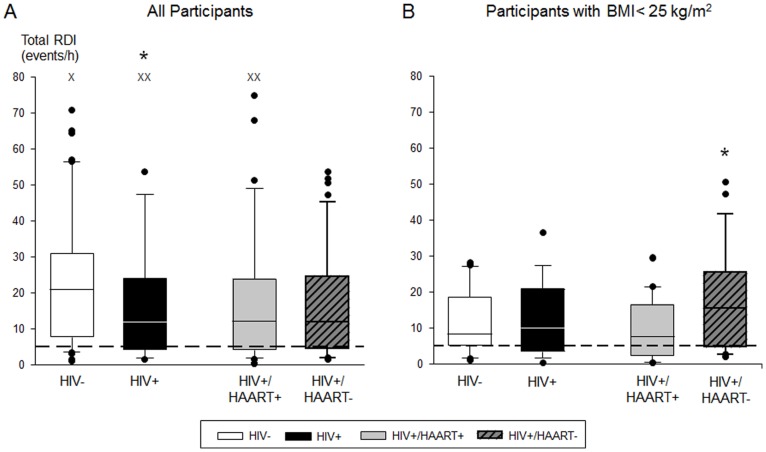
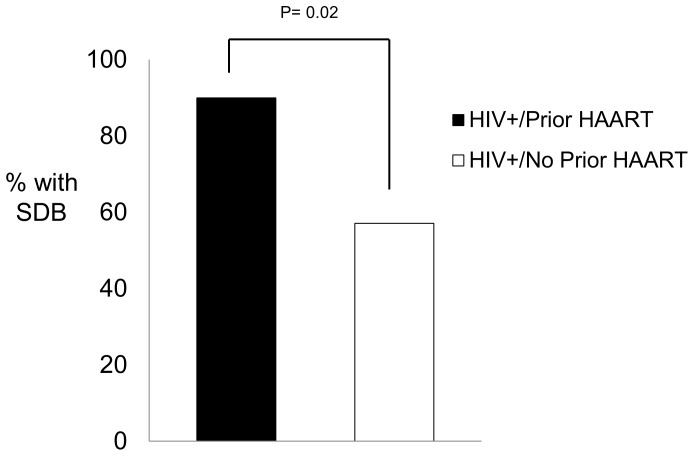
The prevalence of SDB was unexpectedly high in all groups: 86.7% for HIV-, 70.7% for HIV+/HAART+, and 73.2% for HIV+/HAART-, despite lower body-mass indices (BMI) in HIV+ groups. The higher prevalence in the HIV- men was significant in univariate analyses but not after adjustment for BMI and other variables. SDB was significantly more common in HIV- men in this study than those in SHHS, and was common in participants with BMIs <25 kg/m2. HIV+ men reported fatigue more frequently than HIV- men (25.5% vs. 6.7%; p = 0.003), but self-reported sleepiness did not differ among the three groups. Sleepiness, but not fatigue, was significantly associated with SDB.
SDB was highly prevalent in HIV- and HIV+ men, despite a normal or slightly elevated BMI. The high rate of SDB in men who have sex with men deserves further investigation. Sleepiness, but not fatigue, was related to the presence of SDB. Clinicians caring for HIV-infected patients should distinguish between fatigue and sleepiness when considering those at risk for SDB, especially in non-obese men.
我们调查了HIV感染及高效抗逆转录病毒治疗(HAART)与睡眠呼吸障碍(SDB)、疲劳和嗜睡之间的关联。
从多中心艾滋病队列研究(MACS)的两个地点招募未感染HIV的男性(HIV-;n = 60)、使用HAART的感染HIV男性(HIV+/HAART+;n = 58)以及未使用HAART的感染HIV男性(HIV+/HAART-;n = 41),他们接受了夜间睡眠研究、人体测量评估以及关于疲劳和爱泼沃斯嗜睡量表的问卷调查。将HIV-男性中SDB的患病率与来自睡眠心脏健康研究(SHHS)的匹配男性的患病率进行比较。
所有组中SDB的患病率出乎意料地高:HIV-组为86.7%,HIV+/HAART+组为70.7%,HIV+/HAART-组为73.2%,尽管HIV+组的体重指数(BMI)较低。HIV-男性中较高的患病率在单因素分析中具有显著性,但在调整BMI和其他变量后则不显著。在本研究中,HIV-男性中的SDB比SHHS中的男性更常见,并且在BMI<25 kg/m²的参与者中也很常见。HIV+男性比HIV-男性更频繁地报告疲劳(25.5%对6.7%;p = 0.003),但三组之间自我报告的嗜睡情况没有差异。嗜睡而非疲劳与SDB显著相关。
尽管BMI正常或略有升高,但SDB在HIV-和HIV+男性中高度流行。男男性行为者中SDB的高发生率值得进一步研究。嗜睡而非疲劳与SDB的存在有关。在考虑有SDB风险的患者时,尤其是非肥胖男性,照顾HIV感染患者的临床医生应区分疲劳和嗜睡。