• 文献检索
  • 文档翻译
  • 深度研究
  • 学术资讯
  • Suppr Zotero 插件Zotero 插件
  • 邀请有礼
  • 套餐&价格
  • 历史记录
应用&插件
Suppr Zotero 插件Zotero 插件浏览器插件Mac 客户端Windows 客户端微信小程序
定价
高级版会员购买积分包购买API积分包
服务
文献检索文档翻译深度研究API 文档MCP 服务
关于我们
关于 Suppr公司介绍联系我们用户协议隐私条款
关注我们

Suppr 超能文献

核心技术专利:CN118964589B侵权必究
粤ICP备2023148730 号-1Suppr @ 2026

文献检索

告别复杂PubMed语法,用中文像聊天一样搜索,搜遍4000万医学文献。AI智能推荐,让科研检索更轻松。

立即免费搜索

文件翻译

保留排版,准确专业,支持PDF/Word/PPT等文件格式,支持 12+语言互译。

免费翻译文档

深度研究

AI帮你快速写综述,25分钟生成高质量综述,智能提取关键信息,辅助科研写作。

立即免费体验

“鲨鱼就是王者!”:巴西巴伊亚州南部渔民对鲨鱼行为的民族知识

"Shark is the man!": ethnoknowledge of Brazil's South Bahia fishermen regarding shark behaviors.

作者信息

Barbosa-Filho Márcio Luiz Vargas, Schiavetti Alexandre, Alarcon Daniela Trigueirinho, Costa-Neto Eraldo Medeiros

机构信息

Departamento de Ciências Biológicas (DCB), Programa de Pós-graduação em Zoologia, Universidade Estadual de Santa Cruz, Rodovia Jorge Amado, Km 16, Bairro Salobrinho, Ilhéus, Bahia, Brazil.

出版信息

J Ethnobiol Ethnomed. 2014 Jul 3;10:54. doi: 10.1186/1746-4269-10-54.

DOI:10.1186/1746-4269-10-54
PMID:24994466
原文链接:https://pmc.ncbi.nlm.nih.gov/articles/PMC4131805/
Abstract

BACKGROUND

Fishermen's knowledge is a source of indispensable information in decision-making processes related to efforts to stimulate the management and conservation of fishing resources, especially in developing countries. This study analyzed the knowledge of fishermen from three municipal areas of Bahia in northeast Brazil regarding the behavior repertoire of sharks and the possible influence that these perceptions may have on the inclination to preserve these animals. This is a pioneering study on the ethnobiological aspects of elasmobranchs in Brazil.

METHODS

Open, semi-structured interviews with shark fishing specialists were conducted between September 2011 and October 2012. The interviews addressed the fishermen's profile, fishing techniques and knowledge about sharks, focusing on the behaviours exhibited by sharks. The data were analysed with quantitative approach and conducted with the use of descriptive statistical techniques.

RESULTS

Sixty-five fishermen were interviewed. They descend from the rafting subculture of Brazil's northeast, which has historically been disregarded by public policies addressing the management and conservation of fishing resources. The fishing fleet involved in shark fishing includes rafts, fishing boats and lobster boats equipped with fishing lines, gillnets, longlines and "esperas". The informers classified sharks' behaviour repertoire into 19 ethological categories, related especially to feeding, reproduction, and social and migratory behaviours. Because they identify sharks as predators, the detailed recognition of the behaviours exhibited is crucial both for an efficient catch and to avoid accidents. Therefore, this knowledge is doubly adaptive as it contributes to safer, more lucrative fishing. A feeling of respect for sharks predominates, since informers recognize the ecological role of these animals in marine ecosystems, attributing them the status of leader (or "the man") in the sea.

CONCLUSIONS

This work demonstrates the complexity and robustness of artisanal fishermen's ichthyological knowledge of sharks. Therefore, we suggest that such knowledge should be considered to develop public policies for the control of the fishing activity, as well as to develop and consolidate the National Action Plan for the Conservation of Shark and Ray Species (PAN - Tubarões e Raias).

摘要

背景

渔民的知识是与促进渔业资源管理和养护相关决策过程中不可或缺的信息来源,尤其是在发展中国家。本研究分析了巴西东北部巴伊亚州三个市辖区渔民对鲨鱼行为模式的了解,以及这些认知可能对保护这些动物意愿产生的影响。这是巴西关于板鳃亚纲动物民族生物学方面的开创性研究。

方法

2011年9月至2012年10月期间,对鲨鱼捕捞专家进行了开放式、半结构化访谈。访谈涉及渔民的个人情况、捕鱼技术以及对鲨鱼的了解,重点关注鲨鱼表现出的行为。数据采用定量方法进行分析,并运用描述性统计技术。

结果

共访谈了65名渔民。他们来自巴西东北部的筏钓亚文化群体,该群体在以往涉及渔业资源管理和养护的公共政策中一直被忽视。参与鲨鱼捕捞的渔船队包括筏子、渔船和配备钓线、刺网、延绳钓和“esperas”的龙虾船。受访者将鲨鱼的行为模式分为19个行为学类别,尤其与摄食、繁殖、社交和洄游行为有关。由于他们将鲨鱼视为捕食者,详细了解其表现出的行为对于高效捕鱼和避免事故都至关重要。因此,这种知识具有双重适应性,因为它有助于实现更安全、利润更高的捕鱼。对鲨鱼的尊重之情占主导,因为受访者认识到这些动物在海洋生态系统中的生态作用,赋予它们海洋中“领袖”(或“老大”)的地位。

结论

这项工作展示了个体渔民对鲨鱼的鱼类学知识的复杂性和丰富性。因此,我们建议在制定渔业活动控制的公共政策以及制定和巩固鲨鱼和鳐鱼物种保护国家行动计划(PAN - Tubarões e Raias)时应考虑此类知识。
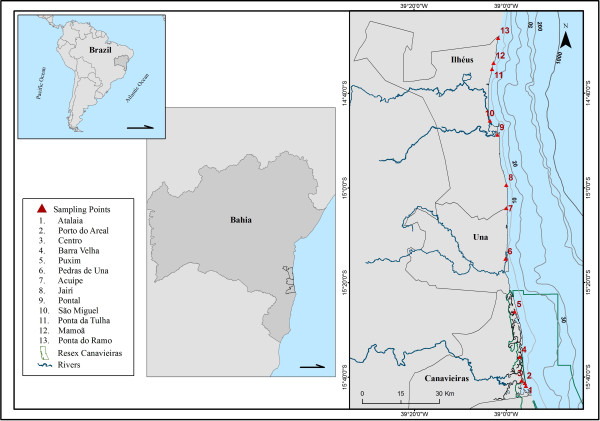
https://cdn.ncbi.nlm.nih.gov/pmc/blobs/5738/4131805/fd5f17c70fe2/1746-4269-10-54-3.jpg
https://cdn.ncbi.nlm.nih.gov/pmc/blobs/5738/4131805/2c71ff03bdc4/1746-4269-10-54-1.jpg
https://cdn.ncbi.nlm.nih.gov/pmc/blobs/5738/4131805/5470e680702c/1746-4269-10-54-2.jpg
https://cdn.ncbi.nlm.nih.gov/pmc/blobs/5738/4131805/fd5f17c70fe2/1746-4269-10-54-3.jpg
https://cdn.ncbi.nlm.nih.gov/pmc/blobs/5738/4131805/2c71ff03bdc4/1746-4269-10-54-1.jpg
https://cdn.ncbi.nlm.nih.gov/pmc/blobs/5738/4131805/5470e680702c/1746-4269-10-54-2.jpg
https://cdn.ncbi.nlm.nih.gov/pmc/blobs/5738/4131805/fd5f17c70fe2/1746-4269-10-54-3.jpg

相似文献

1
"Shark is the man!": ethnoknowledge of Brazil's South Bahia fishermen regarding shark behaviors.“鲨鱼就是王者!”:巴西巴伊亚州南部渔民对鲨鱼行为的民族知识
J Ethnobiol Ethnomed. 2014 Jul 3;10:54. doi: 10.1186/1746-4269-10-54.
2
Attitudes and local ecological knowledge of experts fishermen in relation to conservation and bycatch of sea turtles (reptilia: testudines), Southern Bahia, Brazil.巴西南 Bahia 地区专家渔民对海龟保护和兼捕的态度及地方生态知识(爬行纲:龟鳖目)。
J Ethnobiol Ethnomed. 2013 Mar 1;9:15. doi: 10.1186/1746-4269-9-15.
3
Ethnotaxonomy of sharks from tropical waters of Brazil.巴西热带水域鲨鱼的民族分类学。
J Ethnobiol Ethnomed. 2018 Nov 21;14(1):71. doi: 10.1186/s13002-018-0273-0.
4
Analysis of the supply chain and conservation status of sharks (Elasmobranchii: Superorder Selachimorpha) based on fisher knowledge.基于渔民知识的鲨鱼(软骨鱼纲:板鳃亚纲)供应链和保护状况分析。
PLoS One. 2018 Mar 13;13(3):e0193969. doi: 10.1371/journal.pone.0193969. eCollection 2018.
5
Trends in the exploitation of South Atlantic shark populations.南大西洋鲨鱼种群的开发趋势。
Conserv Biol. 2016 Aug;30(4):792-804. doi: 10.1111/cobi.12663. Epub 2016 Mar 1.
6
Shark discards in selective and mixed-species pelagic longline fisheries.选择性和混合性远洋延绳钓渔业中的鲨鱼抛弃物。
PLoS One. 2020 Aug 31;15(8):e0238595. doi: 10.1371/journal.pone.0238595. eCollection 2020.
7
Preferred conservation policies of shark researchers.鲨鱼研究人员偏好的保护政策。
Conserv Biol. 2016 Aug;30(4):805-15. doi: 10.1111/cobi.12668. Epub 2016 Feb 15.
8
Molecular identification and first demographic insights of sharks based on artisanal fisheries bycatch in the Pacific Coast of Colombia: implications for conservation.基于哥伦比亚太平洋沿岸渔业副渔获物的鲨鱼分子鉴定和初步人口学见解:对保护的启示。
PeerJ. 2022 Aug 4;10:e13478. doi: 10.7717/peerj.13478. eCollection 2022.
9
Behaviour of Sotalia guianensis (van Bénéden, 1864) (Cetacea, Delphinidae) and ethnoecological knowledge of artisanal fishermen from Canavieiras, Bahia, Brazil.巴西巴伊亚州卡纳维拉尔渔民的行为和民族生态学知识与瓜纳亚萨托蒂亚(van Bénéden,1864)(鲸目,海豚科)的行为。
J Ethnobiol Ethnomed. 2012 May 14;8:18. doi: 10.1186/1746-4269-8-18.
10
Evaluating fishermen's conservation attitudes and local ecological knowledge of the European sardine (Sardina pilchardus), Peniche, Portugal.评估葡萄牙佩尼切渔民对欧洲沙丁鱼(Sardina pilchardus)的保护态度和当地生态知识。
J Ethnobiol Ethnomed. 2017 May 5;13(1):25. doi: 10.1186/s13002-017-0154-y.

引用本文的文献

1
Almost nothing is known about the tiger shark in South Atlantic waters.在南大西洋水域,人们对长尾真鲨几乎一无所知。
PeerJ. 2023 Jan 20;11:e14750. doi: 10.7717/peerj.14750. eCollection 2023.
2
Telling the same story: Fishers and landing data reveal changes in fisheries on the Southeastern Brazilian Coast.讲述同一个故事:渔民和上岸数据揭示了东南巴西南部海岸渔业的变化。
PLoS One. 2021 Jun 1;16(6):e0252391. doi: 10.1371/journal.pone.0252391. eCollection 2021.
3
Ethnotaxonomy of sharks from tropical waters of Brazil.巴西热带水域鲨鱼的民族分类学。

本文引用的文献

1
A review of the biology and ecology of the whale shark.鲸鲨的生物学与生态学综述。
J Fish Biol. 1997 Dec;51(6):1219-1234. doi: 10.1111/j.1095-8649.1997.tb01138.x.
2
Linking sensory biology and fisheries bycatch reduction in elasmobranch fishes: a review with new directions for research.通过减少板鳃亚纲鱼类的渔业兼捕来连接感官生物学与渔业:一项带有新研究方向的综述
Conserv Physiol. 2013 Apr 8;1(1):cot002. doi: 10.1093/conphys/cot002. eCollection 2013.
3
Extinction risk and conservation of the world's sharks and rays.世界鲨鱼和鳐鱼的灭绝风险与保护
J Ethnobiol Ethnomed. 2018 Nov 21;14(1):71. doi: 10.1186/s13002-018-0273-0.
4
Analysis of the supply chain and conservation status of sharks (Elasmobranchii: Superorder Selachimorpha) based on fisher knowledge.基于渔民知识的鲨鱼(软骨鱼纲:板鳃亚纲)供应链和保护状况分析。
PLoS One. 2018 Mar 13;13(3):e0193969. doi: 10.1371/journal.pone.0193969. eCollection 2018.
Elife. 2014;3:e00590. doi: 10.7554/eLife.00590. Epub 2014 Jan 21.
4
Attitudes and local ecological knowledge of experts fishermen in relation to conservation and bycatch of sea turtles (reptilia: testudines), Southern Bahia, Brazil.巴西南 Bahia 地区专家渔民对海龟保护和兼捕的态度及地方生态知识(爬行纲:龟鳖目)。
J Ethnobiol Ethnomed. 2013 Mar 1;9:15. doi: 10.1186/1746-4269-9-15.
5
A review of the biology, fisheries and conservation of the whale shark Rhincodon typus.鲸鲨 Rhincodon typus 的生物学、渔业和保护综述。
J Fish Biol. 2012 Apr;80(5):1019-56. doi: 10.1111/j.1095-8649.2012.03252.x.
6
Global diversity hotspots and conservation priorities for sharks.全球鲨鱼多样性热点地区和保护优先事项。
PLoS One. 2011 May 5;6(5):e19356. doi: 10.1371/journal.pone.0019356.
7
An unprecedented aggregation of whale sharks, Rhincodon typus, in Mexican coastal waters of the Caribbean Sea.在加勒比海的墨西哥沿海水域,出现了前所未有的大规模鲸鲨(Rhincodon typus)聚集现象。
PLoS One. 2011 Apr 29;6(4):e18994. doi: 10.1371/journal.pone.0018994.
8
Chapter 4. Susceptibility of sharks, rays and chimaeras to global extinction.第 4 章 鲨鱼、鳐鱼和银鲛的全球灭绝易感性。
Adv Mar Biol. 2009;56:275-363. doi: 10.1016/S0065-2881(09)56004-X.
9
Cascading effects of the loss of apex predatory sharks from a coastal ocean.沿海海洋顶级掠食性鲨鱼消失的级联效应。
Science. 2007 Mar 30;315(5820):1846-50. doi: 10.1126/science.1138657.
10
Impacts of biodiversity loss on ocean ecosystem services.生物多样性丧失对海洋生态系统服务的影响。
Science. 2006 Nov 3;314(5800):787-90. doi: 10.1126/science.1132294.