Department of Radiation Oncology, University Hospital of Heidelberg, Im Neuenheimer Feld 400, Heidelberg 69120, Germany.
Radiat Oncol. 2014 Jul 7;9:151. doi: 10.1186/1748-717X-9-151.
The aim of this trial was to compare the effects of resistance training versus passive physical therapy on quality of life (QoL), fatigue, and emotional distress outcomes during radiation therapy in patients with spinal bone metastases under radiotherapy (RT).
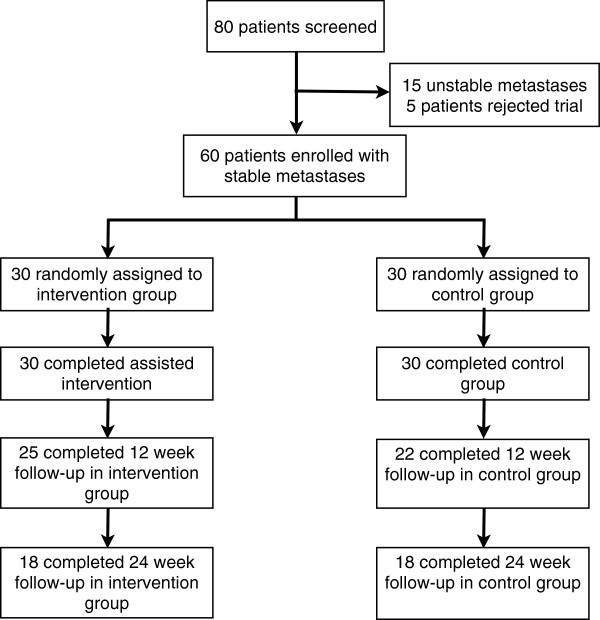
In this randomized trial, 60 patients were treated from September 2011 until March 2013 into one of the two groups: isometric resistance training or physical therapy with thirty patients in each group during RT. EORTC QLQ-BM22, EORTC QLQ-FA13, and FBK-R10 were assessed at baseline, three months, and six months after RT.
Psychosocial aspects in resistance training group (Arm A) were significantly improved after three (p = 0.001) and six months (p = 0.010). Other rated items of the QLQ-BM22 painful site, and pain characteristics were without significant differences. Functional interference showed a positive trend after six months (p = 0.081). After six months, physical fatigue (p = 0.013), and interference with daily life (p = 0.006) according to the QLQ-FA13 assessment improved in Arm A significantly. Emotional distress was in Arm A lower after six months (p = 0.016). The Cohen's effect size confirmed the clinically significant improvement of these findings.
In this group of patients we were able to show that guided isometric resistance training of the paravertebral muscles can improve functional capacity, reduce fatigue and thereby enhance QoL over a 6-months period in patients with stable spinal metastases. The results offer a rationale for future large controlled investigations to confirm these findings.
Clinical trial identifier NCT01409720.
本试验旨在比较阻力训练与被动物理疗法对脊柱骨转移接受放疗患者的生活质量(QoL)、疲劳和情绪困扰结果的影响。
在这项随机试验中,60 名患者于 2011 年 9 月至 2013 年 3 月期间被分为两组:等长阻力训练组或物理治疗组,每组 30 例。在 RT 后,使用 EORTC QLQ-BM22、EORTC QLQ-FA13 和 FBK-R10 进行评估。
阻力训练组(Arm A)的心理社会方面在 3 个月(p=0.001)和 6 个月(p=0.010)后显著改善。QLQ-BM22 的其他评定项目,如疼痛部位和疼痛特征无显著差异。6 个月后,功能障碍呈阳性趋势(p=0.081)。6 个月后,根据 QLQ-FA13 评估,身体疲劳(p=0.013)和日常生活干扰(p=0.006)在 Arm A 中显著改善。6 个月后,Arm A 中的情绪困扰降低(p=0.016)。Cohen 效应量证实了这些发现的临床显著改善。
在这组患者中,我们能够表明,脊柱旁肌肉的有指导的等长阻力训练可以改善功能能力,减轻疲劳,从而在 6 个月内提高稳定脊柱转移患者的生活质量。这些结果为未来进行大型对照研究以证实这些发现提供了依据。
NCT01409720。