Molecular Regulation of Aging, Tokyo Metropolitan Institute of Gerontology, 35-2 Sakae-cho, Itabashi-ku, Tokyo 173-0015, Japan.
Department of Advanced Aging Medicine, Chiba University Graduate School of Medicine, 1-8-1 Inohana, Chuo-ku, Chiba 260-8670, Japan.
FEBS Open Bio. 2014 May 24;4:522-32. doi: 10.1016/j.fob.2014.05.003. eCollection 2014.
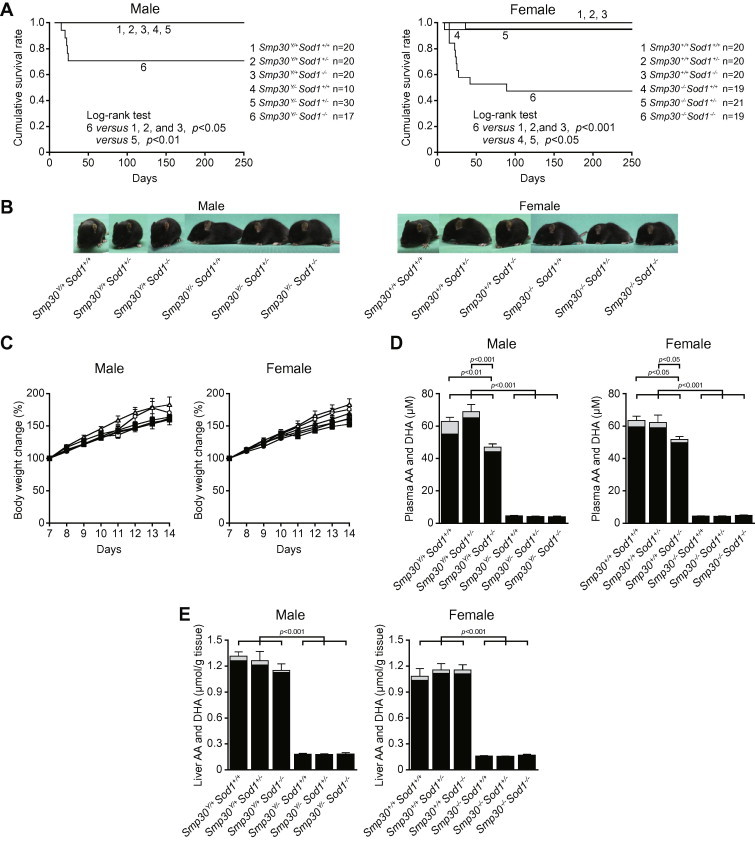
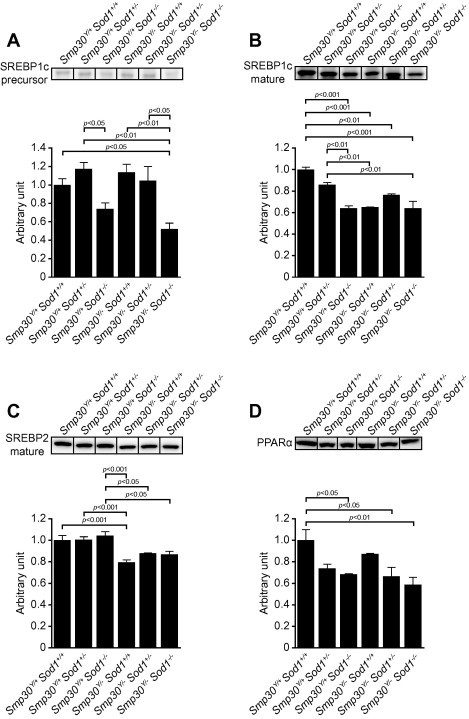
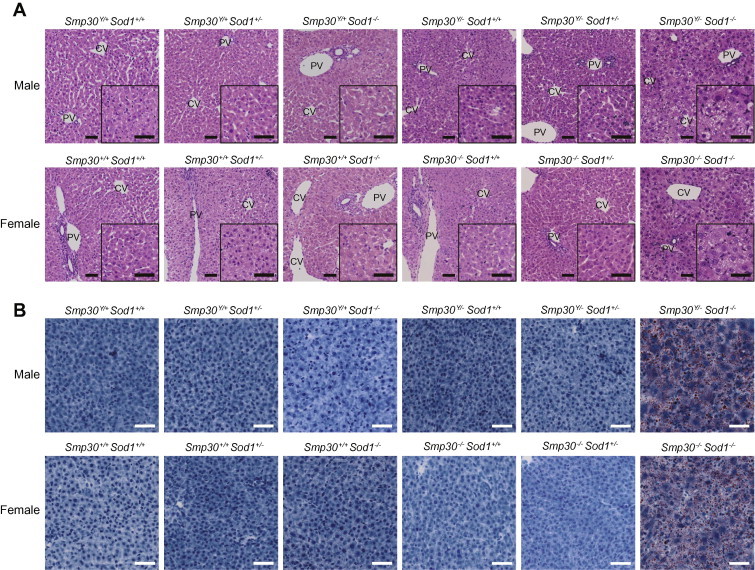
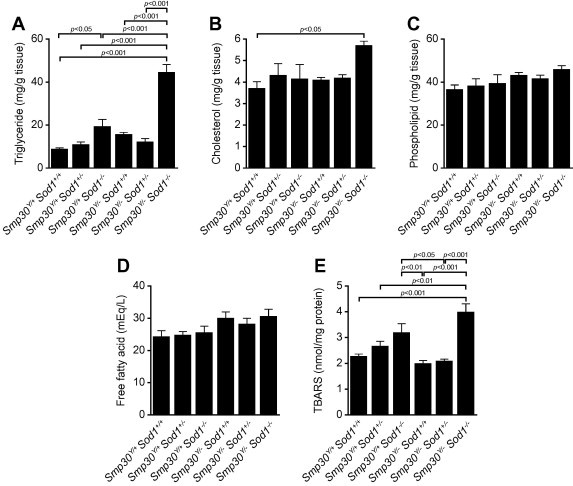
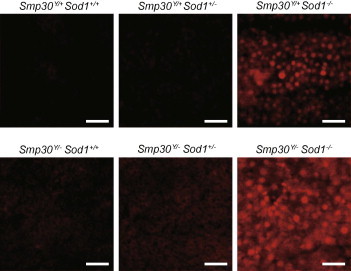
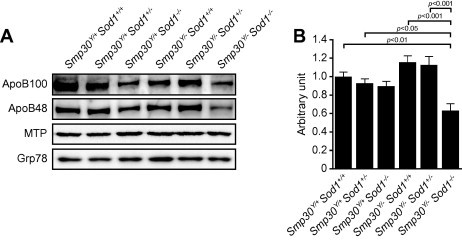
Superoxide dismutase 1 (SOD1) is an antioxidant enzyme that converts superoxide anion radicals into hydrogen peroxide and molecular oxygen. The senescence marker protein-30 (SMP30) is a gluconolactonase that functions as an antioxidant protein in mammals due to its involvement in ascorbic acid (AA) biosynthesis. SMP30 also participates in Ca(2+) efflux by activating the calmodulin-dependent Ca(2+)-pump. To reveal the role of oxidative stress in lipid metabolism defects occurring in non-alcoholic fatty liver disease pathogenesis, we generated SMP30/SOD1-double knockout (SMP30/SOD1-DKO) mice and investigated their survival curves, plasma and hepatic lipid profiles, amounts of hepatic oxidative stress, and hepatic protein levels expressed by genes related to lipid metabolism. While SMP30/SOD1-DKO pups had no growth retardation by 14 days of age, they did have low plasma and hepatic AA levels. Thereafter, 39% and 53% of male and female pups died by 15-24 and 89 days of age, respectively. Compared to wild type, SMP30-KO and SOD1-KO mice, by 14 days SMP30/SOD1-DKO mice exhibited: (1) higher plasma levels of triglyceride and aspartate aminotransferase; (2) severe accumulation of hepatic triglyceride and total cholesterol; (3) higher levels of superoxide anion radicals and thiobarbituric acid reactive substances in livers; and (4) decreased mRNA and protein levels of Apolipoprotein B (ApoB) in livers - ApoB is an essential component of VLDL secretion. These results suggest that high levels of oxidative stress due to concomitant deficiency of SMP30 and/or AA, and SOD1 cause abnormal plasma lipid metabolism, hepatic lipid accumulation and premature death resulting from impaired VLDL secretion.
超氧化物歧化酶 1(SOD1)是一种抗氧化酶,可将超氧阴离子自由基转化为过氧化氢和分子氧。衰老标志物蛋白 30(SMP30)是一种葡萄糖酸内酯酶,由于其参与抗坏血酸(AA)的生物合成,因此在哺乳动物中作为抗氧化蛋白发挥作用。SMP30 还通过激活钙调蛋白依赖性 Ca(2+)-泵参与 Ca(2+)外排。为了揭示氧化应激在非酒精性脂肪肝病发病机制中脂质代谢缺陷中的作用,我们生成了 SMP30/SOD1 双敲除(SMP30/SOD1-DKO)小鼠,并研究了它们的存活曲线、血浆和肝脂质谱、肝氧化应激程度以及与脂质代谢相关的基因表达的肝蛋白水平。虽然 SMP30/SOD1-DKO 幼鼠在 14 日龄时没有生长迟缓,但它们的血浆和肝 AA 水平较低。此后,雄性和雌性幼鼠分别有 39%和 53%在 15-24 日龄和 89 日龄死亡。与野生型、SMP30-KO 和 SOD1-KO 小鼠相比,在 14 日龄时,SMP30/SOD1-DKO 小鼠表现出:(1)更高的血浆甘油三酯和天冬氨酸转氨酶水平;(2)肝甘油三酯和总胆固醇严重堆积;(3)肝脏中超氧阴离子自由基和硫代巴比妥酸反应物质水平升高;(4)肝内载脂蛋白 B(ApoB)的 mRNA 和蛋白水平降低-ApoB 是 VLDL 分泌的必需成分。这些结果表明,由于 SMP30 和/或 AA 以及 SOD1 的同时缺乏导致的高水平氧化应激导致异常的血浆脂质代谢、肝脂质堆积和 VLDL 分泌受损导致的早逝。