Department of Internal Medicine, Kyungpook National University School of Medicine, Daegu, Korea.
Diabetes Metab J. 2014 Jun;38(3):181-6. doi: 10.4093/dmj.2014.38.3.181.
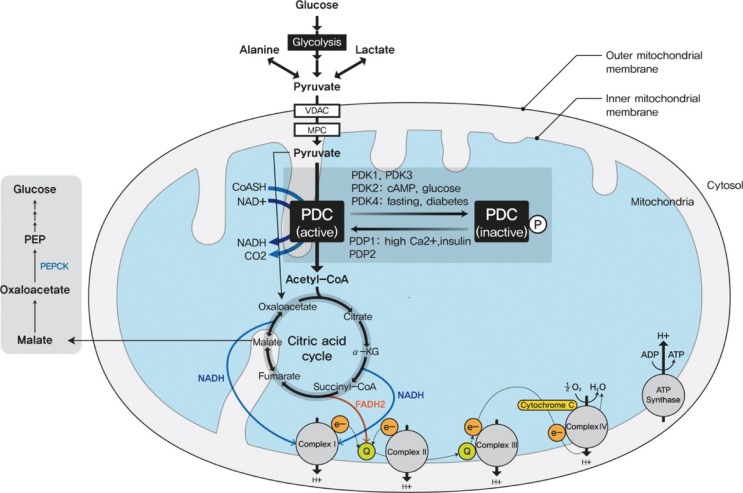
The pyruvate dehydrogenase complex (PDC) is an emerging target for the treatment of metabolic syndrome. To maintain a steady-state concentration of adenosine triphosphate during the feed-fast cycle, cells require efficient utilization of fatty acid and glucose, which is controlled by the PDC. The PDC converts pyruvate, coenzyme A (CoA), and oxidized nicotinamide adenine dinucleotide (NAD(+)) into acetyl-CoA, reduced form of nicotinamide adenine dinucleotide (NADH), and carbon dioxide. The activity of the PDC is up- and down-regulated by pyruvate dehydrogenase kinase and pyruvate dehydrogenase phosphatase, respectively. In addition, pyruvate is a key intermediate of glucose oxidation and an important precursor for the synthesis of glucose, glycerol, fatty acids, and nonessential amino acids.
丙酮酸脱氢酶复合物(PDC)是治疗代谢综合征的新兴靶点。为了在进食-禁食循环中维持三磷酸腺苷(ATP)的稳定浓度,细胞需要有效地利用脂肪酸和葡萄糖,这由 PDC 控制。PDC 将丙酮酸、辅酶 A(CoA)和氧化型烟酰胺腺嘌呤二核苷酸(NAD(+))转化为乙酰辅酶 A、还原型烟酰胺腺嘌呤二核苷酸(NADH)和二氧化碳。PDC 的活性分别由丙酮酸脱氢酶激酶和丙酮酸脱氢酶磷酸酶上调和下调。此外,丙酮酸是葡萄糖氧化的关键中间产物,也是葡萄糖、甘油、脂肪酸和非必需氨基酸合成的重要前体。