Cai Gaojun, Zhang Bifeng, Weng Weijin, Shi Ganwei, Xue Sheliang, Song Yanbin, Ma Chunyan
Department of Cardiology, Wujin hospital affiliated to Jiangsu University, Changzhou, Jiangsu Province, China.
Department of Pathology and Molecular Medicine, McMaster University, Ontario, Canada.
PLoS One. 2014 Jul 8;9(7):e102058. doi: 10.1371/journal.pone.0102058. eCollection 2014.
Epidemiological studies have shown that E-selectin gene polymorphisms (A561C and C1839T) may be associated with essential hypertension (EH), but the results are conflicting in different ethnic populations. Thus, we performed this meta-analysis to investigate a more authentic association between E-selectin gene polymorphisms and the risk of EH.
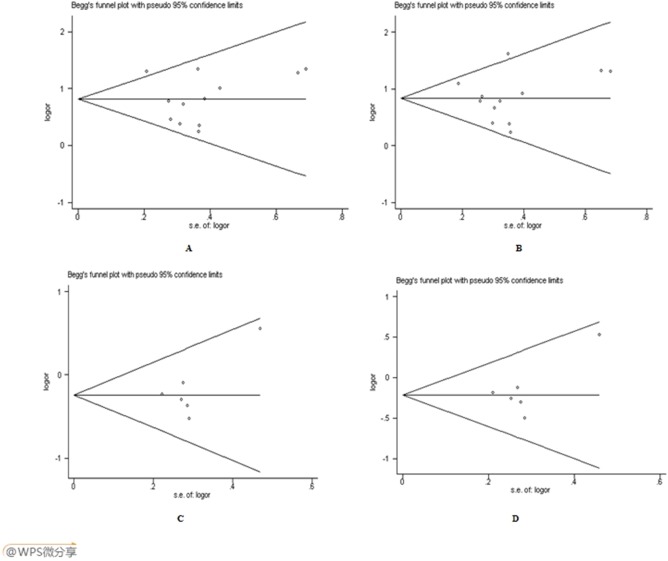
We searched the relevant studies for the present meta-analysis from the following electronic databases: PubMed, Embase, Cochrane Library, Google Scholar, Web of Science, Wanfang Data, and China National Knowledge Infrastructure (CNKI). Odds ratios (OR) with 95% confidence interval (CI) were used to evaluate the strength of the association between E-selectin gene polymorphisms and EH susceptibility. The pooled ORs were performed for dominant model, allelic model and recessive model. The publication bias was examined by Begg's funnel plots and Egger's test.
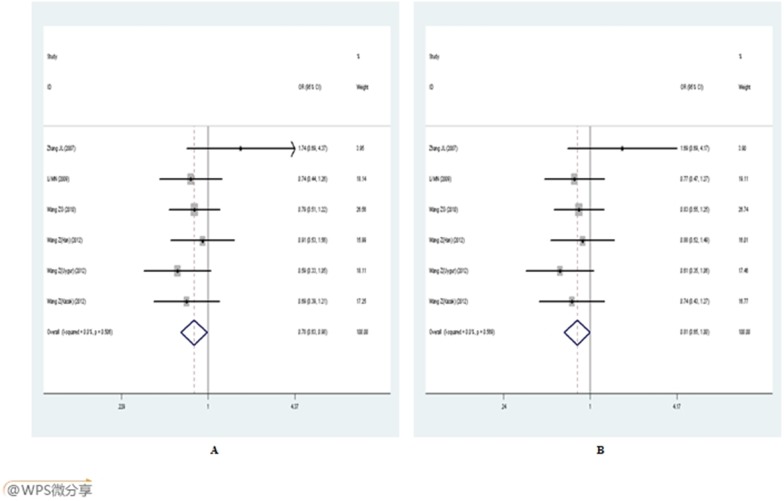
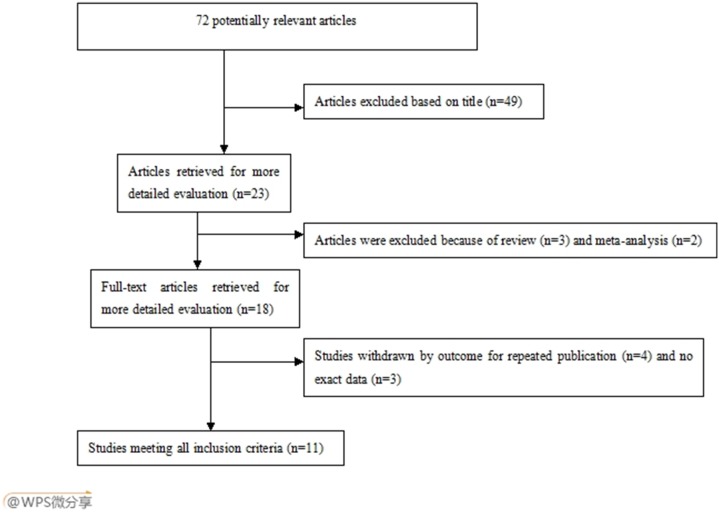
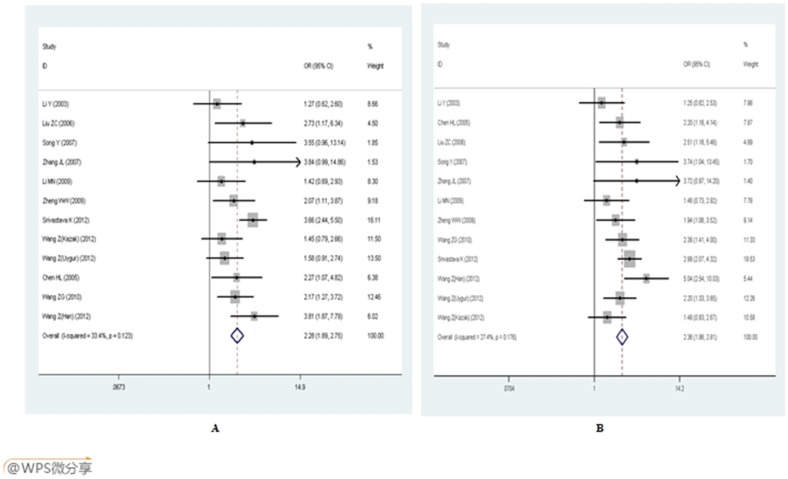
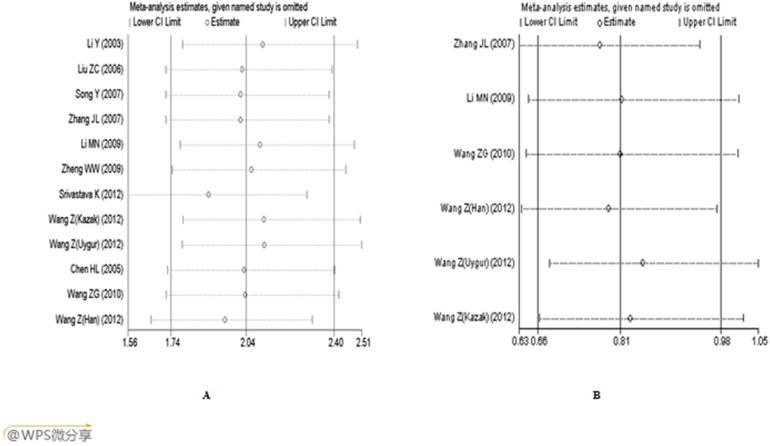
A total of eleven studies met the inclusion criteria. All studies came from Asians. Ten studies (12 cohorts) evaluated the A561C polymorphism and EH risk, including 2,813 cases and 2,817 controls. The pooled OR was 2.280 (95%CI: 1.893-2.748, P<0.001) in dominant model, 5.284 (95%CI: 2.679-10.420, P<0.001) in recessive model and 2.359 (95%CI: 1.981-2.808, P = 0.001) in allelic model. Four studies (six cohorts) evaluated C1839T polymorphism and EH risk, including 1,700 cases and 1,681 controls. The pooled OR was 0.785 (95%CI: 0.627-0.983, P = 0.035) in dominant model, 1.250 (95%CI: 0.336-4.652, P = 0.739) in recessive model and 0.805 (95%CI: 0.649-0.999, P = 0.049) in allelic model.
The current meta-analysis concludes that the C allele of E-selectin A561C gene polymorphism might increase the EH risk in Asian population, whereas the T allele of E-selectin C1839T gene polymorphism might decrease the EH risk.
流行病学研究表明,E-选择素基因多态性(A561C和C1839T)可能与原发性高血压(EH)相关,但不同种族人群的研究结果相互矛盾。因此,我们进行了这项荟萃分析,以研究E-选择素基因多态性与EH风险之间更可靠的关联。
我们从以下电子数据库中检索了本荟萃分析的相关研究:PubMed、Embase、Cochrane图书馆、谷歌学术、科学网、万方数据和中国知网。采用比值比(OR)及95%置信区间(CI)评估E-选择素基因多态性与EH易感性之间关联的强度。对显性模型、等位基因模型和隐性模型进行合并OR分析。通过Begg漏斗图和Egger检验检测发表偏倚。
共有11项研究符合纳入标准。所有研究均来自亚洲人群。10项研究(12个队列)评估了A561C多态性与EH风险,包括2813例病例和2817例对照。显性模型中合并OR为2.280(95%CI:1.893 - 2.748,P<0.001),隐性模型中为5.284(95%CI:2.679 - 10.420,P<0.001),等位基因模型中为2.359(95%CI:1.981 - 2.808,P = 0.001)。4项研究(6个队列)评估了C1839T多态性与EH风险,包括1700例病例和1681例对照。显性模型中合并OR为0.785(95%CI:0.627 - 0.983,P = 0.035),隐性模型中为1.250(95%CI:0.336 - 4.652,P = 0.739),等位基因模型中为0.805(95%CI:0.649 - 0.999,P = 0.049)。
当前的荟萃分析得出结论,E-选择素A561C基因多态性的C等位基因可能增加亚洲人群的EH风险,而E-选择素C1839T基因多态性的T等位基因可能降低EH风险。