Université François Rabelais de Tours, Tours, UMR-S930, France ; Inserm U930, University of Tours, Tours 37000, France ; CHRU Tours, Tours 37000, France ; CIC-IT INSERM 806 Ultrasons et Radiopharmaceutiques, Tours, France ; Service de Médecine Nucléaire, Hôpital Bretonneau, 2, Boulevard Tonnellé, Tours CEDEX 37044, France.
Université François Rabelais de Tours, Tours, UMR-S930, France ; Inserm U930, University of Tours, Tours 37000, France.
EJNMMI Res. 2014 Jun 6;4:28. doi: 10.1186/s13550-014-0028-4. eCollection 2014.
Cerebral stroke is a severe and frequent condition that requires rapid and reliable diagnosis. If administered shortly after the first symptoms manifest themselves, IV thrombolysis has been shown to increase the functional prognosis by restoring brain reperfusion. However, a better understanding of the pathophysiology of stroke should help to identify potential new therapeutic targets. Stroke is known to induce an inflammatory brain reaction that involves overexpression of the 18-kDa translocator protein (TSPO) in glial cells and infiltrated leukocytes, which can be visualised by positron emission tomography (PET). We aimed to evaluate post-stroke neuroinflammation using the PET TSPO radioligand (18) F-DPA-714.
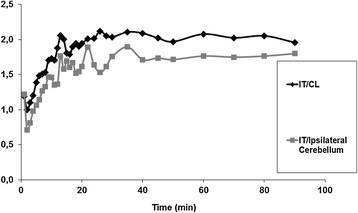
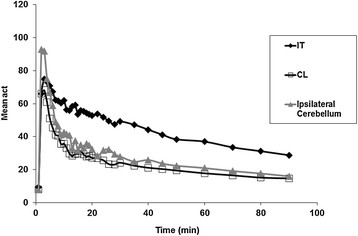
Nine patients underwent (18) F-DPA-714 PET and magnetic resonance imaging (MRI) between 8 and 18 days after the ictus. Co-registration of MRI and PET images was used to define three volumes of interest (VOIs): core infarction, contralateral region, and cerebellum ipsilateral to the stroke lesion. Time activity curves were obtained from each VOI, and ratios of mean and maximum activities between the VOIs were calculated.
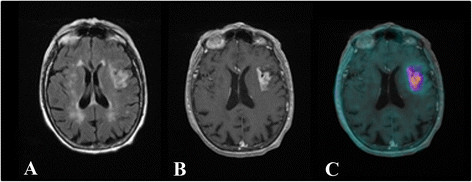
We observed an increased uptake of (18) F-DPA-714 co-localised with the infarct tissue and extension beyond the region corresponding to the damage in the blood brain barrier. No correlation was identified between (18) F-DPA-714 uptake and infarct volume. (18) F-DPA-714 uptake in ischemic lesion (mainly associated with TSPO expression in the infarct area and in the surrounding neighbourhood) slowly decreased from 10 min pi to the end of the PET acquisition, remaining higher than that in both contralateral region and ipsilateral cerebellum.
Our results show that (18) F-DPA-714 uptake after acute ischemia is mainly associated with TSPO expression in the infarct area and in the surrounding neighbourhood. We also demonstrated that the kinetics of (18) F-DPA-714 differs in injured tissue compared to normal tissue. Therefore, (18) F-DPA-714 may be useful in assessing the extent of neuroinflammation associated with acute stroke and could also help to predict clinical outcomes and functional recovery, as well as to assess therapeutic strategies, such as the use of neuroprotective/anti-inflammatory drugs.
脑卒中是一种严重且常见的疾病,需要快速可靠的诊断。如果在首次出现症状后不久进行静脉溶栓治疗,可通过恢复脑再灌注来提高功能预后。然而,更好地了解脑卒中的病理生理学应有助于确定潜在的新治疗靶点。脑卒中会引起炎症性脑反应,其中包括星形胶质细胞和浸润的白细胞中 18kDa 转位蛋白(TSPO)的过度表达,这可以通过正电子发射断层扫描(PET)进行可视化。我们旨在使用 PET TSPO 放射性配体(18)F-DPA-714 评估脑卒中后的神经炎症。
9 名患者在发病后 8-18 天进行(18)F-DPA-714 PET 和磁共振成像(MRI)检查。将 MRI 和 PET 图像配准,以定义三个感兴趣区(VOI):核心梗死区、对侧区域和病变对侧小脑。从每个 VOI 获得时间活性曲线,并计算 VOI 之间的平均和最大活性比值。
我们观察到(18)F-DPA-714 的摄取增加,与梗死组织共定位,并延伸至血脑屏障损伤区域之外。(18)F-DPA-714 的摄取与梗死体积之间未发现相关性。缺血性病变中的(18)F-DPA-714 摄取(主要与梗死区域和周围区域的 TSPO 表达有关)从注射后 10 分钟开始逐渐减少,直到 PET 采集结束,仍高于对侧区域和同侧小脑。
我们的结果表明,急性缺血后(18)F-DPA-714 的摄取主要与梗死区域和周围区域的 TSPO 表达有关。我们还证明,(18)F-DPA-714 在损伤组织中的动力学与正常组织不同。因此,(18)F-DPA-714 可能有助于评估与急性脑卒中相关的神经炎症程度,并有助于预测临床结局和功能恢复,以及评估治疗策略,如神经保护/抗炎药物的使用。