Zhang Jian-Li, Xu Ying, Shen Jie
Department of Respiration, the First Affiliated Hospital of Zhejiang University School of Medicine, Hangzhou 310003, China.
Department of Pediatrics, the First People's Hospital of Hangzhou, Hangzhou 310003, China.
Int J Mol Sci. 2014 Jul 8;15(7):12119-34. doi: 10.3390/ijms150712119.
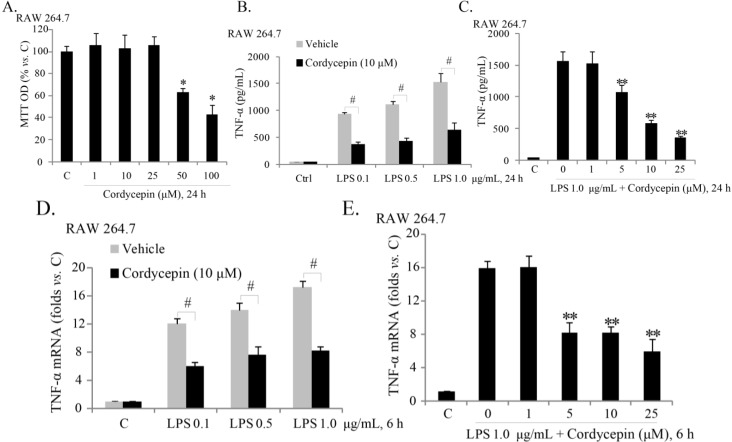
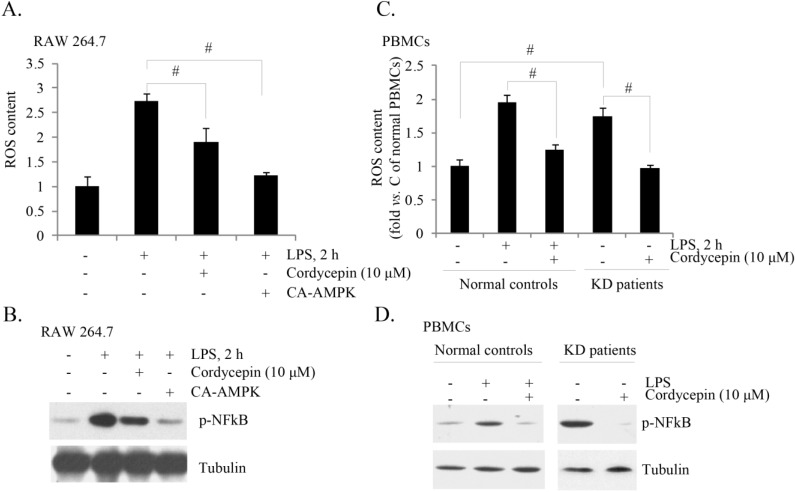
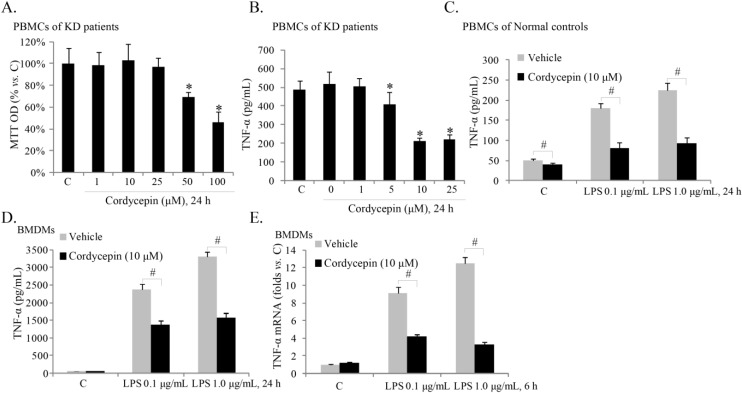
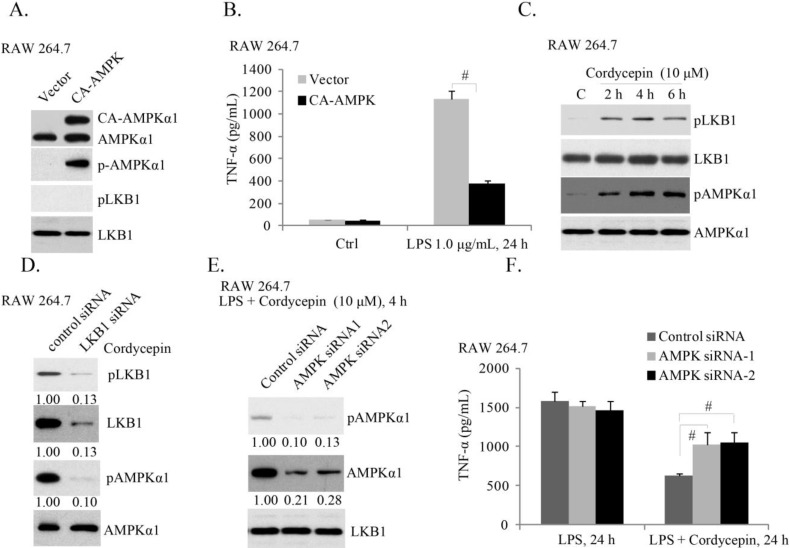
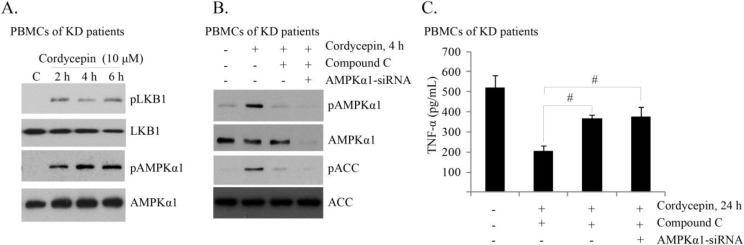
Tumor necrosis factor (TNF)-α is elevated during the acute phase of Kawasaki disease (KD), which damages vascular endothelial cells to cause systemic vasculitis. In the current study, we investigated the potential role of cordycepin on TNFα expression in both lipopolysaccharide (LPS)-stimulated macrophages and ex vivo cultured peripheral blood mononuclear cells (PBMCs) of KD patients. We found that cordycepin significantly suppressed LPS-induced TNFα expression and production in mouse macrophages (RAW 264.7 cells and bone marrow-derived macrophages (BMDMs)). Meanwhile, cordycepin alleviated TNFα production in KD patients' PBMCs. PBMCs from healthy controls had a much lower level of basal TNF-α content than that of KD patients. LPS-induced TNF-α production in healthy controls' PBMCs was also inhibited by cordycepin. For the mechanism study, we discovered that cordycepin activated AMP-activated protein kinase (AMPK) signaling in both KD patients' PBMCs and LPS-stimulated macrophages, which mediated cordycepin-induced inhibition against TNFα production. AMPK inhibition by its inhibitor (compound C) or by siRNA depletion alleviated cordycepin's effect on TNFα production. Further, we found that cordycepin inhibited reactive oxygen species (ROS) production and nuclear factor kappa B (NF-κB) activation in LPS-stimulate RAW 264.7 cells or healthy controls' PBMCs. PBMCs of KD patients showed higher basal level of ROS and NF-κB activation, which was also inhibited by cordycepin co-treatment. In conclusion, our data showed that cordycepin inhibited TNFα production, which was associated with AMPK activation as well as ROS and NF-κB inhibition. The results of this study should have significant translational relevance in managing this devastating disease.
肿瘤坏死因子(TNF)-α在川崎病(KD)急性期升高,它会损伤血管内皮细胞导致全身性血管炎。在本研究中,我们调查了虫草素对脂多糖(LPS)刺激的巨噬细胞以及KD患者体外培养的外周血单核细胞(PBMC)中TNFα表达的潜在作用。我们发现虫草素显著抑制LPS诱导的小鼠巨噬细胞(RAW 264.7细胞和骨髓来源的巨噬细胞(BMDM))中TNFα的表达和产生。同时,虫草素减轻了KD患者PBMC中TNFα的产生。健康对照者的PBMC中基础TNF-α含量远低于KD患者。虫草素也抑制了健康对照者PBMC中LPS诱导的TNF-α产生。对于机制研究,我们发现虫草素在KD患者的PBMC和LPS刺激的巨噬细胞中均激活了AMP激活的蛋白激酶(AMPK)信号通路,这介导了虫草素诱导的对TNFα产生的抑制作用。其抑制剂(化合物C)或通过小干扰RNA(siRNA)缺失抑制AMPK可减轻虫草素对TNFα产生的影响。此外,我们发现虫草素抑制LPS刺激的RAW 264.7细胞或健康对照者PBMC中活性氧(ROS)的产生和核因子κB(NF-κB)的激活。KD患者的PBMC显示出较高的基础ROS水平和NF-κB激活,虫草素联合处理也可抑制这一现象。总之,我们的数据表明虫草素抑制TNFα的产生,这与AMPK激活以及ROS和NF-κB抑制有关。本研究结果在管理这种毁灭性疾病方面应具有重要的转化意义。