Nielsen Sofie V, Poulsen Esben G, Rebula Caio A, Hartmann-Petersen Rasmus
Department of Biology, University of Copenhagen, Ole Maaløes Vej 5, DK-2200 Copenhagen N, Denmark.
Biomolecules. 2014 Jul 9;4(3):646-61. doi: 10.3390/biom4030646.
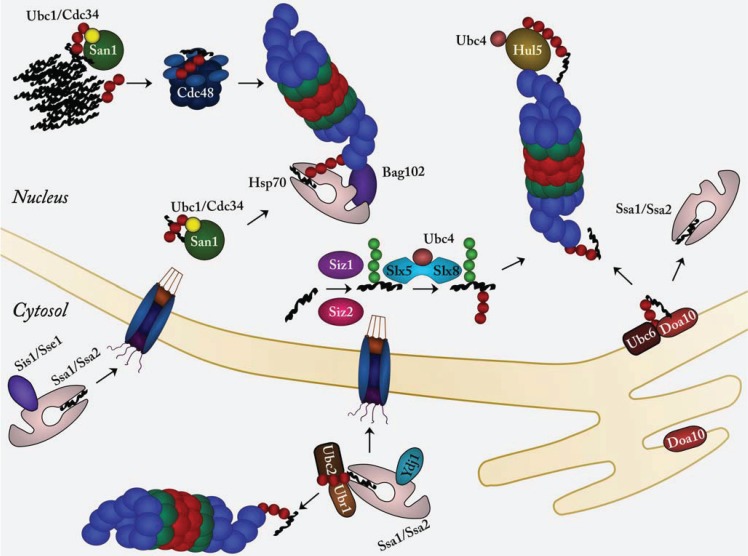
In their natural environment, cells are regularly exposed to various stress conditions that may lead to protein misfolding, but also in the absence of stress, misfolded proteins occur as the result of mutations or failures during protein synthesis. Since such partially denatured proteins are prone to aggregate, cells have evolved several elaborate quality control systems to deal with these potentially toxic proteins. First, various molecular chaperones will seize the misfolded protein and either attempt to refold the protein or target it for degradation via the ubiquitin-proteasome system. The degradation of misfolded proteins is clearly compartmentalized, so unique degradation pathways exist for misfolded proteins depending on whether their subcellular localization is ER/secretory, mitochondrial, cytosolic or nuclear. Recent studies, mainly in yeast, have shown that the nucleus appears to be particularly active in protein quality control. Thus, specific ubiquitin-protein ligases located in the nucleus, target not only misfolded nuclear proteins, but also various misfolded cytosolic proteins which are transported to the nucleus prior to their degradation. In comparison, much less is known about these mechanisms in mammalian cells. Here we highlight recent advances in our understanding of nuclear protein quality control, in particular regarding substrate recognition and proteasomal degradation.
在自然环境中,细胞经常会受到各种应激条件的影响,这些应激条件可能导致蛋白质错误折叠;而且,即使在没有应激的情况下,由于蛋白质合成过程中的突变或失误也会产生错误折叠的蛋白质。由于这些部分变性的蛋白质易于聚集,细胞已经进化出几种精密的质量控制系统来处理这些潜在的有毒蛋白质。首先,各种分子伴侣会捕获错误折叠的蛋白质,要么尝试将其重新折叠,要么通过泛素-蛋白酶体系统将其靶向降解。错误折叠蛋白质的降解明显是分区进行的,因此根据错误折叠蛋白质的亚细胞定位是内质网/分泌型、线粒体、胞质还是细胞核,存在独特的降解途径。最近主要在酵母中的研究表明,细胞核在蛋白质质量控制中似乎特别活跃。因此,位于细胞核中的特定泛素-蛋白连接酶不仅靶向错误折叠的核蛋白,还靶向各种错误折叠的胞质蛋白,这些胞质蛋白在降解之前会被转运到细胞核中。相比之下,我们对哺乳动物细胞中这些机制的了解要少得多。在这里,我们重点介绍了我们在核蛋白质量控制理解方面的最新进展,特别是关于底物识别和蛋白酶体降解方面的进展。