Golovakhа Maxim L, Orljanski Weniamin, Benedetto Karl-Peter, Panchenko Sergey, Büchler Philippe, Henle Philipp, Aghayev Emin
Institute for Evaluative Research in Medicine, University of Bern, Stauffacherstrasse 78, Bern 3014, Switzerland.
BMC Musculoskelet Disord. 2014 Jul 10;15:230. doi: 10.1186/1471-2474-15-230.
Medial open wedge high tibial osteotomy is a well-established procedure for the treatment of unicompartmental osteoarthritis and symptomatic varus malalignment. We hypothesized that different fixation devices generate different fixation stability profiles for the various wedge sizes in a finite element (FE) analysis.
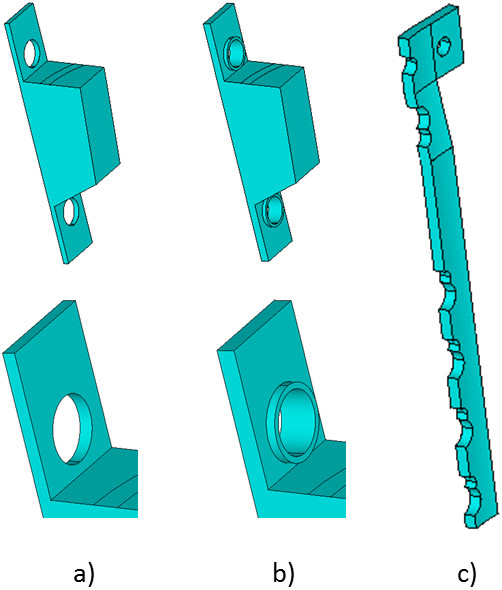
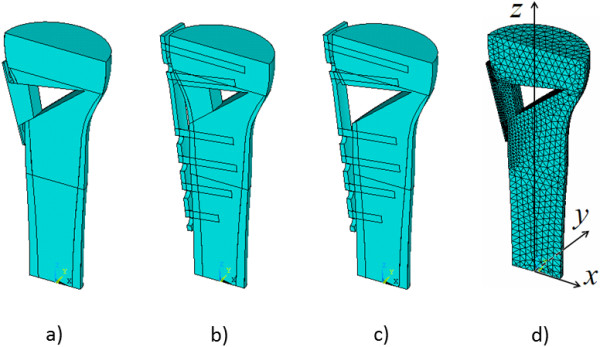
Four types of fixation were compared: 1) first and 2) second generation Puddu plates, and 3) TomoFix plate with and 4) without bone graft. Cortical and cancellous bone was modelled and five different opening wedge sizes were studied for each model. Outcome measures included: 1) stresses in bone, 2) relative displacement of the proximal and distal tibial fragments, 3) stresses in the plates, 4) stresses on the upper and lower screw surfaces in the screw channels.
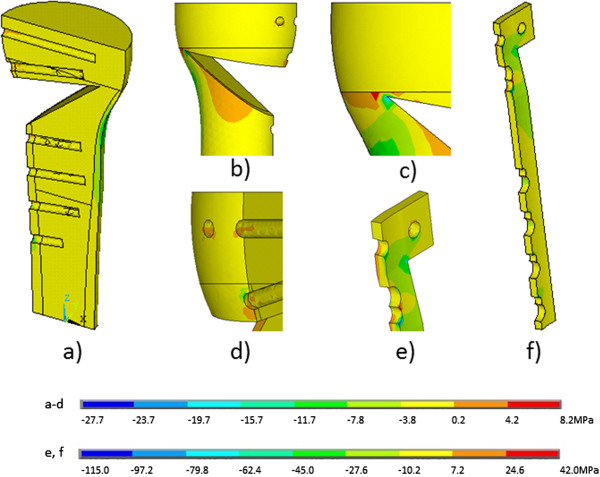
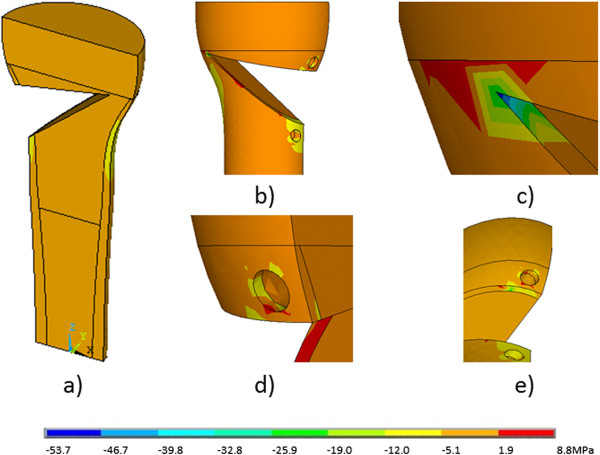
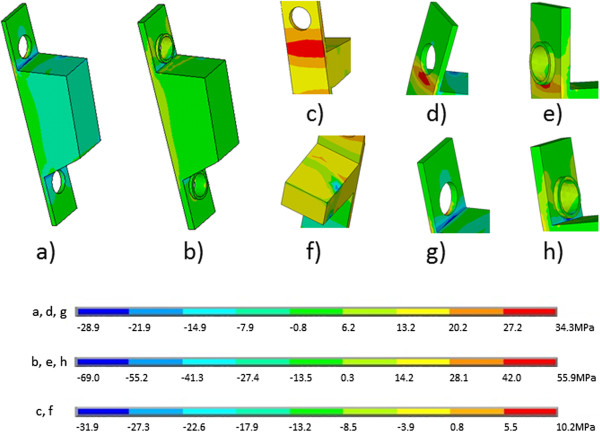
The highest load for all fixation types occurred in the plate axis. For the vast majority of the wedge sizes and fixation types the shear stress (von Mises stress) was dominating in the bone independent of fixation type. The relative displacements of the tibial fragments were low (in μm range). With an increasing wedge size this displacement tended to increase for both Puddu plates and the TomoFix plate with bone graft. For the TomoFix plate without bone graft a rather opposite trend was observed.For all fixation types the occurring stresses at the screw-bone contact areas pulled at the screws and exceeded the allowable threshold of 1.2 MPa for at least one screw surface. Of the six screw surfaces that were studied, the TomoFix plate with bone graft showed a stress excess of one out of twelve and without bone graft, five out of twelve. With the Puddu plates, an excess stress occurred in the majority of screw surfaces.
The different fixation devices generate different fixation stability profiles for different opening wedge sizes. Based on the computational simulations, none of the studied osteosynthesis fixation types warranted an intransigent full weight bearing per se. The highest fixation stability was observed for the TomoFix plates and the lowest for the first generation Puddu plate. These findings were revealed in theoretical models and need to be validated in controlled clinical settings.
内侧开放楔形高位胫骨截骨术是治疗单髁骨关节炎和症状性内翻畸形的一种成熟手术。我们假设在有限元(FE)分析中,不同的固定装置对于各种楔形尺寸会产生不同的固定稳定性特征。
比较了四种固定方式:1)第一代和2)第二代普杜钢板,以及3)带骨移植和4)不带骨移植的TomoFix钢板。对皮质骨和松质骨进行建模,并针对每个模型研究了五种不同的开放楔形尺寸。结果指标包括:1)骨内应力,2)胫骨干近端和远端片段的相对位移,3)钢板内应力,4)螺钉通道内上下螺钉表面的应力。
所有固定类型的最大载荷均出现在钢板轴线上。对于绝大多数楔形尺寸和固定类型,无论固定类型如何,骨内的剪应力(冯·米塞斯应力)均占主导。胫骨片段的相对位移较低(在微米范围内)。随着楔形尺寸的增加,普杜钢板和带骨移植的TomoFix钢板的这种位移都有增加的趋势。对于不带骨移植的TomoFix钢板,观察到的趋势则相反。对于所有固定类型,螺钉 - 骨接触区域产生的应力会牵拉螺钉,并且至少一个螺钉表面的应力超过了1.2 MPa的允许阈值。在所研究的六个螺钉表面中,带骨移植的TomoFix钢板有十二分之一的螺钉表面出现应力超标,不带骨移植的则有十二分之五。对于普杜钢板,大多数螺钉表面都出现了应力超标。
不同的固定装置对于不同的开放楔形尺寸会产生不同的固定稳定性特征。基于计算模拟,所研究的任何一种骨合成固定类型本身都不能保证绝对的完全负重。观察到TomoFix钢板的固定稳定性最高,第一代普杜钢板的最低。这些发现是在理论模型中得出的,需要在对照的临床环境中进行验证。