Heydari Gholamreza, Masjedi Mohammadreza, Ahmady Arezoo Ebn, Leischow Scott J, Lando Harry A, Shadmehr Mohammad Behgam, Fadaizadeh Lida
Tobacco Prevention and Control Research Center, National Research Institute of Tuberculosis and Lung Diseases, Shahid Beheshti University of Medical Sciences, Darabad, Niavaran, Tehran 1955841452, Iran.
Department of Community Oral Health, School of Dentistry, Shahid Beheshti University of Medical Sciences, Tehran 1983963113, Iran.
Int J Prev Med. 2014 Jun;5(6):673-8.
During recent years, there have been many advances in different types of pharmacological and non-pharmacological tobacco control treatments. In this study, we aimed to identify the most effective smoking cessation methods used in quit based upon a review of the literature.
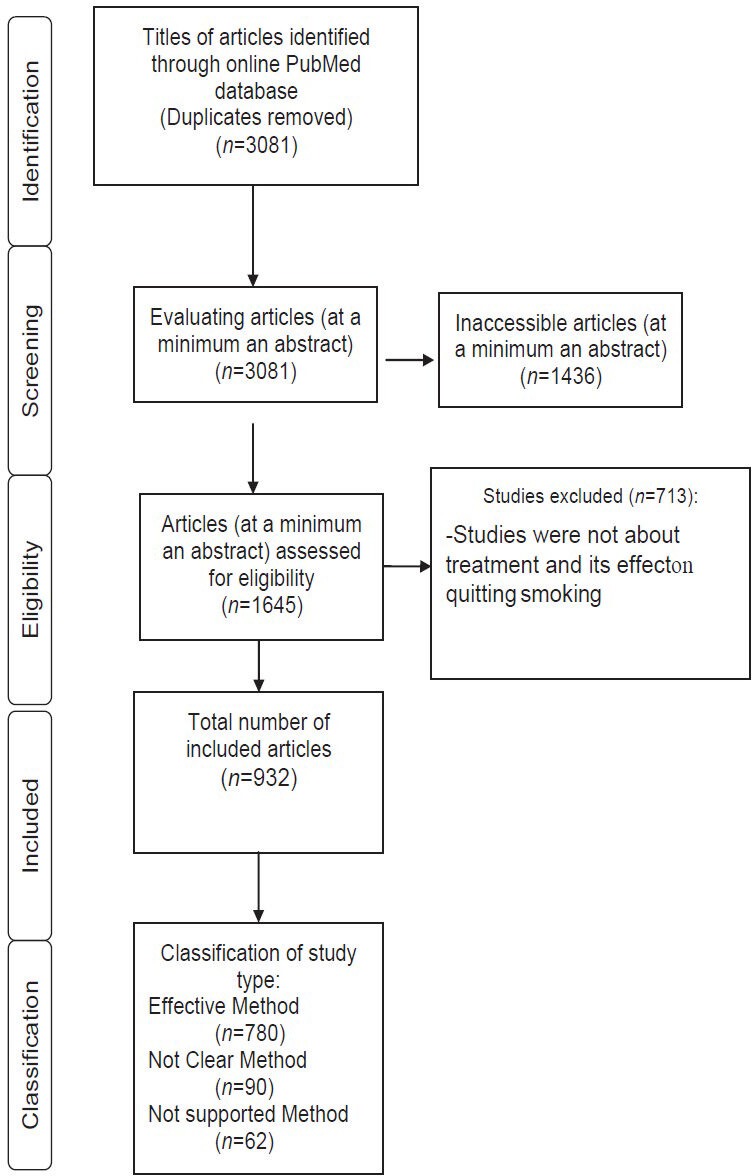
We did a search of PubMed, limited to English publications from 2000 to 2012. Two trained reviewers independently assessed titles, abstracts and full texts of articles after a pilot inter-rater reliability assessment which was conducted by the author (GH). The total number of papers and their conclusions including recommendation of that method (positive) or not supporting (negative) was computed for each method. The number of negative papers was subtracted from the number of positive ones for each method. In cases of inconsistency between the two reviewers, these were adjudicated by author.
Of the 932 articles that were critically assessed, 780 studies supported quit smoking methods. In 90 studies, the methods were not supported or rejected and in 62 cases the methods were not supported. Nicotine replacement therapy (NRT), Champix and Zyban with 352, 117 and 71 studies respectively were the most supported methods and e-cigarettes and non-Nicotine medications with one case were the least supported methods. Finally, NRT with 39 and Champix and education with 36 scores were the most supported methods.
Results of this review indicate that the scientific papers in the most recent decade recommend the use of NRT and Champix in combination with educational interventions. Additional research is needed to compare qualitative and quantitative studies for smoking cessation.
近年来,不同类型的药物和非药物控烟治疗取得了许多进展。在本研究中,我们旨在通过文献综述确定戒烟中最有效的戒烟方法。
我们检索了PubMed,限于2000年至2012年的英文出版物。在作者(GH)进行的初步评分者间信度评估之后,两名经过培训的评审员独立评估文章的标题、摘要和全文。计算每种方法的论文总数及其结论,包括该方法的推荐(阳性)或不支持(阴性)。从每种方法的阳性论文数量中减去阴性论文数量。在两名评审员意见不一致的情况下,由作者进行裁决。
在932篇经过严格评估的文章中,780项研究支持戒烟方法。在90项研究中,这些方法未得到支持或被拒绝,在62项研究中,这些方法未得到支持。尼古丁替代疗法(NRT)、畅沛和安非他酮分别有352项、117项和71项研究支持,是得到最多支持的方法,而电子烟和非尼古丁药物各有一项研究支持,是得到最少支持的方法。最后,NRT得分为39分,畅沛和教育得分为36分,是得到最多支持的方法。
本综述结果表明,近十年的科学论文推荐使用NRT和畅沛并结合教育干预措施。需要进行更多研究以比较戒烟的定性和定量研究。