Westenfelder Christof, Togel Florian E
Section of Nephrology (111 N), George E. Wahlen VA HSC and University of Utah Medical Centers , Salt Lake City, Utah, USA.
Department of Internal Medicine, Weill Cornell Medical College , New York, New York, USA.
Kidney Int Suppl (2011). 2011 Sep;1(3):103-106. doi: 10.1038/kisup.2011.24.
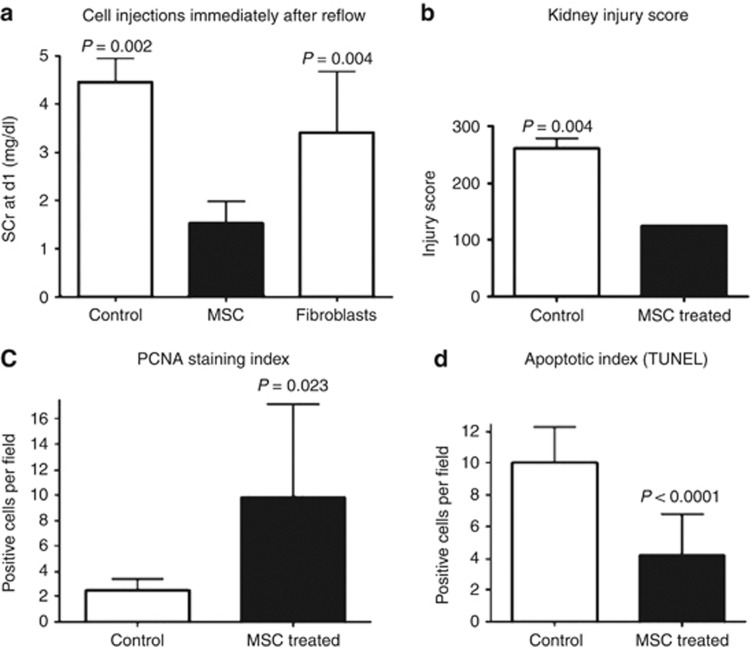
Current therapies for acute kidney injury remain primarily supportive and have failed to reduce morbidity, mortality (>50%), and associated costs. This prompted our studies in which rats with bilateral ischemia/reperfusion-induced acute kidney injury were treated with bone marrow-derived, culture-expanded allogeneic mesenchymal stem cells. Their administration into the suprarenal aorta after reflow significantly protected renal function and hastened repair, mediated by complex antiapoptotic, mitogenic, anti-inflammatory, and immune modulating actions that were not elicited by isogeneic fibroblasts. Infused mesenchymal stem cells, recruited to renal sites of injury, did not significantly differentiate into target cells but rather disappeared from kidneys and other organs within 72 h. Furthermore, at 3 months, compared with vehicle-treated controls, renal function was well preserved and interstitial fibrosis was absent. These preclinical data served as the scientific basis for a recently completed Phase I Clinical Trial (http://www.clinicaltrials.gov; # NCT00733876), in which patients at high risk for cardiac surgery-associated AKI were treated with allogeneic mesenchymal stem cells. Until now, MSC therapy in the study subjects has been safe, and none of the patients has developed postoperative AKI or subsequent loss of renal function, suggesting that this novel form of therapy may have promise in this group of high-risk patients, which will be further investigated in a Phase II Trial.
目前针对急性肾损伤的治疗主要仍是支持性治疗,未能降低发病率、死亡率(超过50%)以及相关成本。这促使我们开展了相关研究,在研究中,对双侧缺血/再灌注诱导的急性肾损伤大鼠给予骨髓来源的、经培养扩增的异体间充质干细胞进行治疗。在再灌注后将其注入肾上腺主动脉可显著保护肾功能并加速修复,这是由复杂的抗凋亡、促有丝分裂、抗炎和免疫调节作用介导的,而同基因成纤维细胞不会引发这些作用。注入的间充质干细胞被募集到肾脏损伤部位,并未显著分化为靶细胞,而是在72小时内从肾脏和其他器官中消失。此外,在3个月时,与接受赋形剂治疗的对照组相比,肾功能得到良好保留,且不存在间质纤维化。这些临床前数据为最近完成的一项I期临床试验(http://www.clinicaltrials.gov;#NCT00733876)提供了科学依据,在该试验中,对心脏手术相关急性肾损伤高危患者给予异体间充质干细胞治疗。到目前为止,该研究受试者接受间充质干细胞治疗一直是安全的,且没有患者发生术后急性肾损伤或随后的肾功能丧失,这表明这种新型治疗方法可能对这组高危患者有前景,将在II期试验中进一步研究。