
成分对金属玻璃本征塑性或脆性的影响。
Composition effect on intrinsic plasticity or brittleness in metallic glasses.
作者信息
Zhao Yuan-Yun, Inoue Akihisa, Chang Chuntao, Liu Jian, Shen Baolong, Wang Xinmin, Li Run-Wei
机构信息
1] Key Laboratory of Magnetic Materials and Devices, Ningbo Institute of Materials Technology and Engineering, Chinese Academy of Sciences, Ningbo 315201, China [2] Zhejiang Province Key Laboratory of Magnetic Materials and Application Technology, Ningbo Institute of Materials Technology and Engineering, Chinese Academy of Sciences, Ningbo 315201, China.
1] Key Laboratory of Magnetic Materials and Devices, Ningbo Institute of Materials Technology and Engineering, Chinese Academy of Sciences, Ningbo 315201, China [2] Zhejiang Province Key Laboratory of Magnetic Materials and Application Technology, Ningbo Institute of Materials Technology and Engineering, Chinese Academy of Sciences, Ningbo 315201, China [3] International Institute of Green Materials, Josai International University, Togane 283-8555, Japan.
出版信息
Sci Rep. 2014 Jul 21;4:5733. doi: 10.1038/srep05733.
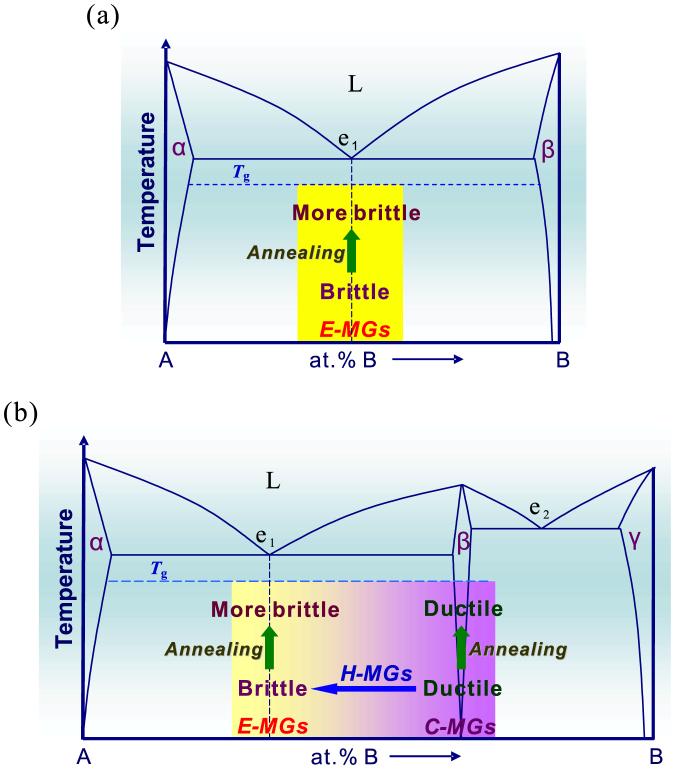
The high plasticity of metallic glasses is highly desirable for a wide range of novel engineering applications. However, the physical origin of the ductile/brittle behaviour of metallic glasses with various compositions and thermal histories has not been fully clarified. Here we have found that metallic glasses with compositions at or near intermetallic compounds, in contrast to the ones at or near eutectics, are extremely ductile and also insensitive to annealing-induced embrittlement. We have also proposed a close correlation between the element distribution features and the plasticity of metallic glasses by tracing the evolutions of the element distribution rearrangement and the corresponding potential energy change within the sliding shear band. These novel results provide useful and universal guidelines to search for new ductile metallic glasses at or near the intermetallic compound compositions in a number of glass-forming alloy systems.
金属玻璃的高可塑性对于广泛的新型工程应用而言极具吸引力。然而,具有不同成分和热历史的金属玻璃的韧性/脆性行为的物理起源尚未完全阐明。在此,我们发现与共晶点处或其附近的金属玻璃相比,金属间化合物处或其附近成分的金属玻璃具有极高的韧性,并且对退火诱导的脆化不敏感。通过追踪滑动剪切带内元素分布重排的演变以及相应的势能变化,我们还提出了元素分布特征与金属玻璃可塑性之间的紧密关联。这些新结果为在多种玻璃形成合金体系中寻找金属间化合物成分处或其附近的新型韧性金属玻璃提供了有用且通用的指导原则。


 Zotero 插件