Department of Mental Health, Johns Hopkins Bloomberg School of Public Health, 624 N. Broadway, Room 782, Baltimore, MD 21205, United States.
Int J Parasitol Drugs Drug Resist. 2014 Apr 5;4(2):118-25. doi: 10.1016/j.ijpddr.2014.03.002. eCollection 2014 Aug.
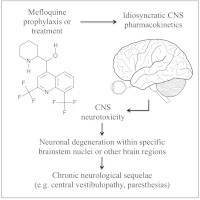
Mefloquine is a quinoline derivative antimalarial which demonstrates promise for the treatment of schistosomiasis. Traditionally employed in prophylaxis and treatment of chloroquine-resistant Plasmodium falciparum malaria, recent changes to the approved European and U.S. product labeling for mefloquine now warn of a risk of permanent and irreversible neurological sequelae including vertigo, loss of balance and symptoms of polyneuropathy. The newly described permanent nature of certain of these neurological effects challenges the conventional belief that they are due merely to the long half-life of mefloquine and its continued presence in the body, and raises new considerations for the rational use of the drug against parasitic disease. In this opinion, it is proposed that many of the reported lasting adverse neurological effects of mefloquine are consistent with the chronic sequelae of a well characterized but idiosyncratic central nervous system (CNS) toxicity syndrome (or toxidrome) common to certain historical antimalarial and antiparasitic quinolines and associated with a risk of permanent neuronal degeneration within specific CNS regions including the brainstem. Issues in the development and licensing of mefloquine are then considered in the context of historical awareness of the idiosyncratic CNS toxicity of related quinoline drugs. It is anticipated that the information presented in this opinion will aid in the future clinical recognition of the mefloquine toxidrome and its chronic sequelae, and in informing improved regulatory evaluation of mefloquine and related quinoline drugs as they are explored for expanded antiparasitic use and for other indications.
盐酸甲氟喹是一种奎宁衍生物类抗疟药,对治疗血吸虫病有一定疗效。传统上,盐酸甲氟喹用于预防和治疗耐氯喹恶性疟原虫疟疾。最近,欧洲和美国批准的盐酸甲氟喹产品标签发生变化,警告该药有发生永久性和不可逆转的神经后遗症的风险,包括眩晕、失去平衡和多发性神经病的症状。某些神经毒性的永久性特征新描述,对其仅仅由于盐酸甲氟喹半衰期长且持续存在于体内而引起的传统观点提出了挑战,也为针对寄生虫病合理使用该药提出了新的考虑。在本意见中,认为许多报道的盐酸甲氟喹持续不良神经影响与特定历史抗疟和抗寄生虫喹啉类药物中常见的、具有特征性但具有个体差异性的中枢神经系统(CNS)毒性综合征(或毒性症候群)的慢性后遗症一致,并伴有特定 CNS 区域(包括脑干)内神经元永久性退化的风险。随后,从历史上认识到相关喹啉类药物具有个体差异性的 CNS 毒性的角度,考虑了盐酸甲氟喹的开发和许可问题。预计本意见中提供的信息将有助于未来临床识别盐酸甲氟喹毒性症候群及其慢性后遗症,并为改善对盐酸甲氟喹和相关喹啉类药物的监管评估提供信息,这些药物正在探索用于扩大抗寄生虫用途和其他适应症。