Lileikyte Gabriele, Bakochi Anahita, Ali Ashfaq, Moseby-Knappe Marion, Cronberg Tobias, Friberg Hans, Lilja Gisela, Levin Helena, Årman Filip, Kjellström Sven, Dankiewicz Josef, Hassager Christian, Malmström Johan, Nielsen Niklas
Department of Clinical Sciences Lund, Anaesthesia and Intensive Care, Lund University, Helsingborg Hospital, Svartbrödragränden 3, 251 87, Helsingborg, Sweden.
Swedish National Infrastructure for Biological Mass Spectrometry (BioMS), Lund University, Lund, Sweden.
Intensive Care Med Exp. 2023 Jul 17;11(1):43. doi: 10.1186/s40635-023-00528-0.
Definition of temporal serum proteome profiles after out-of-hospital cardiac arrest may identify biological processes associated with severe hypoxia-ischaemia and reperfusion. It may further explore intervention effects for new mechanistic insights, identify candidate prognostic protein biomarkers and potential therapeutic targets. This pilot study aimed to investigate serum proteome profiles from unconscious patients admitted to hospital after out-of-hospital cardiac arrest according to temperature treatment and neurological outcome.
Serum samples at 24, 48, and 72 h after cardiac arrest at three centres included in the Target Temperature Management after out-of-hospital cardiac arrest trial underwent data-independent acquisition mass spectrometry analysis (DIA-MS) to find changes in serum protein concentrations associated with neurological outcome at 6-month follow-up and targeted temperature management (TTM) at 33 °C as compared to 36 °C. Neurological outcome was defined according to Cerebral Performance Category (CPC) scale as "good" (CPC 1-2, good cerebral performance or moderate disability) or "poor" (CPC 3-5, severe disability, unresponsive wakefulness syndrome, or death).
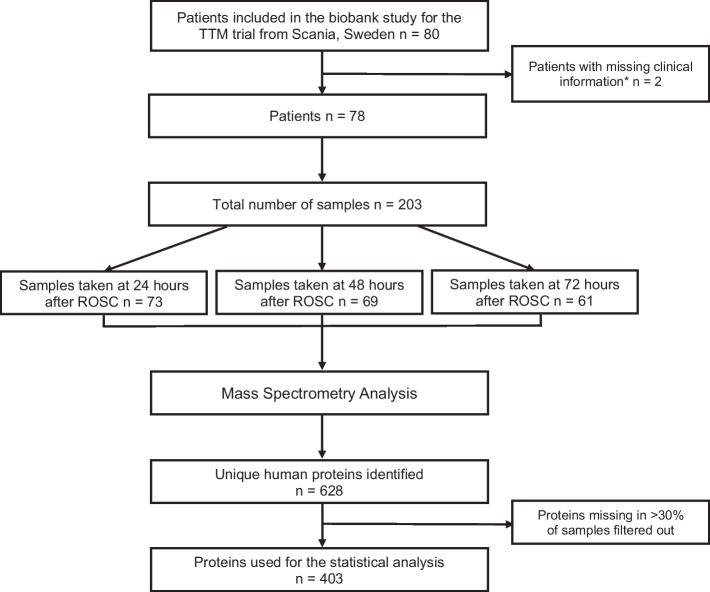
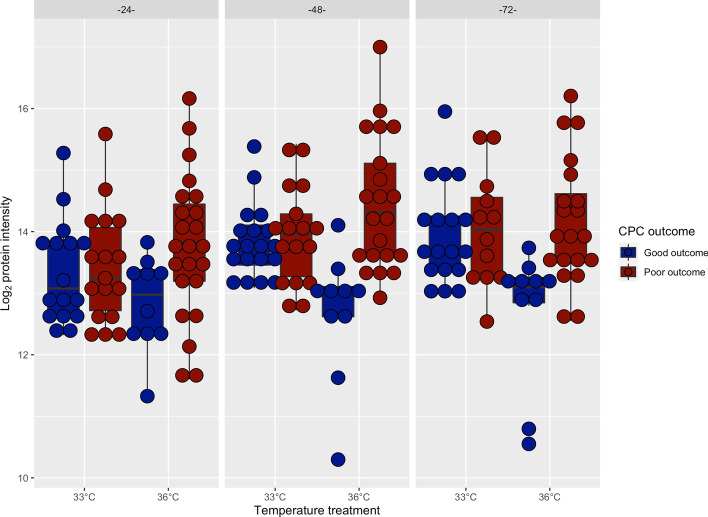
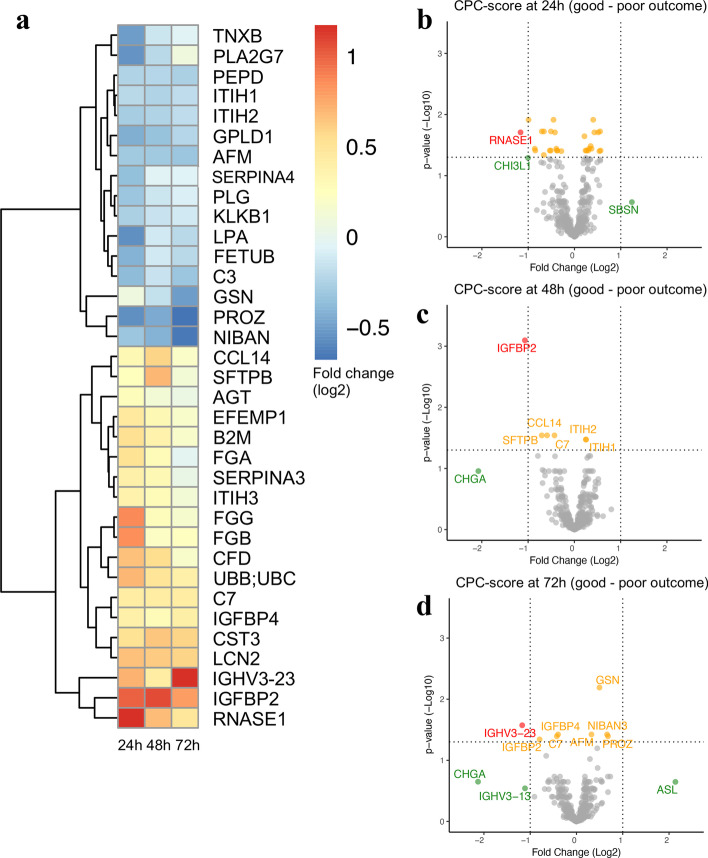
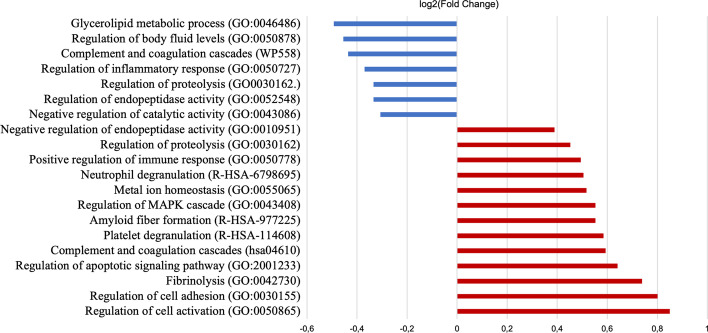
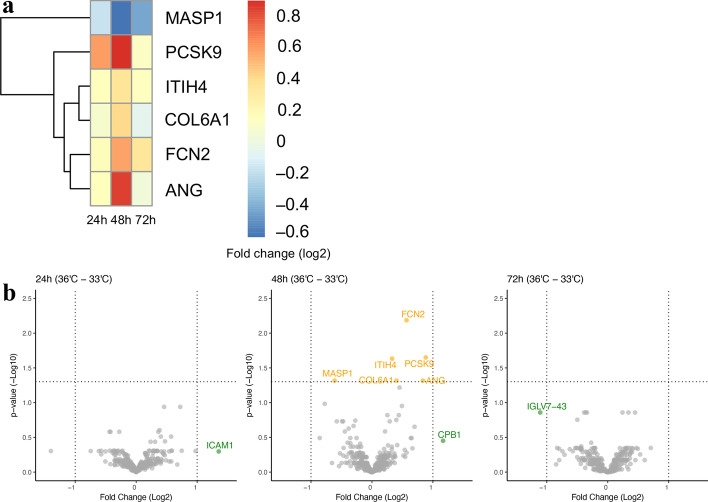
Of 78 included patients [mean age 66 ± 12 years, 62 (80.0%) male], 37 (47.4%) were randomised to TTM at 36 °C. Six-month outcome was poor in 47 (60.3%) patients. The DIA-MS analysis identified and quantified 403 unique human proteins. Differential protein abundance testing comparing poor to good outcome showed 19 elevated proteins in patients with poor outcome (log-fold change (FC) range 0.28-1.17) and 16 reduced proteins (log(FC) between - 0.22 and - 0.68), involved in inflammatory/immune responses and apoptotic signalling pathways for poor outcome and proteolysis for good outcome. Analysis according to level of TTM showed a significant protein abundance difference for six proteins [five elevated proteins in TTM 36 °C (log(FC) between 0.33 and 0.88), one reduced protein (log(FC) - 0.6)] mainly involved in inflammatory/immune responses only at 48 h after cardiac arrest.
Serum proteome profiling revealed an increase in inflammatory/immune responses and apoptosis in patients with poor outcome. In patients with good outcome, an increase in proteolysis was observed, whereas TTM-level only had a modest effect on the proteome profiles. Further validation of the differentially abundant proteins in response to neurological outcome is necessary to validate novel biomarker candidates that may predict prognosis after cardiac arrest.
院外心脏骤停后血清蛋白质组随时间变化的特征定义,可能有助于识别与严重缺氧缺血及再灌注相关的生物学过程。这可能进一步探索新机制的干预效果,识别候选的预后蛋白质生物标志物和潜在治疗靶点。这项前瞻性研究旨在根据体温治疗和神经学转归,调查院外心脏骤停后入院的昏迷患者的血清蛋白质组特征。
在院外心脏骤停后目标体温管理试验中的三个中心,采集心脏骤停后24、48和72小时的血清样本,进行非数据依赖采集质谱分析(DIA-MS),以发现与6个月随访时的神经学转归以及33℃与36℃的目标体温管理(TTM)相关的血清蛋白浓度变化。神经学转归根据脑功能分类(CPC)量表定义为“良好”(CPC 1-2,脑功能良好或中度残疾)或“不良”(CPC 3-5,严重残疾、无反应觉醒综合征或死亡)。
纳入的78例患者[平均年龄66±12岁,62例(80.0%)为男性]中,37例(47.4%)被随机分配至36℃的TTM组。47例(60.3%)患者6个月时转归不良。DIA-MS分析鉴定并定量了403种独特的人类蛋白质。比较不良与良好转归的差异蛋白质丰度检测显示,转归不良的患者中有19种蛋白质升高(对数倍变化(FC)范围为0.28-1.17),16种蛋白质降低(对数(FC)在-0.22至-0.68之间),不良转归涉及炎症/免疫反应和凋亡信号通路,良好转归涉及蛋白水解。根据TTM水平分析显示,六种蛋白质存在显著的蛋白质丰度差异[36℃的TTM组中有五种蛋白质升高(对数(FC)在0.33至0.88之间),一种蛋白质降低(对数(FC)-0.6)],主要仅在心脏骤停后48小时涉及炎症/免疫反应。
血清蛋白质组分析显示,转归不良的患者炎症/免疫反应和凋亡增加。转归良好的患者中观察到蛋白水解增加,而TTM水平对蛋白质组特征的影响较小。有必要进一步验证差异丰度蛋白质对神经学转归的反应,以验证可能预测心脏骤停后预后的新型生物标志物候选物。