Department of Orthopaedic Surgery, Canada East Spine Centre, Saint John Regional Hospital, Saint John, New Brunswick, Canada ; Department of Medicine, Dalhousie University, Halifax, Nova Scotia, Canada ; Faculty of Medicine, Memorial University of Newfoundland, Newfoundland, Canada.
Department of Orthopaedic Surgery, Canada East Spine Centre, Saint John Regional Hospital, Saint John, New Brunswick, Canada.
Global Spine J. 2014 Jun;4(2):83-8. doi: 10.1055/s-0034-1370693. Epub 2014 Feb 25.
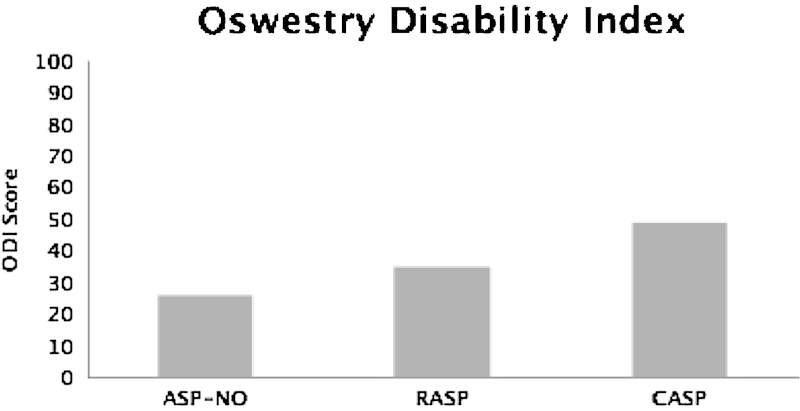
Study Design Retrospective cohort study. Objective To identify the incidence of adjacent segment pathology (ASP) after thoracolumbar fusion of three or more levels, the risk factors for the development of ASP, and the need for further surgical intervention in this particular patient population. Methods A retrospective analysis of a prospective surgical database identified 217 patients receiving polysegmental (≥ 3 levels) spinal fusion with minimum 5-year follow-up. Risk factors were evaluated, and the following data were obtained from the review of radiographs and charts: radiographic measures-levels fused, fusion status, presence of ASP; clinical measures-patient assessment, Oswestry Disability Index (ODI), and the need for further surgery. Results The incidence of radiographic ASP (RASP) was 29%; clinical or symptomatic ASP (CASP), 18%; and those requiring surgery, 9%. Correlation was observed between ODI and ASP, symptomatic ASP, and need for revision surgery. Age, preoperative degenerative diagnosis, and absence of fusion demonstrated significant association to ASP. Conclusions ASP was observed in a significant number of patients receiving polysegmental fusion of three or more levels. ODI scores correlated to RASP, CASP, and the need for revision surgery.
回顾性队列研究。目的:确定三个或更多节段的胸腰椎融合术后发生邻近节段病变(ASP)的发生率、发展为 ASP 的危险因素以及该特定患者人群中进一步手术干预的必要性。方法:对前瞻性手术数据库进行回顾性分析,共纳入 217 例接受多节段(≥3 个节段)脊柱融合术且至少随访 5 年的患者。评估了危险因素,并通过对影像学和图表的回顾获得以下数据:融合节段数、融合状态、ASP 存在情况;临床评估指标-患者评估、Oswestry 功能障碍指数(ODI)和进一步手术的需求。结果:影像学 ASP(RASP)的发生率为 29%;临床或有症状的 ASP(CASP)为 18%;需要手术的为 9%。ODI 与 ASP、有症状的 ASP 和需要翻修手术之间存在相关性。年龄、术前退行性诊断以及融合缺失与 ASP 显著相关。结论:在接受三个或更多节段多节段融合的患者中,观察到大量发生 ASP。ODI 评分与 RASP、CASP 和需要翻修手术相关。