
即时工具整合过程决定了人类使用工具的运动规划。
Immediate tool incorporation processes determine human motor planning with tools.
作者信息
Ganesh G, Yoshioka T, Osu R, Ikegami T
机构信息
1] Center for Information and Neural Networks (CiNet), National Institute of Information and Communications Technology, 1-4 Yamadaoka, Osaka University Campus, Suita 5650871, Japan [2] CNRS-AIST JRL (Joint Robotics Laboratory), UMI3218/CRT, Intelligent Systems Research Institute, National Institute of Advanced Industrial Science and Technology (AIST) Tsukuba Central 2, 1-1-1 Umezono, Tsukuba, Ibaraki 305-8568, Japan.
ATR Brain Information Communications research Laboratories, 2-2-2 Hikaridai, Seika-cho, Soraku-gun, Kyoto 6190288, Japan.
出版信息
Nat Commun. 2014 Jul 31;5:4524. doi: 10.1038/ncomms5524.
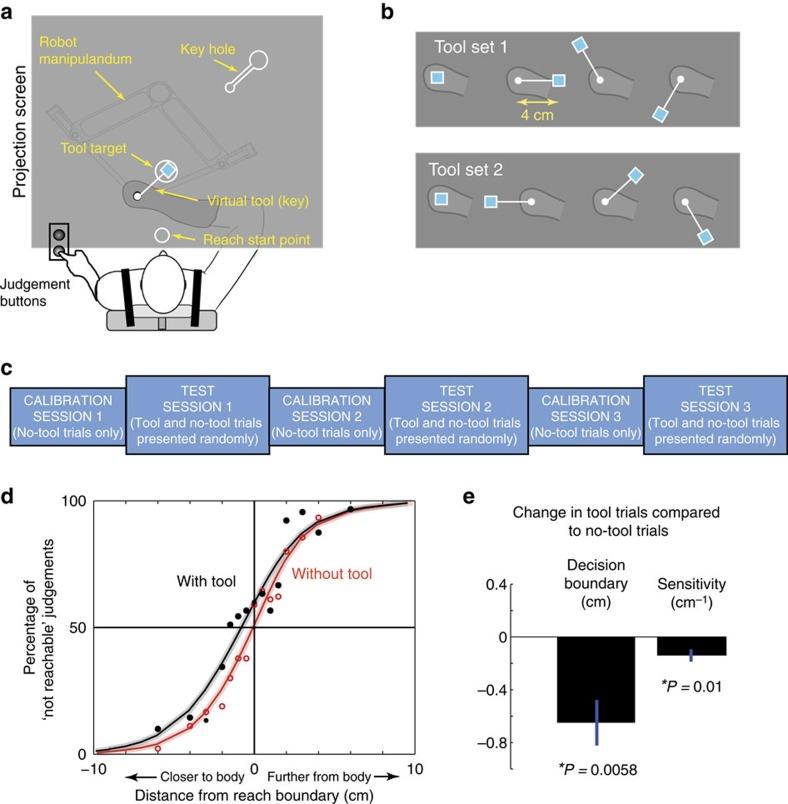
Human dexterity with tools is believed to stem from our ability to incorporate and use tools as parts of our body. However tool incorporation, evident as extensions in our body representation and peri-personal space, has been observed predominantly after extended tool exposures and does not explain our immediate motor behaviours when we change tools. Here we utilize two novel experiments to elucidate the presence of additional immediate tool incorporation effects that determine motor planning with tools. Interestingly, tools were observed to immediately induce a trial-by-trial, tool length dependent shortening of the perceived limb lengths, opposite to observations of elongations after extended tool use. Our results thus exhibit that tools induce a dual effect on our body representation; an immediate shortening that critically affects motor planning with a new tool, and the slow elongation, probably a consequence of skill related changes in sensory-motor mappings with the repeated use of the tool.
人类使用工具的灵巧性被认为源于我们将工具纳入并作为身体一部分使用的能力。然而,工具纳入表现为身体表征和个人周边空间的扩展,主要是在长时间接触工具后才被观察到,并且无法解释我们更换工具时的即时运动行为。在此,我们利用两个新颖的实验来阐明额外的即时工具纳入效应的存在,这些效应决定了使用工具时的运动规划。有趣的是,观察到工具会立即逐次试验地、根据工具长度导致感知肢体长度缩短,这与长时间使用工具后观察到的伸长现象相反。因此,我们的结果表明,工具对我们的身体表征产生双重影响;一种即时缩短会严重影响使用新工具时的运动规划,而缓慢的伸长可能是由于随着工具的重复使用,感觉运动映射中与技能相关的变化所致。



 Zotero 插件