
群体药物给药对埃及血吸虫保护性免疫发展的预测影响。
Predicted impact of mass drug administration on the development of protective immunity against Schistosoma haematobium.
作者信息
Mitchell Kate M, Mutapi Francisca, Mduluza Takafira, Midzi Nicholas, Savill Nicholas J, Woolhouse Mark E J
机构信息
Centre for Immunity, Infection and Evolution, Institute of Immunology and Infection Research, School of Biological Sciences, University of Edinburgh, Edinburgh, United Kingdom.
Department of Biochemistry, University of Zimbabwe, Harare, Zimbabwe; College of Health Sciences, University of KwaZulu Natal, Durban, South Africa.
出版信息
PLoS Negl Trop Dis. 2014 Jul 31;8(7):e3059. doi: 10.1371/journal.pntd.0003059. eCollection 2014.
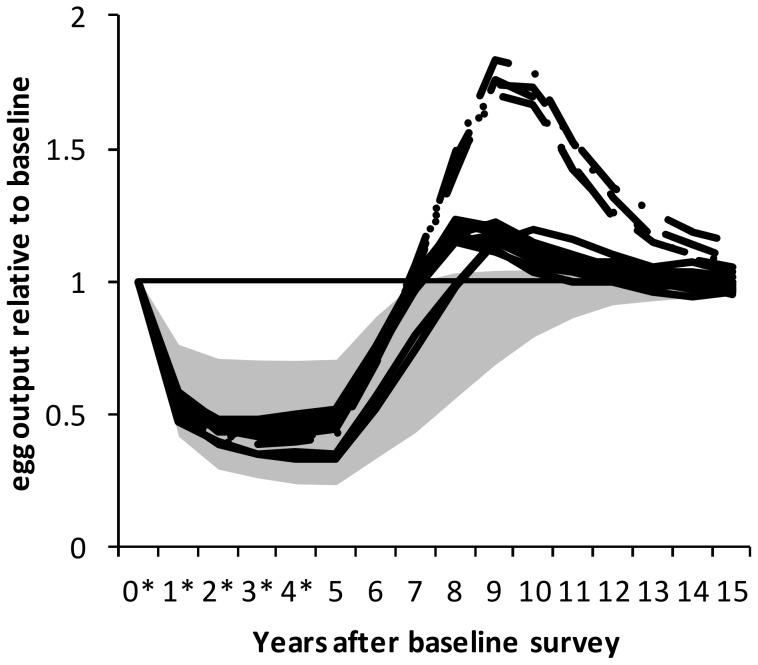
Previous studies suggest that protective immunity against Schistosoma haematobium is primarily stimulated by antigens from dying worms. Praziquantel treatment kills adult worms, boosting antigen exposure and protective antibody levels. Current schistosomiasis control efforts use repeated mass drug administration (MDA) of praziquantel to reduce morbidity, and may also reduce transmission. The long-term impact of MDA upon protective immunity, and subsequent effects on infection dynamics, are not known. A stochastic individual-based model describing levels of S. haematobium worm burden, egg output and protective parasite-specific antibody, which has previously been fitted to cross-sectional and short-term post-treatment egg count and antibody patterns, was used to predict dynamics of measured egg output and antibody during and after a 5-year MDA campaign. Different treatment schedules based on current World Health Organisation recommendations as well as different assumptions about reductions in transmission were investigated. We found that antibody levels were initially boosted by MDA, but declined below pre-intervention levels during or after MDA if protective immunity was short-lived. Following cessation of MDA, our models predicted that measured egg counts could sometimes overshoot pre-intervention levels, even if MDA had had no effect on transmission. With no reduction in transmission, this overshoot occurred if protective immunity was short-lived. This implies that disease burden may temporarily increase following discontinuation of treatment, even in the absence of any reduction in the overall transmission rate. If MDA was additionally assumed to reduce transmission, a larger overshoot was seen across a wide range of parameter combinations, including those with longer-lived protective immunity. MDA may reduce population levels of immunity to urogenital schistosomiasis in the long-term (3-10 years), particularly if transmission is reduced. If MDA is stopped while S. haematobium is still being transmitted, large rebounds (up to a doubling) in egg counts could occur.
先前的研究表明,针对埃及血吸虫的保护性免疫主要由垂死蠕虫的抗原激发。吡喹酮治疗可杀死成虫,增加抗原暴露和保护性抗体水平。当前的血吸虫病控制措施采用反复大规模药物施用(MDA)吡喹酮来降低发病率,也可能减少传播。MDA对保护性免疫的长期影响以及随后对感染动态的影响尚不清楚。一个基于个体的随机模型,描述了埃及血吸虫虫负荷、虫卵产量和保护性寄生虫特异性抗体水平,该模型先前已根据横断面和治疗后短期虫卵计数及抗体模式进行拟合,用于预测5年MDA运动期间及之后实测虫卵产量和抗体的动态变化。研究了基于世界卫生组织当前建议的不同治疗方案以及关于传播减少的不同假设。我们发现,MDA最初会提高抗体水平,但如果保护性免疫持续时间较短,在MDA期间或之后抗体水平会降至干预前水平以下。MDA停止后,我们的模型预测,即使MDA对传播没有影响,实测虫卵计数有时也可能超过干预前水平。在没有传播减少的情况下,如果保护性免疫持续时间较短,就会出现这种超调现象。这意味着即使在总体传播率没有任何降低的情况下,停止治疗后疾病负担可能会暂时增加。如果额外假设MDA会减少传播,在广泛的参数组合中,包括那些具有较长寿命保护性免疫的组合,会出现更大的超调现象。从长期来看(3 - 10年),MDA可能会降低人群对泌尿生殖系统血吸虫病的免疫水平,特别是在传播减少的情况下。如果在埃及血吸虫仍在传播时停止MDA,虫卵计数可能会大幅反弹(高达翻倍)。



 Zotero 插件