Biomedical Research Center EPLS, Saint Louis, Senegal.
CIIL-Center for Infection and Immunity of Lille, Institut Pasteur de Lille, Univ. Lille, CNRS UMR, Inserm U1019-Lille, France.
PLoS Negl Trop Dis. 2018 Dec 7;12(12):e0006968. doi: 10.1371/journal.pntd.0006968. eCollection 2018 Dec.
Urinary schistosomiasis, the result of infection by Schistosoma haematobium (Sh), remains a major global health concern. A schistosome vaccine could represent a breakthrough in schistosomiasis control strategies, which are presently based on treatment with praziquantel (PZQ). We report the safety and efficacy of the vaccine candidate recombinant 28-kDa glutathione S-transferase of Sh (rSh28GST) designated as Bilhvax, in a phase 3 trial conducted in Senegal.
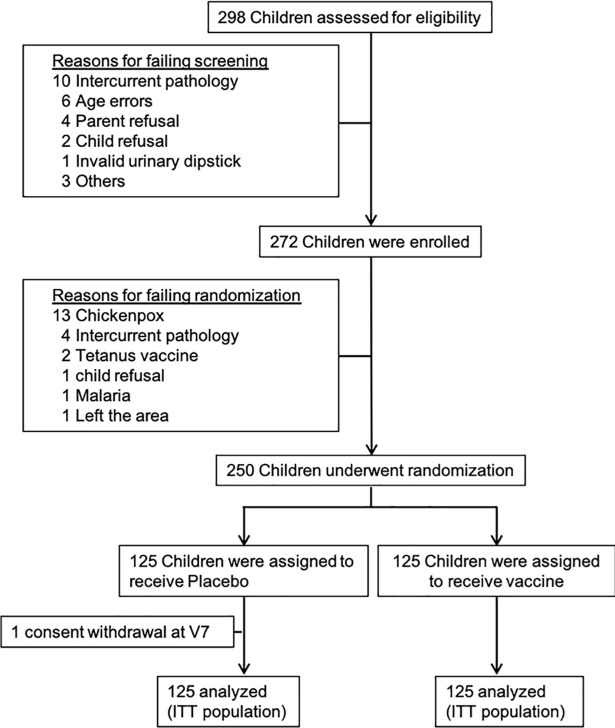
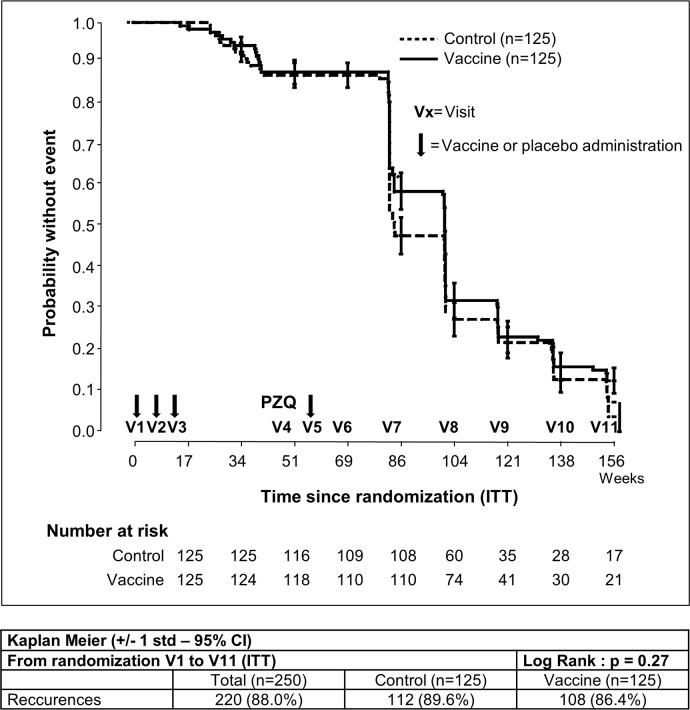
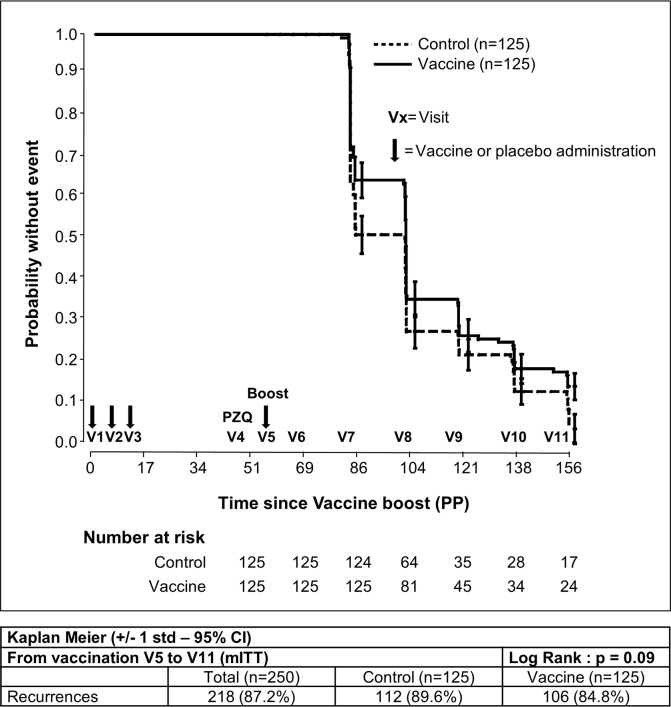
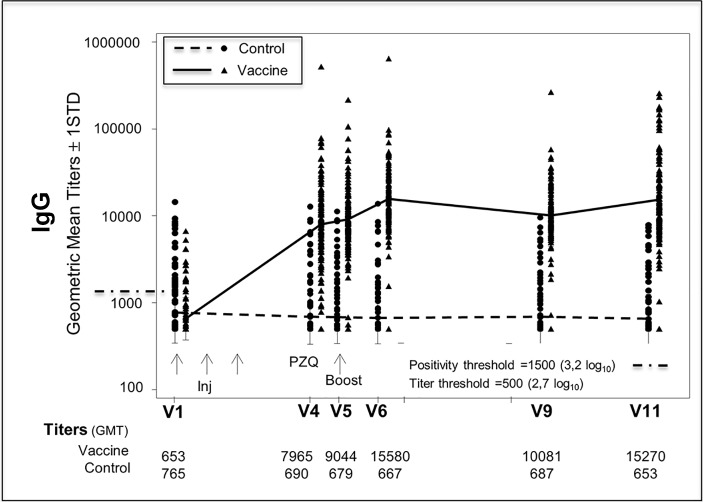
After clearance of their ongoing schistosomiasis infection with two doses of PZQ, 250 children aged 6-9 years were randomized to receive three subcutaneous injections of either rSh28GST/Alhydrogel (Bilhvax group) or Alhydrogel alone (control group) at week 0 (W0), W4, and W8 and then a booster at W52 (one year after the first injection). PZQ treatment was given at W44, according to previous phase 2 results. The primary endpoint of the analysis was efficacy, evaluated as a delay of recurrence of urinary schistosomiasis, defined by a microhematuria associated with at least one living Sh egg in urine from baseline to W152. During the 152-week follow-up period, there was no difference between study arms in the incidence of serious adverse events. The median follow-up time for subjects without recurrence was 22.9 months for the Bilhvax group and 18.8 months for the control group (log-rank p = 0.27). At W152, 108 children had experienced at least one recurrence in the Bilhvax group versus 112 in the control group. Specific immunoglobulin (Ig)G1, IgG2, and IgG4, but not IgG3 or IgA titers, were increased in the vaccine group.
While Bilhvax was immunogenic and well tolerated by infected children, a sufficient efficacy was not reached. The lack of effect may be the result of several factors, including interference by individual PZQ treatments administered each time a child was found infected, or the chosen vaccine-injection regimen favoring blocking IgG4 rather than protective IgG3 antibodies. These observations contrasting with results obtained in experimental models will help in the design of future trials.
ClinicalTrials.gov NCT 00870649.
由埃及血吸虫(Schistosoma haematobium,Sh)感染引起的尿路血吸虫病仍然是一个主要的全球健康问题。血吸虫疫苗的出现可能是血吸虫病控制策略的一个突破,目前的控制策略主要是基于使用吡喹酮(PZQ)进行治疗。我们报告了在塞内加尔进行的 3 期试验中,Sh 重组 28kDa 谷胱甘肽 S-转移酶(rSh28GST)疫苗候选物被称为 Bilhvax 的安全性和疗效。
在接受两剂 PZQ 清除正在进行的血吸虫病感染后,250 名 6-9 岁的儿童被随机分为两组,分别接受 rSh28GST/Alhydrogel(Bilhvax 组)或单独的 Alhydrogel(对照组)三次皮下注射,时间分别为第 0 周(W0)、第 4 周(W4)和第 8 周(W8),然后在第 52 周(第一次注射后一年)进行加强注射。根据之前的 2 期结果,在第 44 周时给予 PZQ 治疗。分析的主要终点是疗效,定义为从基线到第 152 周时微血尿(伴有至少一个活的 Sh 卵)的复发延迟。在 152 周的随访期间,两组之间在严重不良事件的发生率方面没有差异。Bilhvax 组无复发的中位随访时间为 22.9 个月,对照组为 18.8 个月(对数秩检验,p=0.27)。在第 152 周时,Bilhvax 组有 108 名儿童至少经历了一次复发,而对照组有 112 名儿童。疫苗组特异性免疫球蛋白(Ig)G1、IgG2 和 IgG4,但不是 IgG3 或 IgA 滴度增加。
虽然 Bilhvax 对感染的儿童具有免疫原性且耐受性良好,但没有达到足够的疗效。这种效果的缺乏可能是由于几个因素造成的,包括每次发现儿童感染时进行的个体 PZQ 治疗的干扰,或者选择的疫苗注射方案有利于阻断 IgG4,而不是保护性 IgG3 抗体。这些与实验模型中获得的结果相矛盾的观察结果将有助于未来试验的设计。
ClinicalTrials.gov NCT 00870649。