London Centre for Neglected Tropical Disease Research, London, United Kingdom.
Department of Infectious Disease Epidemiology, School of Public Health, Faculty of Medicine, St Mary's Campus, Imperial College London, London, United Kingdom.
PLoS Negl Trop Dis. 2021 Dec 1;15(12):e0009946. doi: 10.1371/journal.pntd.0009946. eCollection 2021 Dec.
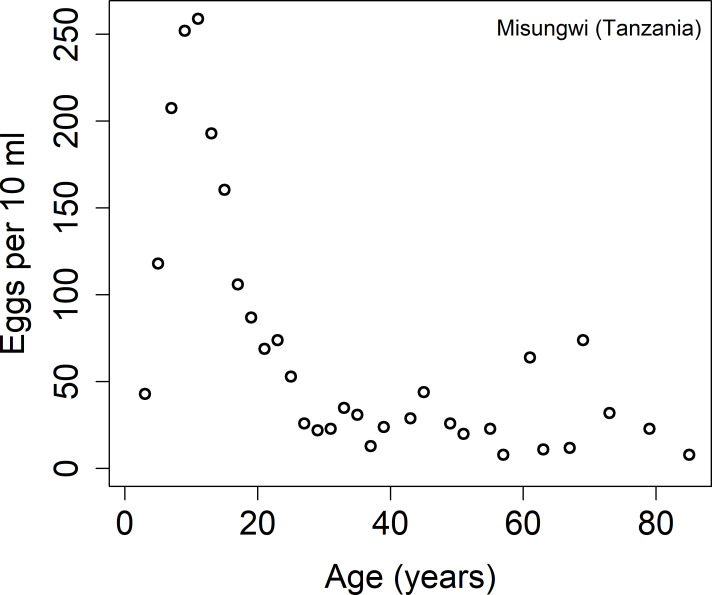
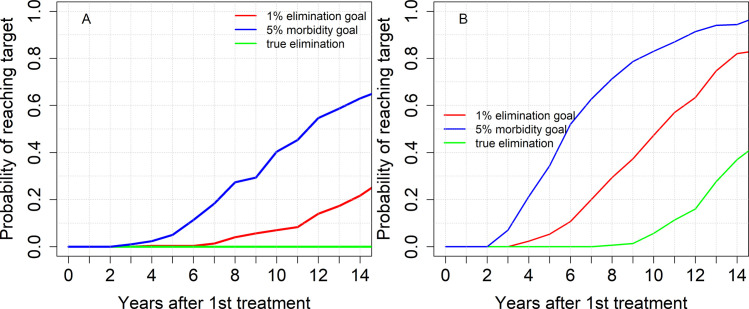
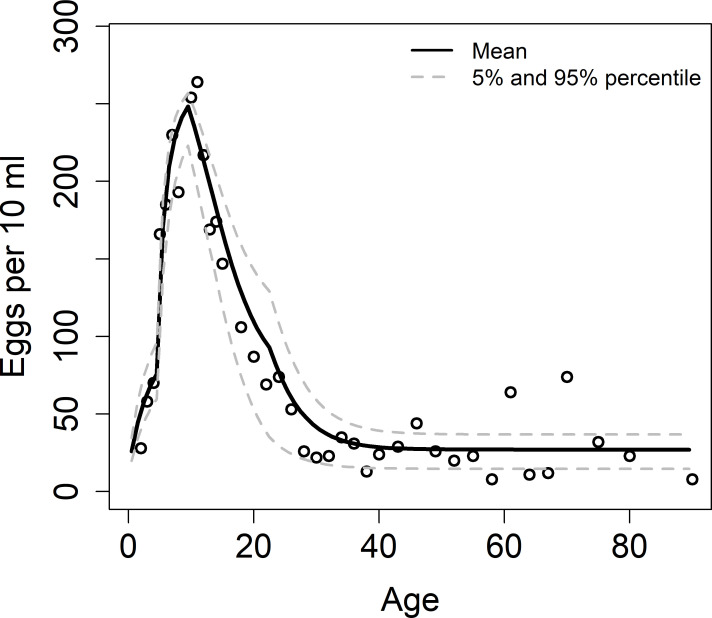
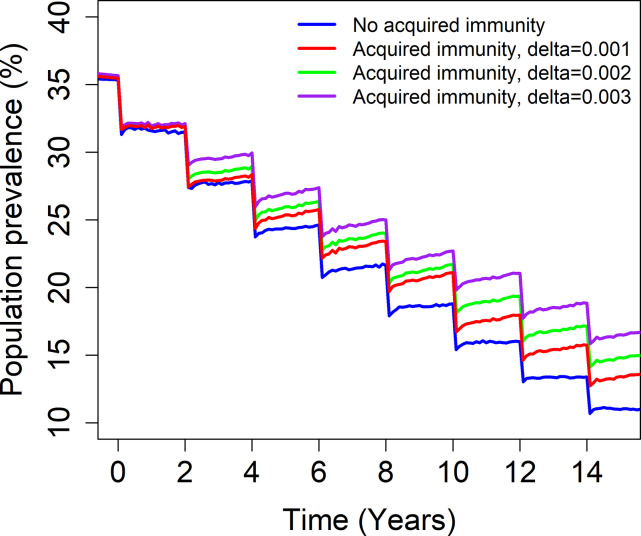
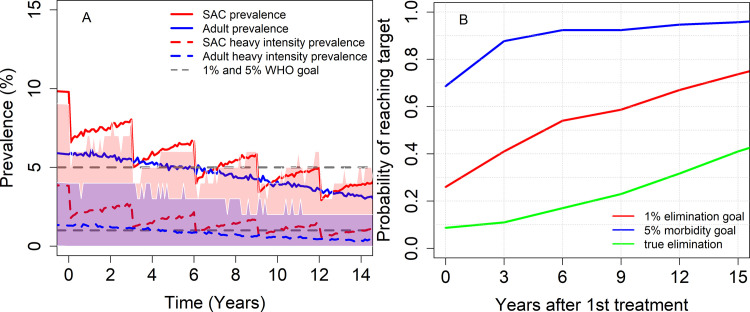
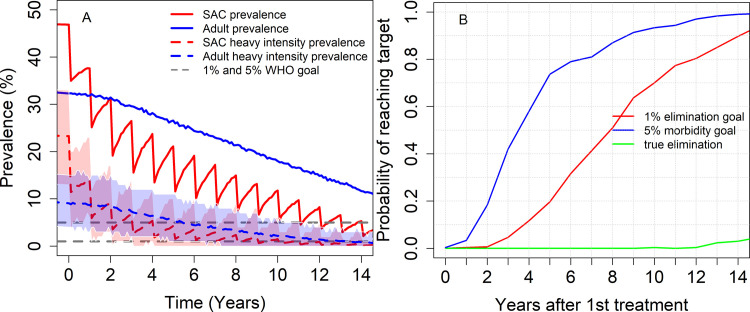
Schistosomiasis causes severe morbidity in many countries with endemic infection with the schistosome digenean parasites in Africa and Asia. To control and eliminate the disease resulting from infection, regular mass drug administration (MDA) is used, with a focus on school-aged children (SAC; 5-14 years of age). In some high transmission settings, the World Health Organization (WHO) also recommends the inclusion of at-risk adults in MDA treatment programmes. The question of whether ecology (age-dependant exposure) or immunity (resistance to reinfection), or some combination of both, determines the form of observed convex age-intensity profile is still unresolved, but there is a growing body of evidence that the human hosts acquire some partial level of immunity after a long period of repeated exposure to infection. In the majority of past research modelling schistosome transmission and the impact of MDA programmes, the effect of acquired immunity has not been taken into account. Past work has been based on the assumption that age-related contact rates generate convex horizontal age-intensity profiles. In this paper, we use an individual based stochastic model of transmission and MDA impact to explore the effect of acquired immunity in defined MDA programmes. Compared with scenarios with no immunity, we find that acquired immunity makes the MDA programme less effective with a slower decrease in the prevalence of infection. Therefore, the time to achieve morbidity control and elimination as a public health problem is longer than predicted by models with just age-related exposure and no build-up of immunity. The level of impact depends on the baseline prevalence prior to treatment (the magnitude of the basic reproductive number R0) and the treatment frequency, among other factors. We find that immunity has a larger impact within moderate to high transmission settings such that it is very unlikely to achieve morbidity and transmission control employing current MDA programmes.
血吸虫病在非洲和亚洲的一些流行感染的国家会导致严重的发病率。为了控制和消除因感染而导致的疾病,经常采用大规模药物治疗(MDA),重点是学龄儿童(SAC;5-14 岁)。在一些高传播环境中,世界卫生组织(WHO)还建议将高危成年人纳入 MDA 治疗方案。决定观察到的凸形年龄-强度曲线形式的是生态学(年龄依赖的暴露)还是免疫力(对再感染的抵抗力),或者是两者的某种组合,这个问题仍未解决,但越来越多的证据表明,人类宿主在长期反复暴露于感染后会获得一定程度的部分免疫力。在过去大多数研究血吸虫病传播和 MDA 方案影响的模型中,并未考虑获得性免疫的影响。过去的工作基于这样的假设,即年龄相关的接触率会产生凸形水平年龄-强度曲线。在本文中,我们使用基于个体的传播和 MDA 影响的随机模型来探讨在明确的 MDA 方案中获得性免疫的作用。与没有免疫力的情况相比,我们发现获得性免疫会降低 MDA 方案的有效性,感染的流行率下降速度较慢。因此,实现发病率控制和消除作为公共卫生问题所需的时间比仅考虑年龄相关暴露且没有免疫力积累的模型预测的要长。影响的程度取决于治疗前的基线流行率(基本繁殖数 R0 的大小)和治疗频率等因素。我们发现,在中等到高传播环境中,免疫力的影响更大,因此,采用当前的 MDA 方案非常不可能实现发病率和传播控制。