Aghaizu Adamma, Reid Fiona, Kerry Sally, Hay Phillip E, Mallinson Harry, Jensen Jorgen S, Kerry Sarah, Kerry Sheila, Oakeshott Pippa
Division of Population Health Sciences, St George's, University of London, London, UK HIV & STI Department, Centre for Infectious Disease Surveillance and Control, Public Health England, London, UK.
Division of Population Health Sciences, St George's, University of London, London, UK.
Sex Transm Infect. 2014 Nov;90(7):524-8. doi: 10.1136/sextrans-2014-051607. Epub 2014 Aug 6.
To investigate the frequency and risk factors for incident and redetected Chlamydia trachomatis infection in sexually active, young, multi-ethnic women in the community.
Cohort study.
20 London universities and Further Education colleges.
954 sexually experienced women, mean age 21.5 years (range 16-27), 26% from ethnic minorities, who were recruited to the Prevention of Pelvic Infection (POPI) chlamydia screening trial between 2004 and 2006, and returned repeat postal self-taken vaginal swabs 11-32 (median 16) months after recruitment.
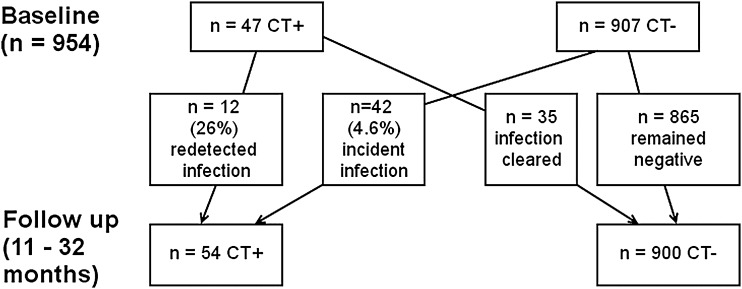
The estimated annual incidence of chlamydia infection among 907 women who tested negative at baseline was 3.4 per 100 person-years (95% CI 2.5 to 4.6 per 100 person-years), but 6.6 per 100 person-years (95% CI 4.5 to 9.3 per 100 person-years) in the 326 teenagers (<20 years). Predictors of incident chlamydia infection were age <20 years (relative risk (RR) 4.0, 95% CI 2.1 to 7.5), and (after adjusting for age) a new sexual partner during 12 months follow-up (RR 4.4, 95% CI 2.0 to 9.9), smoking (RR 2.2 95% CI 1.2 to 3.9), concurrent bacterial vaginosis (RR 2.0 95% CI 1.1 to 3.9) and high risk carcinogenic human papillomavirus (RR 2.2, 95% CI 1.1 to 4.3). Of 47 women positive for chlamydia at baseline, 12 (25.5%, 95% CI 13.9% to 40.3%) had redetected infection at a median of 16 months follow-up. Taking into account follow-up time (65 person-years), the annual redetection rate was 18.5 per 100 person-years (95% CI 9.9 to 30.0 per 100 person-years).
One in four women with chlamydia infection at baseline retested positive, supporting recent recommendations to routinely retest chlamydia positives.
调查社区中年轻、性活跃、多民族女性沙眼衣原体感染新发及再检出的频率和危险因素。
队列研究。
20所伦敦大学和继续教育学院。
954名有性经历的女性,平均年龄21.5岁(范围16 - 27岁),26%为少数民族,她们于2004年至2006年期间被招募至盆腔感染预防(POPI)衣原体筛查试验,并在招募后11 - 32个月(中位数16个月)通过邮寄方式自行采集阴道拭子进行复查。
在907名基线检测为阴性的女性中,衣原体感染的估计年发病率为每100人年3.4例(95%可信区间为每100人年2.5至4.6例),但在326名青少年(<20岁)中为每100人年6.6例(95%可信区间为每100人年4.5至9.3例)。衣原体感染新发的预测因素为年龄<20岁(相对危险度(RR)4.0,95%可信区间2.1至7.5),以及(在调整年龄后)随访12个月内有新的性伴侣(RR 4.4,95%可信区间2.0至9.9)、吸烟(RR 2.2,95%可信区间1.2至3.9)、同时患有细菌性阴道病(RR 2.0,95%可信区间1.1至3.9)和高危致癌性人乳头瘤病毒(RR 2.2,95%可信区间1.1至4.3)。在47名基线衣原体检测呈阳性的女性中,12名(25.5%,95%可信区间13.9%至40.3%)在随访中位数16个月时再次检测出感染。考虑到随访时间(65人年),年再检出率为每100人年18.5例(95%可信区间为每100人年9.9至30.0例)。
四分之一基线衣原体感染的女性复查结果呈阳性,支持近期关于对衣原体阳性者进行常规复查的建议。