Conway Jessica M, Perelson Alan S
Theoretical Biology and Biophysics, Los Alamos National Laboratory, Los Alamos, New Mexico, United States of America.
PLoS Comput Biol. 2014 Aug 7;10(8):e1003769. doi: 10.1371/journal.pcbi.1003769. eCollection 2014 Aug.
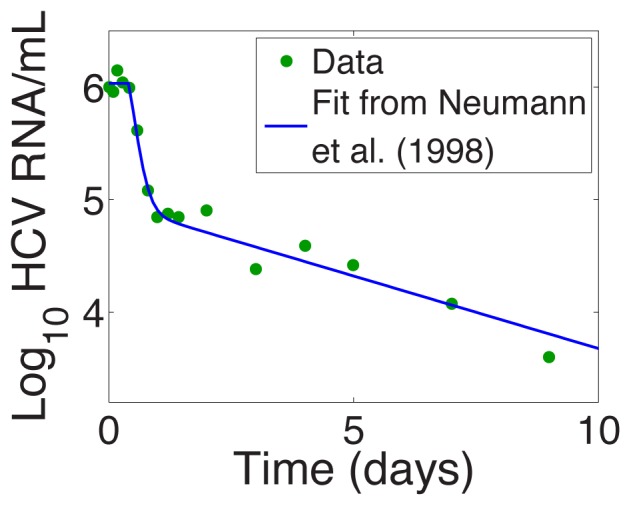
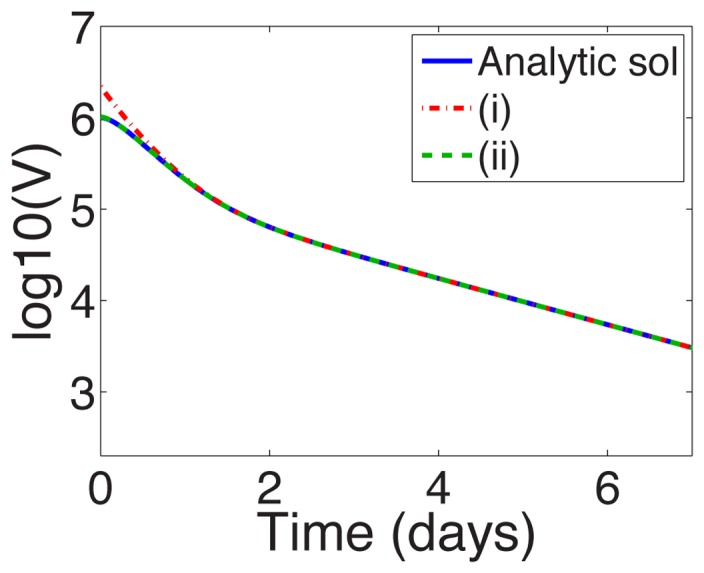
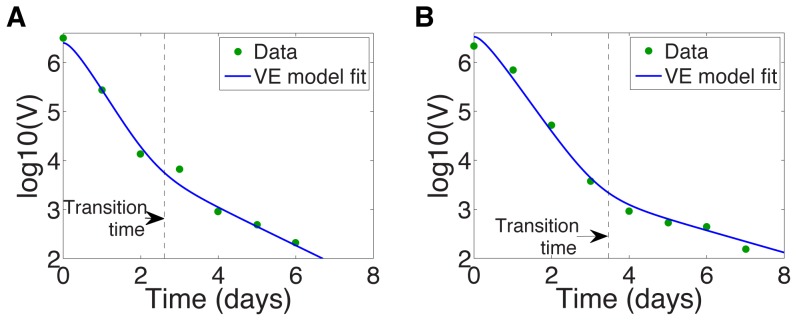
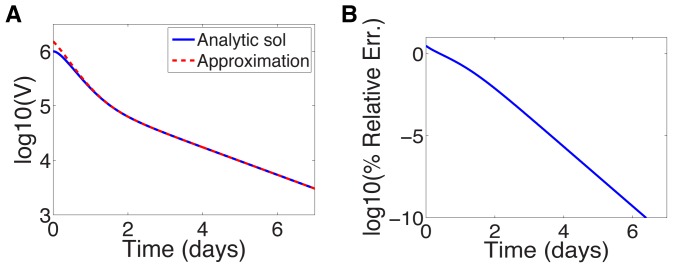
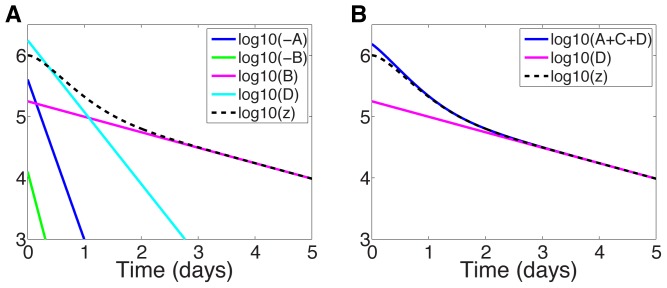
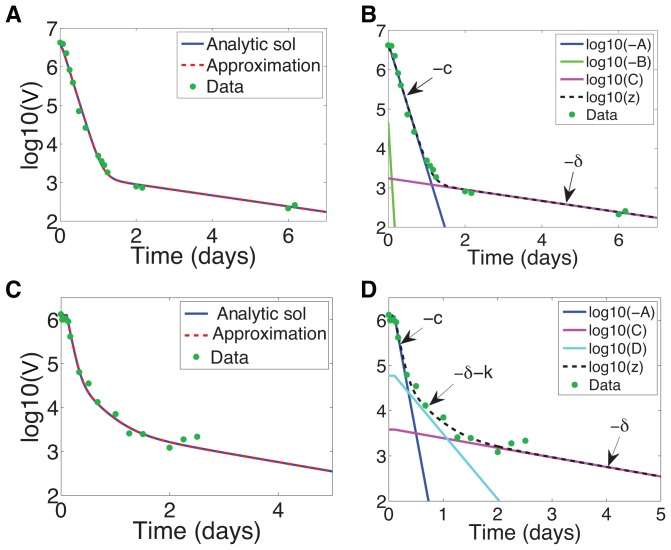
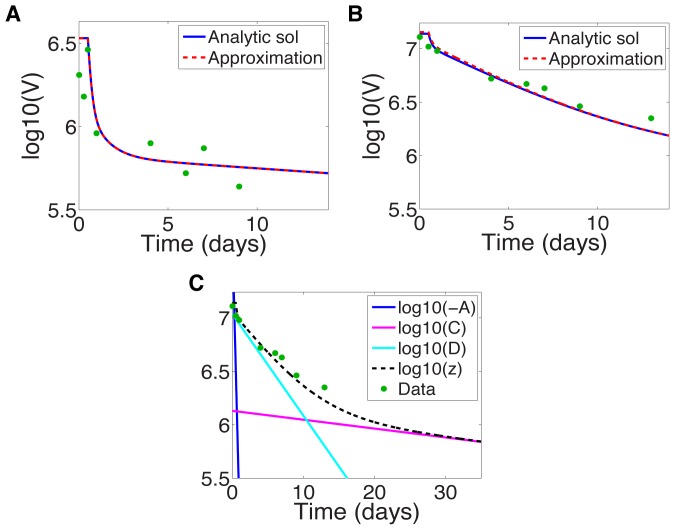
Simple models of therapy for viral diseases such as hepatitis C virus (HCV) or human immunodeficiency virus assume that, once therapy is started, the drug has a constant effectiveness. More realistic models have assumed either that the drug effectiveness depends on the drug concentration or that the effectiveness varies over time. Here a previously introduced varying-effectiveness (VE) model is studied mathematically in the context of HCV infection. We show that while the model is linear, it has no closed-form solution due to the time-varying nature of the effectiveness. We then show that the model can be transformed into a Bessel equation and derive an analytic solution in terms of modified Bessel functions, which are defined as infinite series, with time-varying arguments. Fitting the solution to data from HCV infected patients under therapy has yielded values for the parameters in the model. We show that for biologically realistic parameters, the predicted viral decay on therapy is generally biphasic and resembles that predicted by constant-effectiveness (CE) models. We introduce a general method for determining the time at which the transition between decay phases occurs based on calculating the point of maximum curvature of the viral decay curve. For the parameter regimes of interest, we also find approximate solutions for the VE model and establish the asymptotic behavior of the system. We show that the rate of second phase decay is determined by the death rate of infected cells multiplied by the maximum effectiveness of therapy, whereas the rate of first phase decline depends on multiple parameters including the rate of increase of drug effectiveness with time.
诸如丙型肝炎病毒(HCV)或人类免疫缺陷病毒等病毒性疾病的简单治疗模型假定,一旦开始治疗,药物就具有恒定的疗效。更现实的模型则假定药物疗效要么取决于药物浓度,要么随时间变化。在此,在HCV感染的背景下对先前引入的变疗效(VE)模型进行数学研究。我们表明,虽然该模型是线性的,但由于疗效随时间变化的性质,它没有封闭形式的解。然后我们表明该模型可以转化为贝塞尔方程,并根据修正贝塞尔函数推导解析解,这些函数被定义为具有随时间变化自变量的无穷级数。将该解与接受治疗的HCV感染患者的数据拟合得出了模型中的参数值。我们表明,对于生物学上现实的参数,治疗期间预测的病毒衰减通常是双相的,并且类似于恒定疗效(CE)模型预测的情况。我们引入了一种基于计算病毒衰减曲线最大曲率点来确定衰减阶段之间转变时间的通用方法。对于感兴趣的参数范围,我们还找到了VE模型的近似解并确定了系统的渐近行为。我们表明,第二阶段衰减的速率由被感染细胞的死亡率乘以治疗的最大疗效决定,而第一阶段下降的速率取决于多个参数,包括药物疗效随时间的增加速率。