Baranwal Akash Kumar, Paul Mohan L, Mazumdar Dibyendu, Adhikari Haridas Das, Vyavahare Nishant K, Jhajharia Kapil
Department of Conservative Dentistry and Endodontics, Faculty of Dental Sciences, IMS, BHU, Varanasi, Uttar Pradesh, India.
Department of Conservative Dentistry and Endodontics, Dr. R. Ahmed Dental College and Hospital, Kolkata, West Bengal, India.
J Conserv Dent. 2015 Sep-Oct;18(5):399-404. doi: 10.4103/0972-0707.164054.
Where nonsurgical endodontic intervention is not possible, or it will not solve the problem, surgical endodontic treatment must be considered. A major cause of surgical endodontic failures is an inadequate apical seal, so the use of the suitable substance as root-end filling material that prevents egress of potential contaminants into periapical tissue is very critical.
The aim of the present ex-vivo study was to compare and evaluate the three root-end filling materials of mineral trioxide aggregate (MTA) family (white MTA [WMTA], grey MTA [GMTA] and Portland cement [PC]) for their marginal adaptation at the root-end dentinal wall using scanning electron microscopy (SEM).
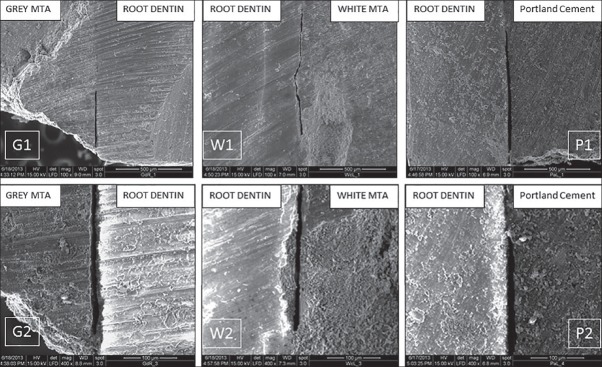
Sixty human single-rooted teeth were decoronated, instrumented, and obturated with Gutta-percha. After the root-end resection and apical cavity preparation, the teeth were randomly divided into three-experimental groups (each containing 20 teeth) and each group was filled with their respective experimental materials. After longitudinal sectioning of root, SEM examination was done to determine the overall gap between retrograde materials and cavity walls in terms of length and width of the gap (maximum) at the interface. Descriptive statistical analysis was performed to calculate the means with corresponding standard errors, median and ranges along with an analysis of variance and Tukey's test.
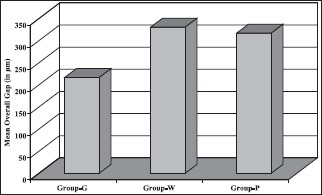
The least overall gap was observed in GMTA followed by PC and WMTA. While after statistically analyzing the various data obtained from different groups, there was no significant difference among these three groups in terms of marginal adaptation.
GMTA showed the best overall adaptation to root dentinal wall compared to PC and WMTA. Being biocompatible and cheaper, the PC may be an alternative but not a substitute for MTA.
在无法进行非手术牙髓治疗或非手术牙髓治疗无法解决问题时,必须考虑进行手术牙髓治疗。手术牙髓治疗失败的一个主要原因是根尖封闭不充分,因此使用合适的物质作为根充材料以防止潜在污染物进入根尖周组织非常关键。
本体外研究的目的是使用扫描电子显微镜(SEM)比较和评估矿物三氧化物凝聚体(MTA)家族的三种根充材料(白色MTA [WMTA]、灰色MTA [GMTA]和波特兰水泥[PC])在根尖牙本质壁处的边缘适应性。
选取60颗人单根牙,去除冠部,进行根管预备,并用牙胶充填。在进行根尖切除和根尖腔预备后,将牙齿随机分为三个实验组(每组20颗牙),每组用各自的实验材料充填。在对牙根进行纵切后,进行SEM检查,以根据界面处间隙的长度和宽度(最大值)确定逆行充填材料与腔壁之间的总体间隙。进行描述性统计分析以计算均值及相应的标准误差、中位数和范围,并进行方差分析和Tukey检验。
观察到GMTA的总体间隙最小,其次是PC和WMTA。虽然对从不同组获得的各种数据进行统计分析后,这三组在边缘适应性方面没有显著差异。
与PC和WMTA相比,GMTA对牙根牙本质壁的总体适应性最佳。由于具有生物相容性且成本较低,PC可能是一种替代材料,但不能替代MTA。