Department of Medical Physics in Radiation Oncology, DKFZ, INF 280, 69120 Heidelberg, Germany.
Radiat Oncol. 2014 Aug 11;9:175. doi: 10.1186/1748-717X-9-175.
To analyse the frequency of re-planning and its variability dependent on the IGRT correction strategy and on the modification of the dosimetric criteria for re-planning for the spinal cord in head and neck IG-IMRT.
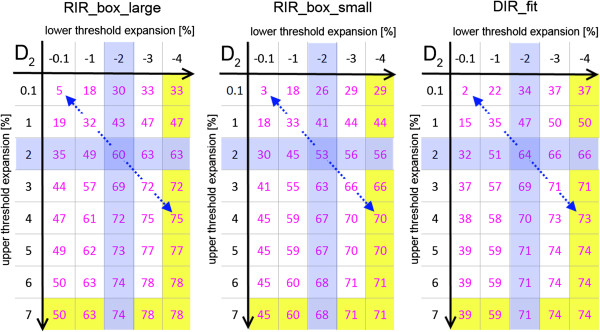
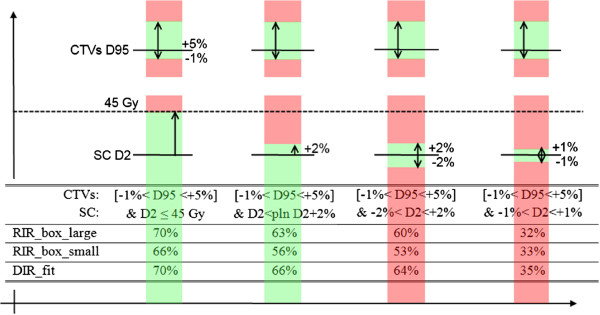
Daily kV-control-CTs of six head and neck patients (=175 CTs) were analysed. All volumes of interest were re-contoured using deformable image registration. Three IGRT correction strategies were simulated and the resulting dose distributions were computed for all fractions. Different sets of criteria with varying dose thresholds for re-planning were investigated. All sets of criteria ensure equivalent target coverage of both CTVs, but vary in the tolerance threshold of the spinal cord.
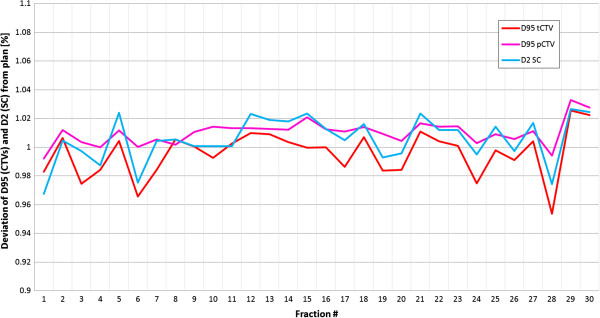
The variations of the D95 and D2 in respect to the planned values ranged from -7% to +3% for both CTVs, and -2% to +6% for the spinal cord. Despite different correction vectors of the three IGRT strategies, the dosimetric differences were small. The number of fractions not requiring re-planning varied between 0% and 11% dependent on the applied IGRT correction strategy. In contrast, this number ranged between 32% and 70% dependent on the dosimetric thresholds, even though these thresholds were only gently modified.
The more precise the planned dose needs to be maintained over the treatment course, the more frequently re-planning is required. The influence of different IGRT correction strategies, even though geometrically notable, was found to be of only limited relevance for the re-planning frequency. In contrast, the definition and modification of thresholds for re-planning have a major impact on the re-planning frequency.
分析头颈部 IG-IMRT 中因 IGRT 校正策略和脊髓重新规划剂量学标准变化而重新规划的频率及其可变性。
分析了 6 例头颈部患者的每日千伏控制 CT(共 175 次 CT)。所有感兴趣的体积均使用变形图像配准进行重新轮廓。模拟了三种 IGRT 校正策略,并为所有分次计算了由此产生的剂量分布。研究了不同的标准集,这些标准集具有不同的重新规划剂量阈值。所有标准集都保证了两个 CTV 的目标覆盖等效,但脊髓的耐受阈值不同。
对于两个 CTV,D95 和 D2 相对于计划值的变化范围分别为+/-7%和+/-3%,对于脊髓,变化范围为+/-2%至+/-6%。尽管三种 IGRT 策略的校正向量不同,但剂量学差异很小。无需重新规划的分次数取决于所应用的 IGRT 校正策略,范围在 0%至 11%之间。相比之下,取决于剂量学阈值,这个数字在 32%至 70%之间变化,尽管这些阈值只是略有修改。
随着治疗过程中需要保持的计划剂量精度的提高,重新规划的频率也会增加。虽然不同的 IGRT 校正策略在几何上有显著影响,但发现其对重新规划频率的影响有限。相比之下,重新规划阈值的定义和修改对重新规划频率有重大影响。