Genz Jutta, Haastert Burkhard, Müller Hardy, Verheyen Frank, Cole Dennis, Rathmann Wolfgang, Nowotny Bettina, Roden Michael, Giani Guido, Ohmann Christian, Icks Andrea
Institute of Biometrics and Epidemiology, German Diabetes Center, Leibniz Institute at the Heinrich Heine University Düsseldorf, Auf'm Hennekamp 65, 40225 Düsseldorf, Germany.
BMC Res Notes. 2014 Aug 18;7:541. doi: 10.1186/1756-0500-7-541.
Having shown in a recent randomized controlled trial that evidence-based patient information (EBPI) significantly increased knowledge on primary prevention of diabetes compared to standard patient information, we now investigated interaction between socioeconomic status (SES) and the effect of an EBPI.
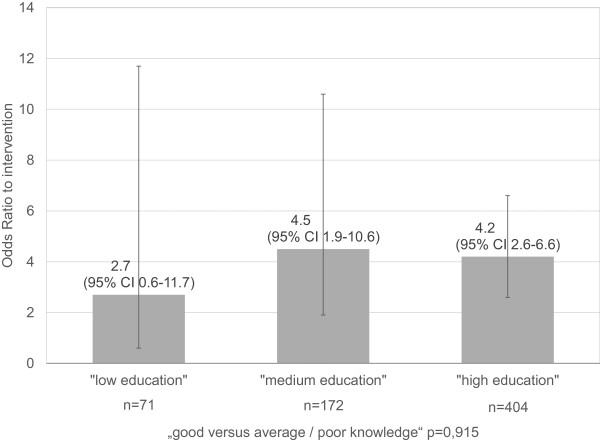
1,120 visitors (aged 40-70 years, without known diabetes) to the "Techniker Krankenkasse" and the "German Diabetes Center" websites were randomized. The intervention group received a newly developed on-line EBPI, the control group standard on-line information. The primary outcome measure was knowledge, classified as "good/average/poor". We analyzed associations of knowledge with socioeconomic variables (education, vocational training, employment, subjective social status) combined with intervention effect including interactions, adjusted for possible confounding by knowledge before intervention, self-reported blood glucose measurements, blood pressure, blood lipid levels, age and gender. Logistic regression models were fitted to the subpopulation (n = 647) with complete values in these variables.Education (high vs. low) was significantly associated with knowledge (good vs. average/poor); however, there was no significant interaction between education and intervention. After adjustment, the other socioeconomic variables were not significantly associated with knowledge.
Socioeconomic variables did not significantly change the effect of the intervention. There was a tendency towards a lower effect where lower educated individuals were concerned. Possibly the power was too low to detect interaction effects. Larger studies using SES-specific designs are needed to clarify the effect of SES. We suggest considering the socioeconomic status when evaluating a decision aid, e.g. an EBPI, to ensure its effectiveness not only in higher socioeconomic groups.
Current Controlled Trials ISRCTN22060616 (Date assigned: 12 September 2008).
在最近一项随机对照试验中,我们发现与标准患者信息相比,循证患者信息(EBPI)显著增加了糖尿病一级预防方面的知识。现在,我们研究了社会经济地位(SES)与EBPI效果之间的相互作用。
1120名访问“技术人员健康保险基金”和“德国糖尿病中心”网站的访客(年龄在40 - 70岁之间,无已知糖尿病)被随机分组。干预组接受新开发的在线EBPI,对照组接受标准在线信息。主要结局指标是知识水平,分为“良好/中等/较差”。我们分析了知识水平与社会经济变量(教育程度、职业培训、就业情况、主观社会地位)之间的关联,并结合干预效果(包括相互作用)进行分析,同时对干预前的知识水平、自我报告的血糖测量值、血压、血脂水平、年龄和性别等可能的混杂因素进行了调整。对这些变量具有完整值的亚组(n = 647)拟合了逻辑回归模型。教育程度(高与低)与知识水平(良好与中等/较差)显著相关;然而,教育程度与干预之间没有显著的相互作用。调整后,其他社会经济变量与知识水平没有显著关联。
社会经济变量并未显著改变干预效果。在受教育程度较低的个体中,干预效果有降低的趋势。可能是检验效能过低,无法检测到相互作用效应。需要采用针对SES的特定设计进行更大规模的研究,以阐明SES的影响。我们建议在评估决策辅助工具(如EBPI)时考虑社会经济地位,以确保其不仅在社会经济地位较高的群体中有效。
当前对照试验ISRCTN22060616(分配日期:2008年9月12日)。