Takenga Claude, Berndt Rolf-Dietrich, Musongya Olivier, Kitero Joël, Katoke Remi, Molo Kakule, Kazingufu Basile, Meni Malikwisha, Vikandy Mambo, Takenga Henri
Infokom GmbH, 17034 Neubrandenburg, Germany.
Health Department, Baptist Church in Central Africa (CBCA), Goma, Democratic Republic of Congo.
Int J Telemed Appl. 2014;2014:437307. doi: 10.1155/2014/437307. Epub 2014 Jul 17.
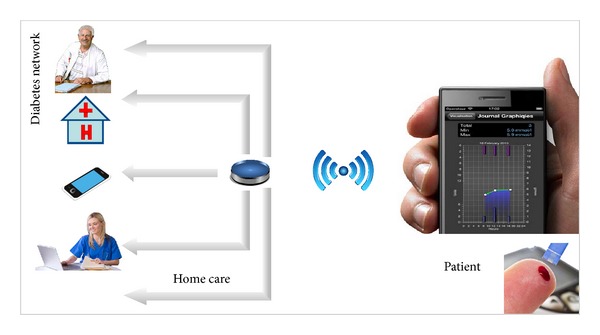
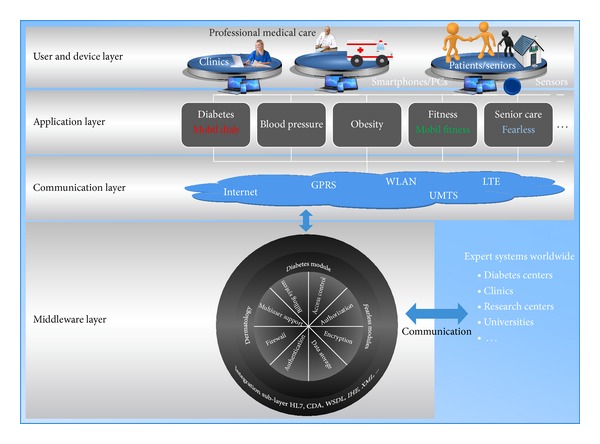
The demand for new healthcare services is growing rapidly. Improving accessibility of the African population to diabetes care seems to be a big challenge in most countries where the number of care centers and medical staff is reduced. Information and communication technologies (ICT) have great potential to address some of these challenges faced by several countries in providing accessible, cost-effective, and high-quality health care services. This paper presents the Mobil Diab system which is a telemedical approach proposed for the management of long-term diseases. The system applies modern mobile and web technologies which overcome geographical barriers, and increase access to health care services. The idea of the system is to involve patients in the therapy process and motivate them for an active participation. For validation of the system in African context, a trial was conducted in the Democratic Republic of Congo. 40 Subjects with diabetes divided randomly into control and intervention groups were included in the test. Results show that Mobil Diab is suitable for African countries and presents a number of benefits for the population and public health care system. It improves clinical management and delivery of diabetes care services by enhancing access, quality, motivation, reassurance, efficiency, and cost-effectiveness.
对新型医疗服务的需求正在迅速增长。在大多数护理中心和医务人员数量减少的国家,提高非洲人口获得糖尿病护理的机会似乎是一项巨大挑战。信息和通信技术(ICT)在应对一些国家在提供可及、经济高效且高质量医疗服务方面面临的这些挑战方面具有巨大潜力。本文介绍了Mobil Diab系统,这是一种为长期疾病管理提出的远程医疗方法。该系统应用现代移动和网络技术,克服地理障碍,增加获得医疗服务的机会。该系统的理念是让患者参与治疗过程并激励他们积极参与。为了在非洲背景下验证该系统,在刚果民主共和国进行了一项试验。40名患有糖尿病的受试者被随机分为对照组和干预组纳入测试。结果表明,Mobil Diab适用于非洲国家,对民众和公共医疗系统有诸多益处。它通过提高可及性、质量、积极性、安心感、效率和成本效益,改善了糖尿病护理服务的临床管理和提供。