Department of Industrial and Manufacturing Systems Engineering, University of Hong Kong, Hong Kong, Hong Kong.
JMIR Mhealth Uhealth. 2020 Aug 4;8(8):e15779. doi: 10.2196/15779.
Mobile app-assisted self-care interventions are emerging promising tools to support self-care of patients with chronic diseases such as type 2 diabetes and hypertension. The effectiveness of such interventions requires further exploration for more supporting evidence.
A systematic review and meta-analysis of randomized controlled trials (RCTs) were conducted to examine the effectiveness of mobile app-assisted self-care interventions developed for type 2 diabetes and/or hypertension in improving patient outcomes.
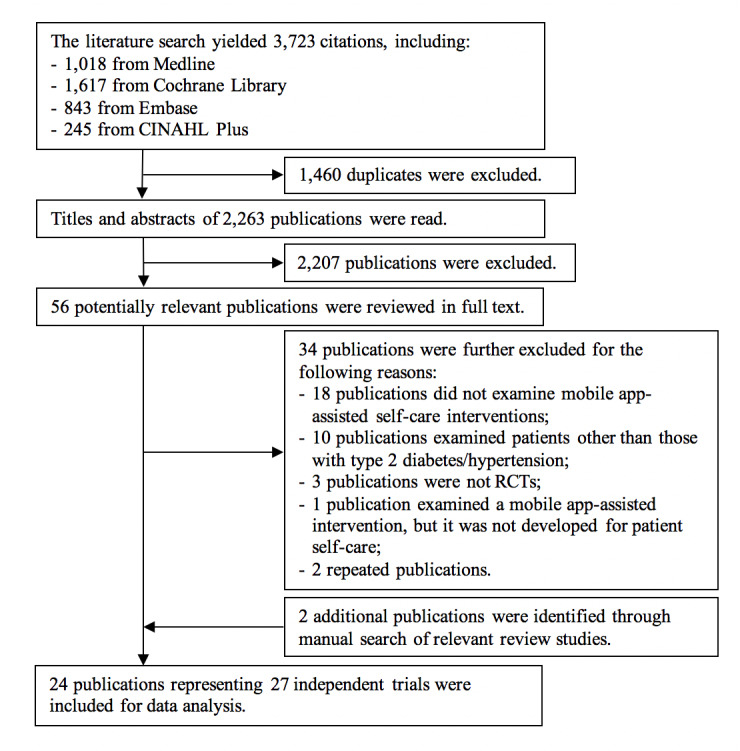
We followed the Cochrane Collaboration guidelines and searched MEDLINE, Cochrane Library, EMBASE, and CINAHL Plus for relevant studies published between January 2007 and January 2019. Primary outcomes included changes in hemoglobin A (HbA) levels, systolic blood pressure (SBP), and diastolic blood pressure (DBP). Changes in other clinical-, behavioral-, knowledge-, and psychosocial-related outcomes were included as secondary outcomes. Primary outcomes and objective secondary outcomes that were reported in at least two trials were meta-analyzed; otherwise, a narrative synthesis was used for data analysis.
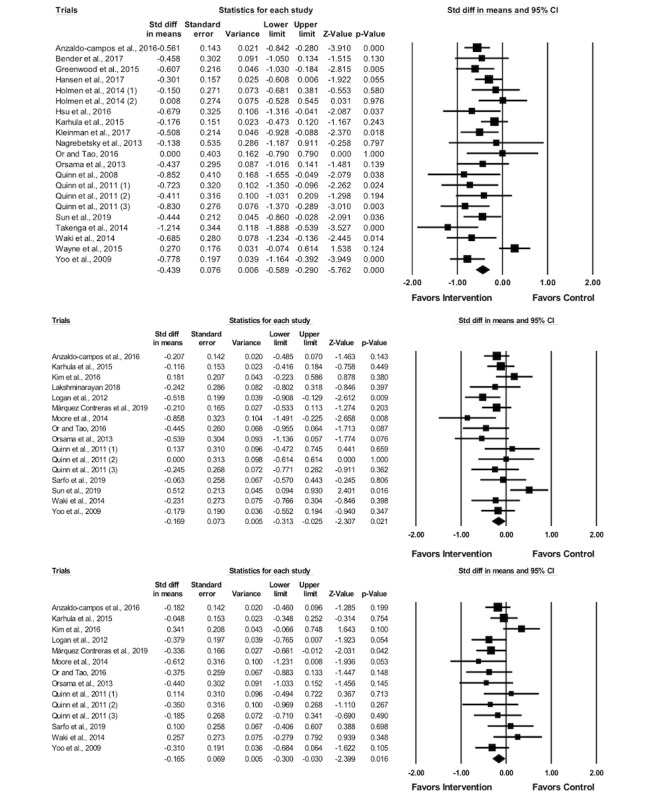
A total of 27 trials were identified and analyzed. For primary outcomes, the use of mobile app-assisted self-care interventions was associated with significant reductions in HbA levels (standardized mean difference [SMD] -0.44, 95% CI -0.59 to -0.29; P<.001), SBP (SMD -0.17, 95% CI -0.31 to -0.03, P=.02), and DBP (SMD -0.17, 95% CI -0.30 to -0.03, P=.02). Subgroup analyses for primary outcomes showed that several intervention features were supportive of self-management, including blood glucose, blood pressure, and medication monitoring, communication with health care providers, automated feedback, personalized goal setting, reminders, education materials, and data visualization. In addition, 8 objective secondary outcomes were meta-analyzed, which showed that the interventions had significant lowering effects on fasting blood glucose levels and waist circumference. A total of 42 secondary outcomes were narratively synthesized, and mixed results were found.
Mobile app-assisted self-care interventions can be effective tools for managing blood glucose and blood pressure, likely because their use facilitates remote management of health issues and data, provision of personalized self-care recommendations, patient-care provider communication, and decision making. More studies are required to further determine which combinations of intervention features are most effective in improving the control of the diseases. Moreover, evidence regarding the effects of these interventions on the behavioral, knowledge, and psychosocial outcomes of patients is still scarce, which warrants further examination.
移动应用程序辅助的自我护理干预措施作为支持 2 型糖尿病和高血压等慢性病患者自我护理的新兴有前途的工具正在出现。为了提供更多支持证据,需要进一步探索此类干预措施的有效性。
系统评价和荟萃分析随机对照试验(RCT),以检查为 2 型糖尿病和/或高血压开发的移动应用程序辅助自我护理干预措施在改善患者结局方面的有效性。
我们遵循 Cochrane 协作组的指南,检索了 MEDLINE、Cochrane 图书馆、EMBASE 和 CINAHL Plus,以查找 2007 年 1 月至 2019 年 1 月期间发表的相关研究。主要结局包括血红蛋白 A(HbA)水平、收缩压(SBP)和舒张压(DBP)的变化。还将其他临床、行为、知识和心理社会相关结局的变化作为次要结局纳入。至少有两项试验报告了主要结局和客观次要结局,进行了荟萃分析;否则,使用叙述性综合法进行数据分析。
共确定并分析了 27 项试验。对于主要结局,使用移动应用程序辅助的自我护理干预措施与 HbA 水平的显著降低相关(标准化均数差 [SMD] -0.44,95%置信区间 [CI] -0.59 至 -0.29;P<.001),SBP(SMD -0.17,95%CI -0.31 至 -0.03,P=.02)和 DBP(SMD -0.17,95%CI -0.30 至 -0.03,P=.02)。主要结局的亚组分析表明,一些干预措施具有支持自我管理的功能,包括血糖、血压和药物监测、与医疗保健提供者的沟通、自动反馈、个性化目标设定、提醒、教育材料和数据可视化。此外,对 8 项客观次要结局进行了荟萃分析,结果表明这些干预措施对空腹血糖水平和腰围有显著的降低作用。共叙述性综合了 42 项次要结局,结果不一。
移动应用程序辅助的自我护理干预措施可能是管理血糖和血压的有效工具,因为它们的使用方便了健康问题和数据的远程管理、提供了个性化的自我护理建议、患者与医疗保健提供者的沟通以及决策。需要更多的研究来进一步确定哪些干预措施的组合在改善疾病控制方面最有效。此外,关于这些干预措施对患者行为、知识和心理社会结局影响的证据仍然很少,这需要进一步研究。