Byskov Jens, Marchal Bruno, Maluka Stephen, Zulu Joseph M, Bukachi Salome A, Hurtig Anna-Karin, Blystad Astrid, Kamuzora Peter, Michelo Charles, Nyandieka Lillian N, Ndawi Benedict, Bloch Paul, Olsen Oystein E
DBL - Centre for Health Research and Development, Faculty of Health and Medical Sciences, University of Copenhagen, Thorvaldsensvej 57, DK 1871 Frederiksberg, Denmark.
Health Res Policy Syst. 2014 Aug 20;12:49. doi: 10.1186/1478-4505-12-49.
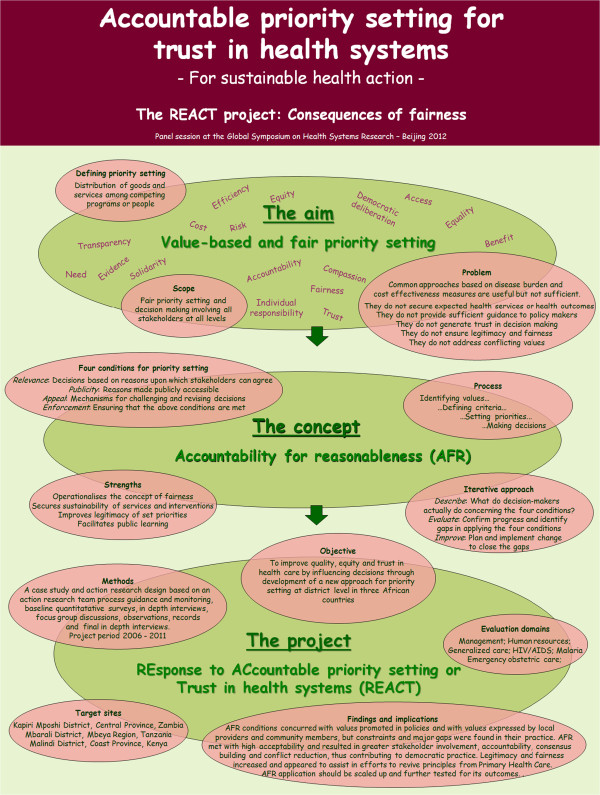
Priority-setting decisions are based on an important, but not sufficient set of values and thus lead to disagreement on priorities. Accountability for Reasonableness (AFR) is an ethics-based approach to a legitimate and fair priority-setting process that builds upon four conditions: relevance, publicity, appeals, and enforcement, which facilitate agreement on priority-setting decisions and gain support for their implementation. This paper focuses on the assessment of AFR within the project REsponse to ACcountable priority setting for Trust in health systems (REACT).
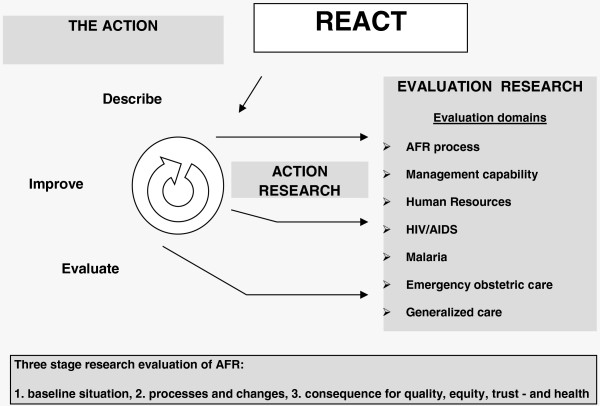
This intervention study applied an action research methodology to assess implementation of AFR in one district in Kenya, Tanzania, and Zambia, respectively. The assessments focused on selected disease, program, and managerial areas. An implementing action research team of core health team members and supporting researchers was formed to implement, and continually assess and improve the application of the four conditions. Researchers evaluated the intervention using qualitative and quantitative data collection and analysis methods.
The values underlying the AFR approach were in all three districts well-aligned with general values expressed by both service providers and community representatives. There was some variation in the interpretations and actual use of the AFR in the decision-making processes in the three districts, and its effect ranged from an increase in awareness of the importance of fairness to a broadened engagement of health team members and other stakeholders in priority setting and other decision-making processes.
District stakeholders were able to take greater charge of closing the gap between nationally set planning and the local realities and demands of the served communities within the limited resources at hand. This study thus indicates that the operationalization of the four broadly defined and linked conditions is both possible and seems to be responding to an actual demand. This provides arguments for the continued application and further assessment of the potential of AFR in supporting priority-setting and other decision-making processes in health systems to achieve better agreed and more sustainable health improvements linked to a mutual democratic learning with potential wider implications.
确定优先事项的决策基于一套重要但并不充分的价值观,因此会导致对优先事项产生分歧。合理问责制(AFR)是一种基于伦理的方法,用于建立合法且公平的优先事项确定过程,该过程基于四个条件:相关性、公开性、申诉和执行,这些条件有助于就优先事项确定决策达成一致,并为其实施获得支持。本文重点关注在“卫生系统信任的可问责优先事项设定应对项目”(REACT)中对合理问责制的评估。
这项干预研究采用行动研究方法,分别在肯尼亚、坦桑尼亚和赞比亚的一个地区评估合理问责制的实施情况。评估集中在选定的疾病、项目和管理领域。组建了一个由核心卫生团队成员和辅助研究人员组成的实施行动研究团队,以实施并持续评估和改进这四个条件的应用。研究人员使用定性和定量数据收集与分析方法对干预措施进行评估。
合理问责制方法所依据的价值观在所有三个地区都与服务提供者和社区代表表达的一般价值观高度一致。在这三个地区的决策过程中,对合理问责制的解释和实际应用存在一些差异,其效果从提高对公平重要性的认识到扩大卫生团队成员和其他利益相关者对优先事项设定及其他决策过程的参与程度不等。
地区利益相关者能够在手头有限的资源范围内,更好地负责弥合国家制定的规划与所服务社区的当地现实及需求之间的差距。因此,本研究表明,这四个宽泛定义且相互关联的条件的实施是可行的,而且似乎满足了实际需求。这为继续应用合理问责制并进一步评估其在支持卫生系统优先事项设定和其他决策过程中的潜力提供了依据,以便实现更好的共识以及更可持续的健康改善,这与相互民主学习相关联,可能具有更广泛的影响。