van Essen T Huibertus, van Pelt Sake I, Versluis Mieke, Bronkhorst Inge H G, van Duinen Sjoerd G, Marinkovic Marina, Kroes Wilma G M, Ruivenkamp Claudia A L, Shukla Shruti, de Klein Annelies, Kiliç Emine, Harbour J William, Luyten Gregorius P M, van der Velden Pieter A, Verdijk Rob M, Jager Martine J
Department of Ophthalmology, Leiden University Medical Center (LUMC), Leiden, The Netherlands.
Department of Pathology, Leiden University Medical Center (LUMC), Leiden, The Netherlands.
Br J Ophthalmol. 2014 Dec;98(12):1738-43. doi: 10.1136/bjophthalmol-2014-305047. Epub 2014 Aug 21.
To determine whether BAP1 gene and protein expression associates with different prognostic parameters in uveal melanoma and whether BAP1 expression correctly identifies patients as being at risk for metastases, following enucleation of the primary tumour.
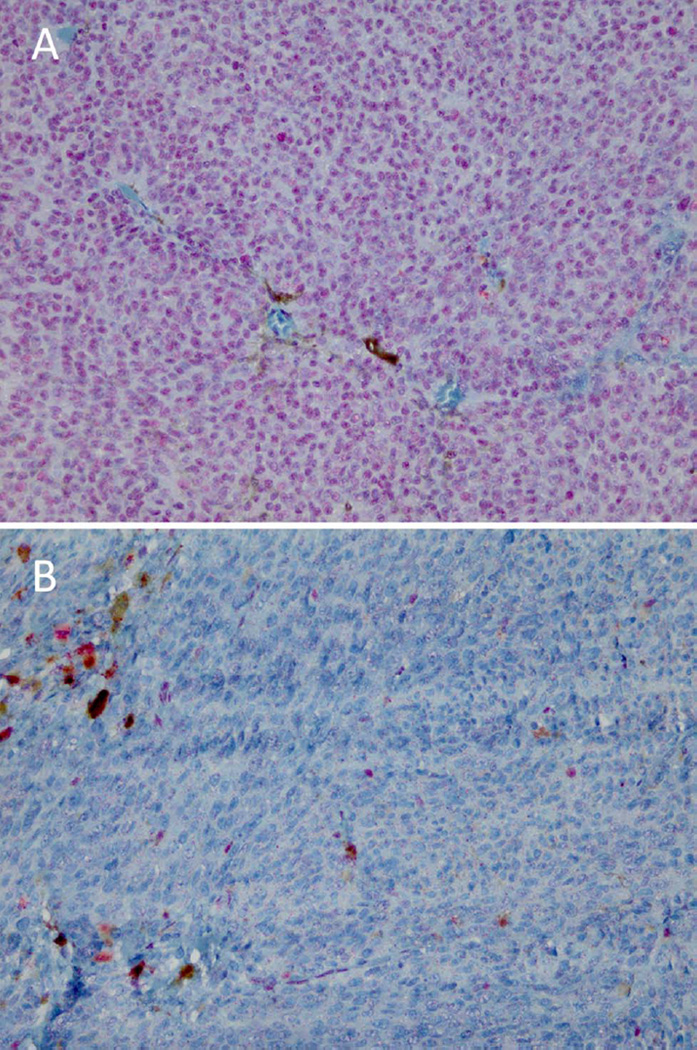
Thirty cases of uveal melanoma obtained by enucleation between 1999 and 2004 were analysed for a variety of prognostic markers, including histological characteristics, chromosome aberrations obtained by fluorescence in situ hybridisation (FISH) and single nucleotide polymorphism (SNP) analysis and gene expression profiling. These parameters were compared with BAP1 gene expression and BAP1 immunostaining.
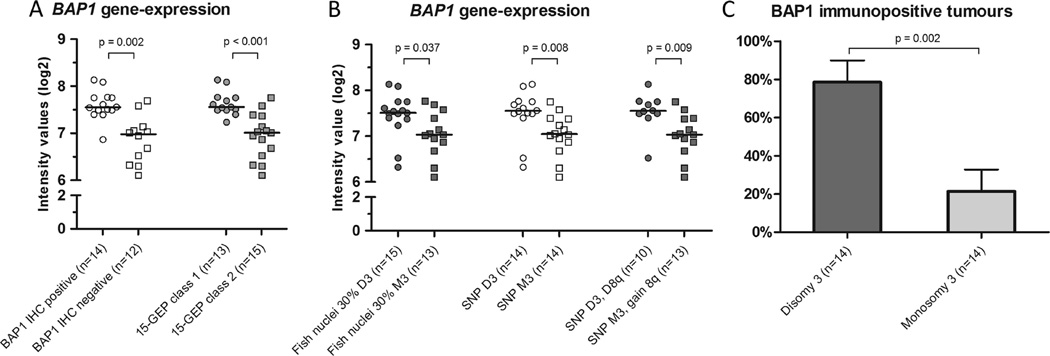
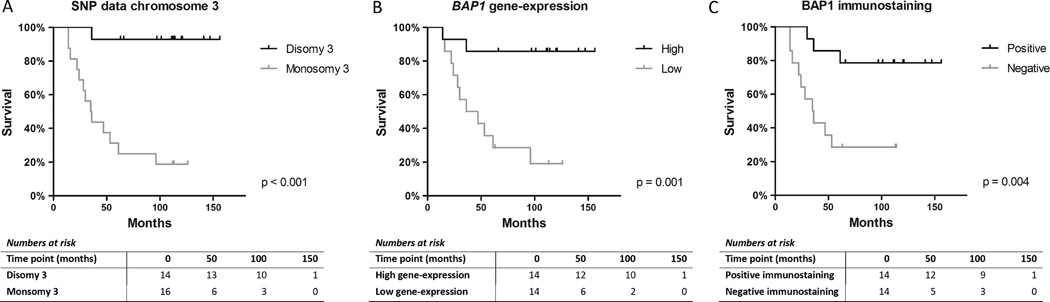
The presence of monosomy of chromosome 3 as identified by the different chromosome 3 tests showed significantly increased HRs (FISH on isolated nuclei cut-off 30%: HR 11.6, p=0.002; SNP analysis: HR 20.3, p=0.004) for death due to metastasis. The gene expression profile class 2, based on the 15-gene expression profile, similarly provided a significantly increased HR for a poor outcome (HR 8.5, p=0.005). Lower BAP1 gene expression and negative BAP1 immunostaining (50% of 28 tumours were immunonegative) were both associated with these markers for prognostication: FISH cut-off 30% monosomy 3 (BAP1 gene expression: p=0.037; BAP1 immunostaining: p=0.001), SNP-monosomy 3 (BAP1 gene expression: p=0.008; BAP1 immunostaining: p=0.002) and class 2 profile (BAP1 gene expression: p<0.001; BAP1 immunostaining: p=0.001) and were themselves associated with an increased risk of death due to metastasis (BAP1 gene expression dichotomised: HR 8.7, p=0.006; BAP1 immunostaining: HR 4.0, p=0.010).
Loss of BAP1 expression associated well with all of the methods currently used for prognostication and was itself predictive of death due to metastasis in uveal melanoma after enucleation, thereby emphasising the importance of further research on the role of BAP1 in uveal melanoma.
确定BAP1基因和蛋白表达是否与葡萄膜黑色素瘤的不同预后参数相关,以及在摘除原发性肿瘤后,BAP1表达能否正确识别有转移风险的患者。
分析了1999年至2004年间通过眼球摘除术获得的30例葡萄膜黑色素瘤病例的多种预后标志物,包括组织学特征、通过荧光原位杂交(FISH)和单核苷酸多态性(SNP)分析获得的染色体畸变以及基因表达谱。将这些参数与BAP1基因表达和BAP1免疫染色进行比较。
通过不同的3号染色体检测鉴定出的3号染色体单体的存在显示,转移导致死亡的风险比(HR)显著增加(分离核FISH临界值30%:HR 11.6,p = 0.002;SNP分析:HR 20.3,p = 0.004)。基于15基因表达谱的基因表达谱2类同样显示预后不良的风险比显著增加(HR = 8.5,p = 0.005)。较低的BAP1基因表达和阴性BAP1免疫染色(28个肿瘤中有50%为免疫阴性)均与这些预后标志物相关:FISH临界值30%的3号染色体单体(BAP1基因表达:p = 0.037;BAP1免疫染色:p = 0.001)、SNP-3号染色体单体(BAP1基因表达:p = 0.008;BAP1免疫染色:p = 0.002)和2类谱(BAP1基因表达:p < 0.001;BAP1免疫染色:p = 0.001),并且它们自身与转移导致死亡的风险增加相关(BAP1基因表达二分法:HR 8.7,p = 0.006;BAP1免疫染色:HR 4.0,p = 0.0 = 0.010)。
BAP1表达缺失与目前用于预后评估的所有方法都密切相关,并且其本身可预测眼球摘除术后葡萄膜黑色素瘤转移导致的死亡,从而强调了进一步研究BAP1在葡萄膜黑色素瘤中作用的重要性。