Moreno Rosa L, Ribera Angeles B
Department of Physiology, University of Colorado Anschutz Medical Campus, RC-1 North, 7403A, Mailstop 8307, 12800 E 19th Ave,, 80045 Aurora, CO, USA.
Neural Dev. 2014 Aug 22;9:19. doi: 10.1186/1749-8104-9-19.
In the spinal cord, stereotypic patterns of transcription factor expression uniquely identify neuronal subtypes. These transcription factors function combinatorially to regulate gene expression. Consequently, a single transcription factor may regulate divergent development programs by participation in different combinatorial codes. One such factor, the LIM-homeodomain transcription factor Islet1, is expressed in the vertebrate spinal cord. In mouse, chick and zebrafish, motor and sensory neurons require Islet1 for specification of biochemical and morphological signatures. Little is known, however, about the role that Islet1 might play for development of electrical membrane properties in vertebrates. Here we test for a role of Islet1 in differentiation of excitable membrane properties of zebrafish spinal neurons.
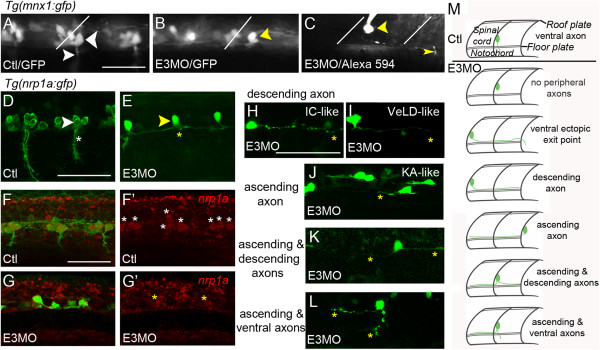
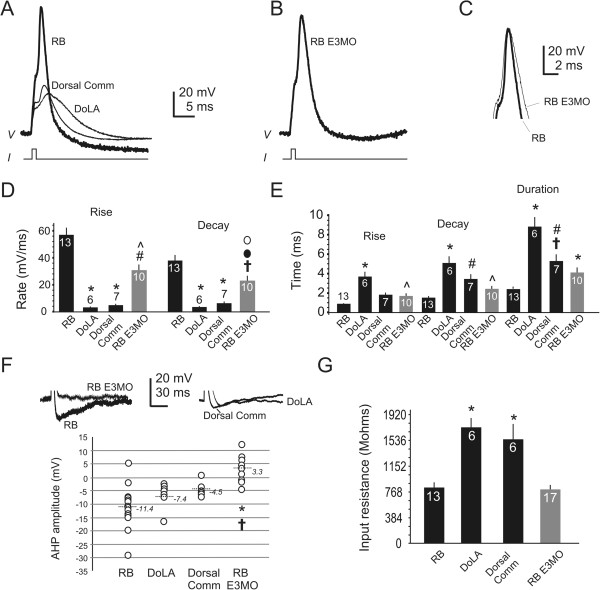
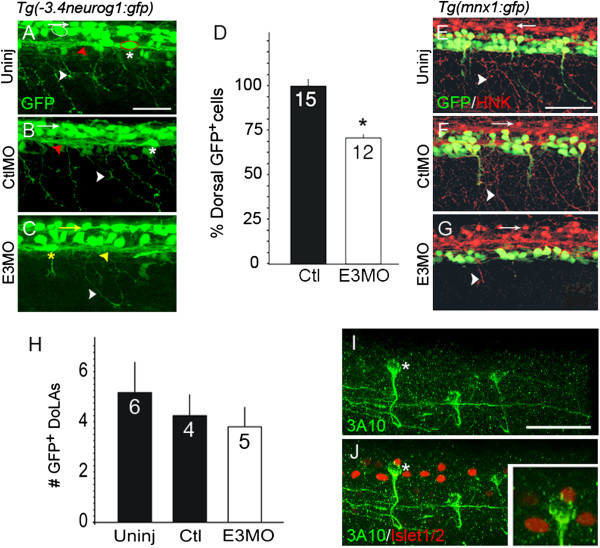
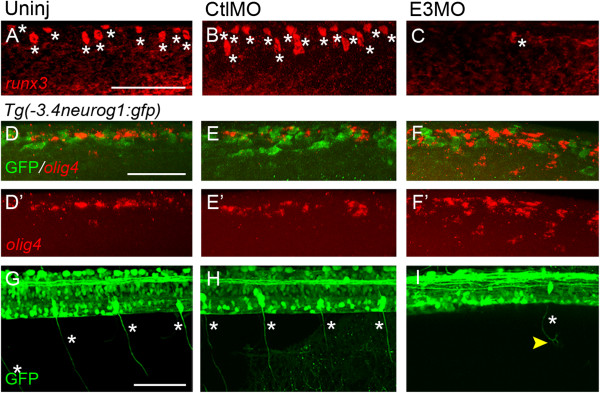
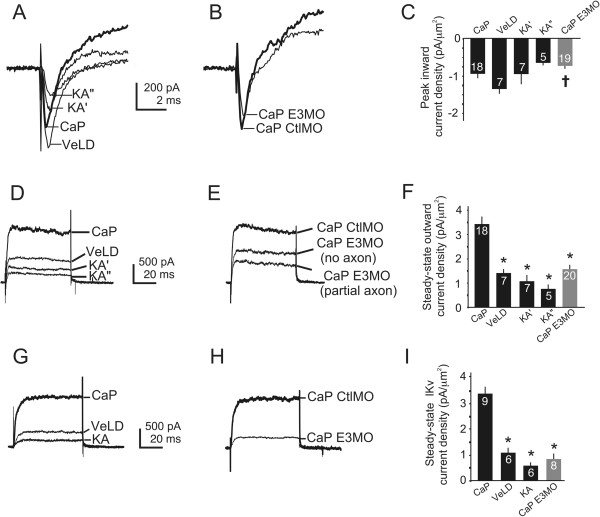
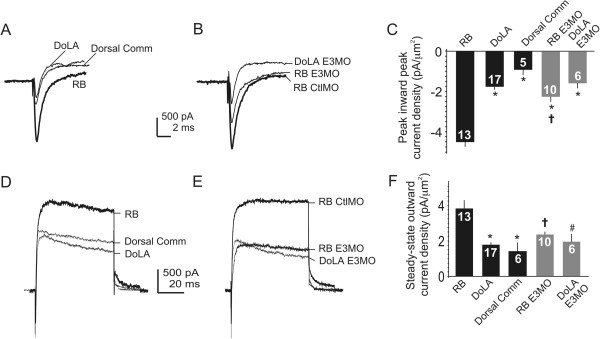
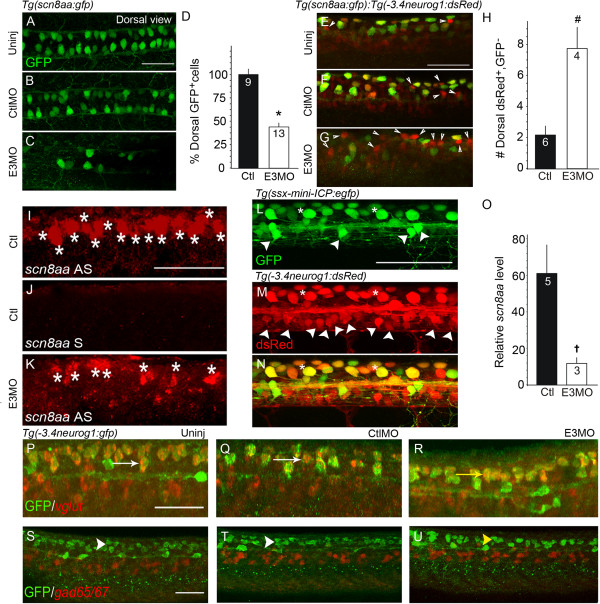
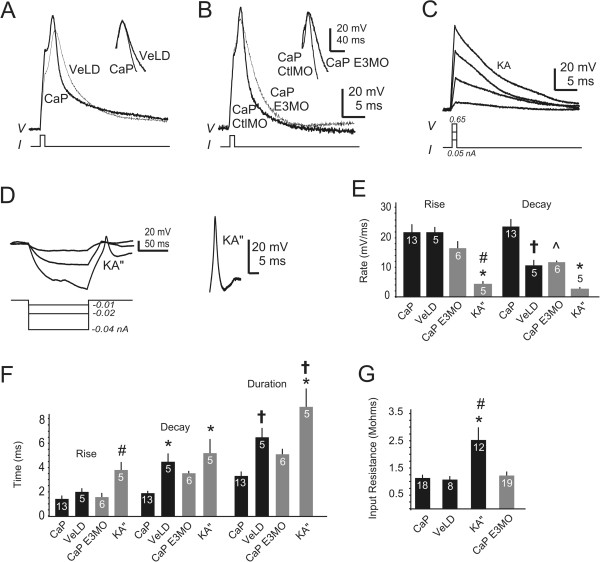
We focus our studies on the role of Islet1 in two populations of early born zebrafish spinal neurons: ventral caudal primary motor neurons (CaPs) and dorsal sensory Rohon-Beard cells (RBs). We take advantage of transgenic lines that express green fluorescent protein (GFP) to identify CaPs, RBs and several classes of interneurons for electrophysiological study. Upon knock-down of Islet1, cells occupying CaP-like and RB-like positions continue to express GFP. With respect to voltage-dependent currents, CaP-like and RB-like neurons have novel repertoires that distinguish them from control CaPs and RBs, and, in some respects, resemble those of neighboring interneurons. The action potentials fired by CaP-like and RB-like neurons also have significantly different properties compared to those elicited from control CaPs and RBs.
Overall, our findings suggest that, for both ventral motor and dorsal sensory neurons, Islet1 directs differentiation programs that ultimately specify electrical membrane as well as morphological properties that act together to sculpt neuron identity.
在脊髓中,转录因子表达的刻板模式可唯一识别神经元亚型。这些转录因子通过组合发挥作用来调节基因表达。因此,单个转录因子可能通过参与不同的组合密码来调节不同的发育程序。其中一个这样的因子,即LIM同源域转录因子Islet1,在脊椎动物脊髓中表达。在小鼠、鸡和斑马鱼中,运动神经元和感觉神经元的生化和形态特征的特化需要Islet1。然而,关于Islet1在脊椎动物电膜特性发育中可能发挥的作用知之甚少。在这里,我们测试Islet1在斑马鱼脊髓神经元兴奋性膜特性分化中的作用。
我们将研究重点放在Islet1在斑马鱼早期出生的两类脊髓神经元中的作用:腹侧尾侧初级运动神经元(CaP)和背侧感觉罗霍恩-比尔兹细胞(RB)。我们利用表达绿色荧光蛋白(GFP)的转基因品系来识别CaP、RB和几类中间神经元,以便进行电生理研究。在敲低Islet1后,占据CaP样和RB样位置的细胞继续表达GFP。就电压依赖性电流而言,CaP样和RB样神经元具有新的电流类型,使它们与对照CaP和RB区分开来,并且在某些方面类似于相邻的中间神经元。与对照CaP和RB引发的动作电位相比,CaP样和RB样神经元引发的动作电位也具有显著不同的特性。
总体而言,我们的研究结果表明,对于腹侧运动神经元和背侧感觉神经元,Islet1指导分化程序,最终确定电膜以及形态特性,这些特性共同塑造神经元身份。