Department of Pediatrics, College of Medicine, Korea University, Seoul, South Korea.
Curr Allergy Asthma Rep. 2014 Oct;14(10):465. doi: 10.1007/s11882-014-0465-1.
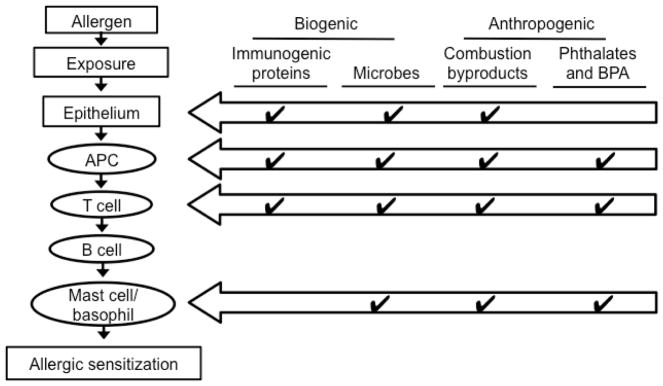
The prevalence of asthma and other allergic diseases is still increasing both in developed and developing countries. Allergic sensitization against common inhalant allergens is common and, although not sufficient, a necessary step in the development of allergic diseases. Despite a small number of proteins from certain plants and animals being common allergens in humans, we still do not fully understand who will develop sensitization and to which allergens. Environmental exposure to these allergens is essential for the development of sensitization, but what has emerged clearly in the literature in the recent years is that the adjuvants to which an individual is exposed at the same time as the allergen are probably an equally important determinant of the immune response to the allergen. These adjuvants act on all steps in the development of sensitization from modifying epithelial barriers, to facilitating antigen presentation, to driving T-cell responses, to altering mast cell and basophil hyperreactivity. The adjuvants come from biogenic sources, including microbes and the plants and animals that produce the allergens, and from man-made sources (anthropogenic), including unintended by-products of combustion and chemicals now ubiquitous in modern life. As we better understand how individuals are exposed to these adjuvants and how the exposure influences the likelihood of an allergic response, we may be able to design individual and community-level interventions that will reverse the increase in allergic disease prevalence, but we are not there yet.
哮喘和其他过敏性疾病在发达国家和发展中国家的发病率仍在上升。对常见吸入性过敏原的过敏致敏很常见,尽管这不是过敏疾病发展的充分条件,但却是必要条件。尽管某些植物和动物的少数蛋白质是人类常见的过敏原,但我们仍然不完全了解谁会产生致敏以及对哪些过敏原产生致敏。环境暴露于这些过敏原对于致敏的发展是必要的,但近年来文献中明确的是,个体同时暴露于过敏原的佐剂可能同样是决定对过敏原的免疫反应的重要决定因素。这些佐剂作用于致敏发展的所有步骤,从修饰上皮屏障,促进抗原呈递,到驱动 T 细胞反应,再到改变肥大细胞和嗜碱性粒细胞的高反应性。佐剂来自生物源,包括产生过敏原的微生物以及植物和动物,也来自人为源(人为),包括燃烧和现代生活中无处不在的化学物质的意外副产品。随着我们更好地了解个体如何接触这些佐剂以及接触如何影响过敏反应的可能性,我们也许能够设计出个体和社区层面的干预措施来逆转过敏性疾病发病率的上升,但我们还没有做到这一点。