Wani Shotaro, Yuda Masamichi, Fujiwara Yosuke, Yamamoto Masaya, Harada Fumio, Ohkuma Yoshiaki, Hirose Yutaka
Laboratory of Gene Regulation, Graduate School of Medicine and Pharmaceutical Sciences, University of Toyama, Sugitani, Toyama, Japan.
Department of Molecular and Cellular Biology, Cancer Research Institute, Kanazawa University, Kakuma-machi, Kanazawa, Japan.
PLoS One. 2014 Aug 28;9(8):e106040. doi: 10.1371/journal.pone.0106040. eCollection 2014.
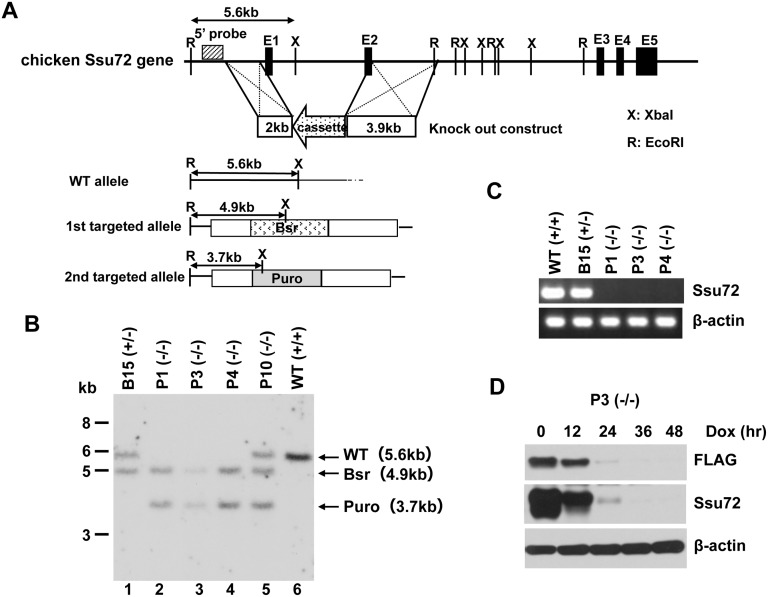
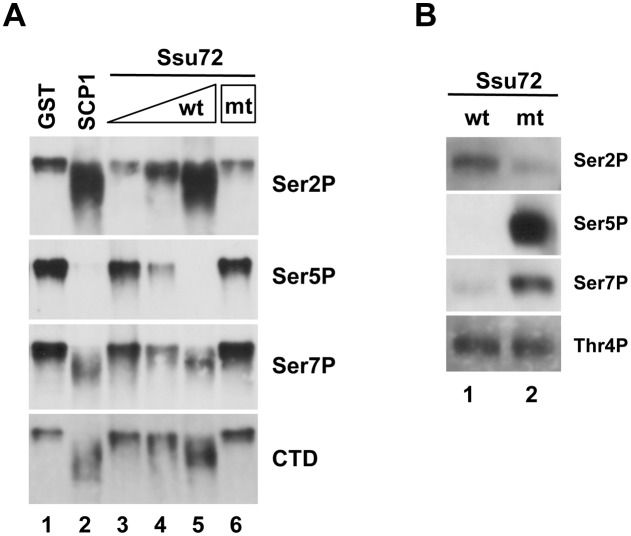
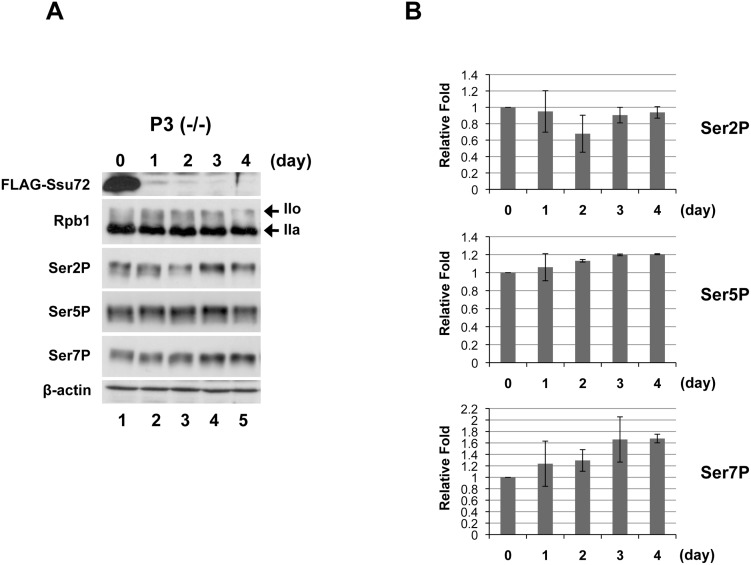
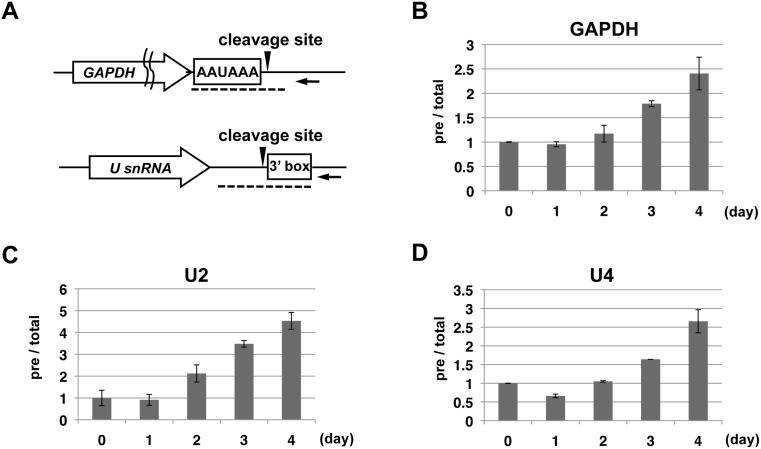
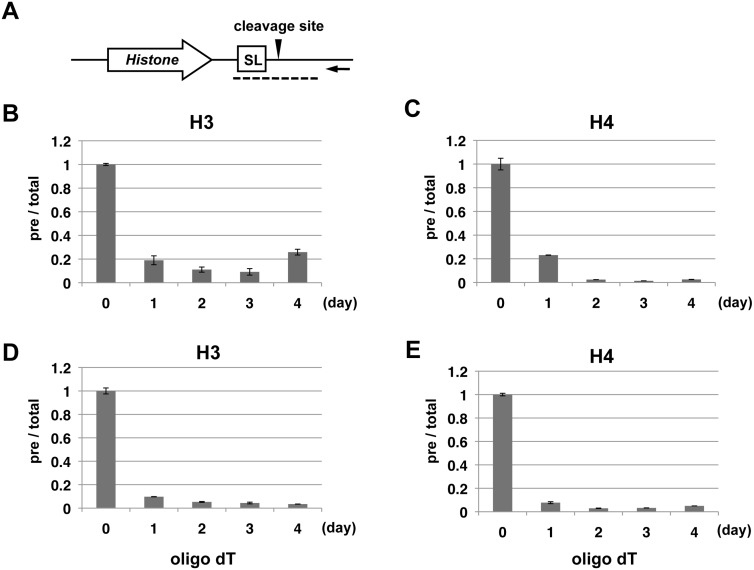
In eukaryotes, the carboxy-terminal domain (CTD) of the largest subunit of RNA polymerase II (Pol II) is composed of tandem repeats of the heptapeptide YSPTSPS, which is subjected to reversible phosphorylation at Ser2, Ser5, and Ser7 during the transcription cycle. Dynamic changes in CTD phosphorylation patterns, established by the activities of multiple kinases and phosphatases, are responsible for stage-specific recruitment of various factors involved in RNA processing, histone modification, and transcription elongation/termination. Yeast Ssu72, a CTD phosphatase specific for Ser5 and Ser7, functions in 3'-end processing of pre-mRNAs and in transcription termination of small non-coding RNAs such as snoRNAs and snRNAs. Vertebrate Ssu72 exhibits Ser5- and Ser7-specific CTD phosphatase activity in vitro, but its roles in gene expression and CTD dephosphorylation in vivo remain to be elucidated. To investigate the functions of vertebrate Ssu72 in gene expression, we established chicken DT40 B-cell lines in which Ssu72 expression was conditionally inactivated. Ssu72 depletion in DT40 cells caused defects in 3'-end formation of U2 and U4 snRNAs and GAPDH mRNA. Surprisingly, however, Ssu72 inactivation increased the efficiency of 3'-end formation of non-polyadenylated replication-dependent histone mRNA. Chromatin immunoprecipitation analyses revealed that Ssu72 depletion caused a significant increase in both Ser5 and Ser7 phosphorylation of the Pol II CTD on all genes in which 3'-end formation was affected. These results suggest that vertebrate Ssu72 plays positive roles in 3'-end formation of snRNAs and polyadenylated mRNAs, but negative roles in 3'-end formation of histone mRNAs, through dephosphorylation of both Ser5 and Ser7 of the CTD.
在真核生物中,RNA聚合酶II(Pol II)最大亚基的羧基末端结构域(CTD)由七肽YSPTSPS的串联重复序列组成,在转录周期中,该七肽在丝氨酸2(Ser2)、丝氨酸5(Ser5)和丝氨酸7(Ser7)处发生可逆磷酸化。由多种激酶和磷酸酶的活性所建立的CTD磷酸化模式的动态变化,负责在RNA加工、组蛋白修饰和转录延伸/终止过程中涉及的各种因子的阶段特异性募集。酵母Ssu72是一种对Ser5和Ser7具有特异性的CTD磷酸酶,在mRNA前体的3'末端加工以及小非编码RNA(如snoRNA和snRNA)的转录终止中发挥作用。脊椎动物Ssu72在体外表现出Ser5和Ser7特异性的CTD磷酸酶活性,但其在体内基因表达和CTD去磷酸化中的作用仍有待阐明。为了研究脊椎动物Ssu72在基因表达中的功能,我们建立了鸡DT40 B细胞系,其中Ssu72的表达被条件性失活。DT40细胞中Ssu72的缺失导致U2和U4 snRNA以及GAPDH mRNA的3'末端形成缺陷。然而,令人惊讶的是,Ssu72失活提高了非聚腺苷酸化的复制依赖性组蛋白mRNA的3'末端形成效率。染色质免疫沉淀分析表明,在所有3'末端形成受到影响的基因上,Ssu72的缺失导致Pol II CTD的Ser5和Ser7磷酸化均显著增加。这些结果表明,脊椎动物Ssu72通过使CTD的Ser5和Ser7去磷酸化,在snRNA和聚腺苷酸化mRNA的3'末端形成中发挥积极作用,但在组蛋白mRNA的3'末端形成中发挥消极作用。