Petrocelli John V
Department of Psychology, Wake Forest University , Winston-Salem, NC, USA.
J Public Health Res. 2013 Dec 1;2(3):e24. doi: 10.4081/jphr.2013.e24.
Counterfactual thinking involves mentally simulating alternatives to reality. The current article reviews literature pertaining to the relevance counterfactual thinking has for the quality of medical decision making. Although earlier counterfactual thought research concluded that counterfactuals have important benefits for the individual, there are reasons to believe that counterfactual thinking is also associated with dysfunctional consequences. Of particular focus is whether or not medical experience, and its influence on counterfactual thinking, actually informs or improves medical practice. It is hypothesized that relatively more probable decision alternatives, followed by undesirable outcomes and counterfactual thought responses, can be abandoned for relatively less probable decision alternatives.
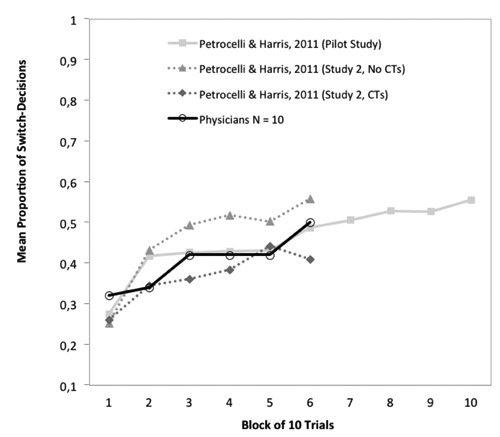
Building on earlier research demonstrating that counterfactual thinking can impede memory and learning in a decision paradigm with undergraduate students, the current study examines the extent to which earlier findings can be generalized to practicing physicians (N=10). Participants were asked to complete 60 trials of a computerized Monty Hall Problem simulation. Learning by experience was operationalized as the frequency of switch-decisions.
Although some learning was evidenced by a general increase in switch-decision frequency across block trials, the extent of learning demonstrated was not ideal, nor practical.
A simple, multiple-trial, decision paradigm demonstrated that doctors fail to learn basic decision-outcome associations through experience. An agenda for future research, which tests the functionality of reference points (other than counterfactual alternatives) for the purposes of medical decision making, is proposed. Significance for public healthThe quality of healthcare depends heavily on the judgments and decisions made by doctors and other medical professionals. Findings from this research indicate that doctors fail to learn basic decision-outcome associations through experience, as evidenced by the sample's tendency to select the optimal decision strategy in only 50% of 60 trials (each of which was followed by veridical feedback). These findings suggest that professional experience is unlikely to enhance the quality of medical decision making. Thus, this research has implications for understanding how doctors' reactions to medical outcomes shape their judgments and affect the degree to which their future treatment intentions are consistent with clinical practice guidelines. The current research is integrated with earlier research on counter-factual thinking, which appears to be a primary element inhibiting the learning of decision-outcome associations. An agenda for future research is proposed.
反事实思维涉及在头脑中模拟现实的替代情况。本文回顾了与反事实思维对医疗决策质量的相关性有关的文献。尽管早期的反事实思维研究得出结论,反事实思维对个体有重要益处,但有理由相信反事实思维也与功能失调的后果相关。特别关注的是医疗经验及其对反事实思维的影响是否真的能为医疗实践提供信息或改善医疗实践。据推测,相对更有可能的决策选项,在出现不良结果和反事实思维反应后,可能会被相对不太可能的决策选项所取代。
基于早期研究表明反事实思维在本科生决策范式中会阻碍记忆和学习,本研究考察了早期研究结果能在多大程度上推广到执业医生(N = 10)。参与者被要求完成60次计算机化的蒙提霍尔问题模拟试验。通过经验学习以转换决策的频率来衡量。
尽管在各块试验中转换决策频率总体增加证明了一定程度的学习,但所显示的学习程度并不理想,也不实用。
一个简单的、多次试验的决策范式表明,医生无法通过经验学习基本的决策 - 结果关联。提出了一个未来研究议程,该议程测试用于医疗决策目的的参考点(而非反事实替代方案)的功能。对公共卫生的意义医疗保健的质量在很大程度上取决于医生和其他医疗专业人员所做的判断和决策。本研究结果表明,医生无法通过经验学习基本的决策 - 结果关联,样本在60次试验中只有50%的情况下倾向于选择最优决策策略(每次试验后都有真实反馈)就证明了这一点。这些发现表明专业经验不太可能提高医疗决策的质量。因此,本研究对于理解医生对医疗结果的反应如何塑造他们的判断以及影响他们未来治疗意图与临床实践指南的一致程度具有启示意义。当前研究与早期关于反事实思维的研究相结合,反事实思维似乎是抑制决策 - 结果关联学习的一个主要因素。提出了一个未来研究议程。
